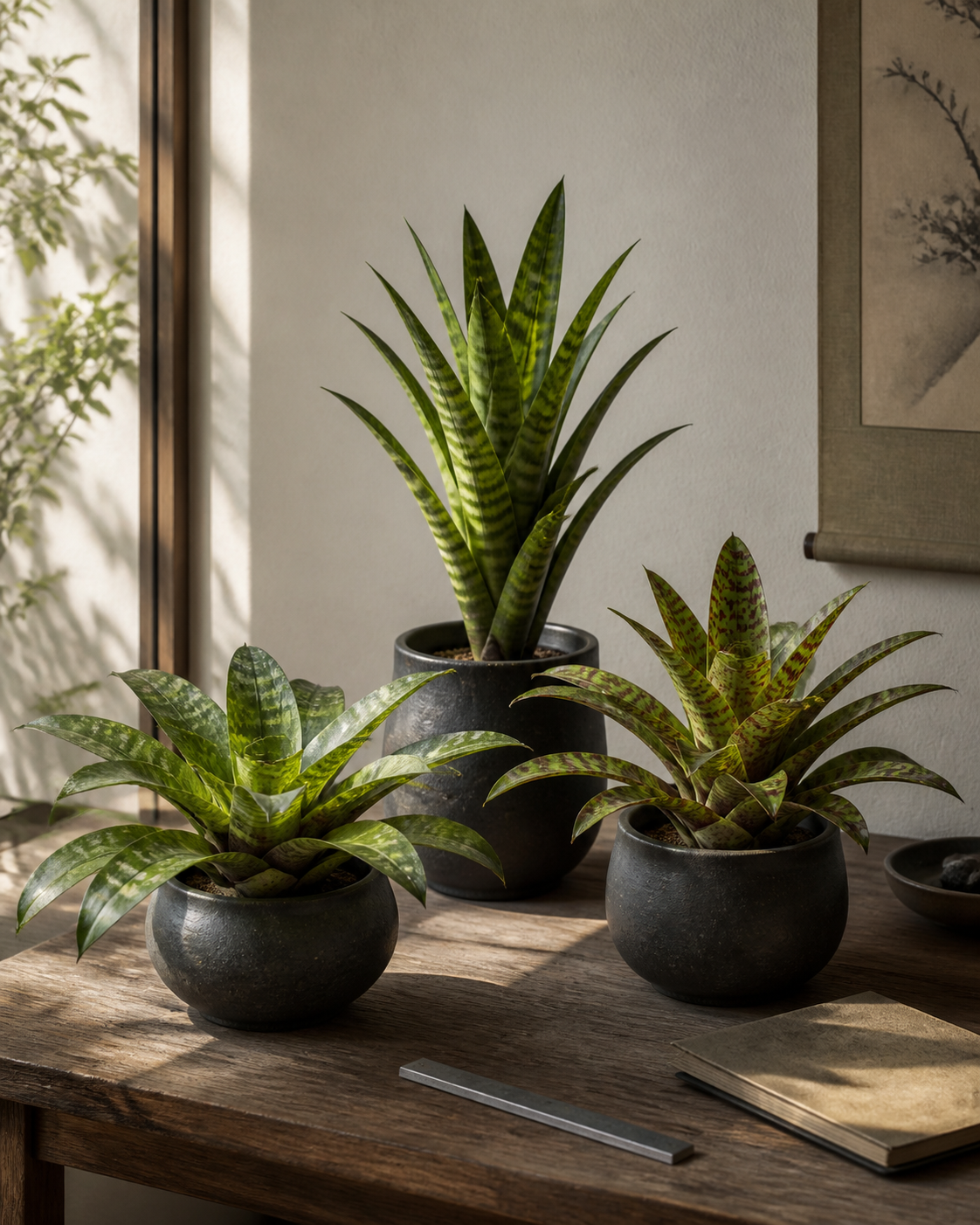
Tank bromeliad is not a single botanical genus or species. It is a practical term for plants whose overlapping leaves form a central reservoir. Many Neoregelia form broad rosettes, while many Vriesea form vase-like ones. Guzmania can also range in height from about 6 inches to nearly 3.3 feet. Without checking the plant's label or the seller's records, it is not possible to guide every plant toward the same idea of a compact form.
First compare the longest leaf now present with the new leaves emerging inside it. If only the older leaves are long, they may reflect earlier growing conditions. If the new leaves are also narrow and long, with a dark color and a soft, drooping texture, those changes overlap with signs associated with insufficient light. Natural cultivar length and maturity can look similar, however, so do not identify an unlabeled plant to species or cultivar from photographs alone.
Read the arrangement of new leaves, not a single leaf
Leaf length alone is not enough to identify stretching. Compare the width of new leaves, the spacing between them, the tightness of the rosette's center, color, and firmness with the preceding leaves. University of Florida guidance describes dark green, soft, drooping leaves as a possible sign of too little light, and yellowing or bleaching as a possible sign of too much. Neither should be used as a diagnosis on its own; consider when the change began and where the plant was placed at the time.
Neoregelia, Guzmania, and Vriesea do not share one preferred light range or leaf texture. Plants with thick, rigid leaves or silvery scales tolerate light differently from those with soft green foliage. Even when the genus is known, the requirements can vary by species and cultivar. For a plant that has lost its label, avoid abrupt treatment and adjust conditions while recording how the leaves respond.
Before increasing light, slow the pace of change
Adequate light supports closely spaced growth and stronger coloration. Moving a plant suddenly from a dim location into direct sun, however, can cause bleaching or scorch. University of Wisconsin–Madison Extension recommends acclimating bromeliads to brighter conditions over several weeks and pairing higher light with suitable humidity and air movement. Indoors, move a plant toward the window gradually, or change the distance from a supplemental light in stages rather than all at once.
Airflow should not be used as a forceful way to make a plant smaller. It can help prevent stagnant air in hot conditions, but constant strong airflow in a dry room may damage leaf tips. Begin with air movement gentle enough to make the leaves barely stir. If the water in the central tank or the potting medium begins drying faster than before, review how often you check both at the same time.
Read fertilizer and water through the plant's response
More fertilizer does not necessarily improve a plant's form. Excess fertilizer can diminish leaf color and produce an oversized, loose rosette. Conversely, adding fertilizer alone during a low-light period is unlikely to produce tightly arranged new leaves. Guidance differs on fertilizer type and placement, and some sources caution against salt accumulation in the tank. Check the product label and the seller's advice, and do not begin at a strong concentration.
Consider water in the tank separately from moisture in the pot. Flush the center with fresh water so old water and salts do not remain, while keeping the potting mix well drained and aerated. Moving the plant into a larger pot will not make its leaves shorter. A pot that is too large for the root system can keep the mix wet for too long and increase the risk of root rot. Choose a pot large enough to stabilize the plant; when extra weight is needed, place a small nursery pot inside a heavier outer container.
Keeping or separating offsets changes the whole silhouette
Offsets that emerge after flowering fill the space around the parent and create a different density from a single rosette. Keeping a clustered display or growing each plant separately is a matter of intent. Sources place the usual separation point at roughly one-third to one-half the size of the parent. Also check rooting, the condition of the attachment point, and the growth habit of the genus; do not rush to remove a small offset solely to change the outline.
Cutting an elongated but healthy leaf does not change the light, fertilizer, water, or temperature that determines the length of the next one. Even when tidying a damaged tip, a deeper cut changes the shape of the leaf and the plant as a whole. Bromeliad Society/Houston guidance for preparing display plants likewise recommends considering the visual effect before cutting and leaving the damage alone when removal would be more disruptive. Treat trimming as a minimal response to damaged tissue, not as pruning intended to restore the plant's shape.