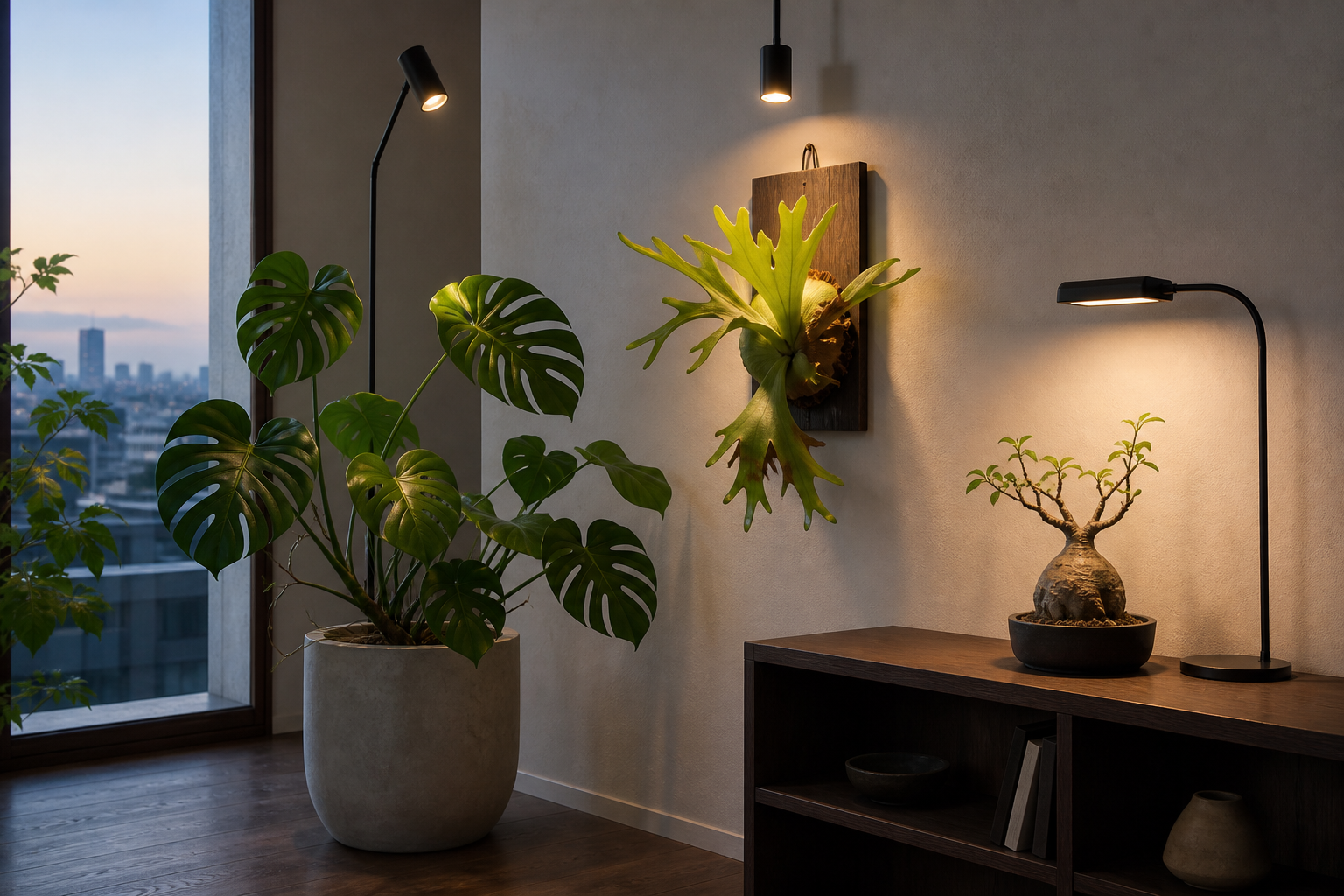
A Monstera near a window and a caudiciform plant in the middle of the room receive very different light, even indoors. The Royal Horticultural Society notes that artificial light can supplement places without enough natural light, while advising growers first to use available daylight and avoid running lights longer than necessary. A grow light is not a uniform substitute for the sun. Reconsider the window, shelf, pot, and leaf height, then add only the light needed where daylight remains insufficient.
Decide the Area Before the Number of Plants
Do you want to accent the form of one pot, or support two or three pots together on a small shelf? Once that is clear, the difference emerges between a bulb’s point source and a panel’s luminous surface. A point source readily concentrates light on a target while preserving the contours of pot and shadow in the room. A broad source can reach several pots or foliage spreading sideways. Do not simply choose the stronger option; match the shape of the light to the area and arrangement you intend to illuminate.
Face the shelf and imagine transferring the reach of the leaves onto paper. For one pot, measure from the center to the outer leaves; for several, measure from one end pot to the other. At the same time, confirm the available fixture height, the load ratings of sockets and stands, and the route of the cord. Beyond the lamp’s dimensions, preserve enough room to water and inspect leaves after installation, so tools do not overtake the scene of living with plants.
Two Points of Light for One Pot
NEO AMATERAS 20W is an E26 bulb with a manufacturer-stated color temperature of approximately 5900K and average color rendering index of Ra97. Its white light makes leaf color and pot texture relatively easy to read, suiting a place where one pot becomes a room’s focal point. The recommended distance is 40–150 cm, but that range is not a universal answer for every plant. Follow fixture requirements, then gradually adjust position while observing leaf color, stretched new growth, and leaning toward the light.
TSUKUYOMI 10W White is also an E26 bulb, with a color temperature of 4000–5000K. For a smaller area than a 20W fixture, it offers an option for one pot on a side table or a small plant by a wall. Its white housing recedes against pale walls and fixtures. Do not determine plant distance from wattage alone: beam angle, fixture direction, and surrounding daylight change what reaches the leaves.
For Several Pots, Create a Broad Plane
ROKI-Octagon 50W is an E26 panel with an octagonal luminous surface 21 cm in diameter. Manufacturer specifications list adjustable color temperature from 3000–5000K, dimming, a timer, and a recommended distance of 20–160 cm. On a shelf of small pots or where leaves spread sideways, a plane of light can be easier to arrange than one intense point. The black fixture may recede into shadow, but its diameter and weight require a compatible socket and stand.
Dimming and color adjustment are not reasons to change settings constantly. Rather than leaving the light on like human room lighting from morning through night, use it as a supplement while watching the plant and avoid unnecessary overlap with daylight. The manufacturer says Wi-Fi is required for remote app settings. Before convenience, establish stable placement, protection from water, and a sustainable lighting period.
Change the Distance and the Same Light Becomes Another Tool
Light weakens and spreads as distance from the fixture increases. University of Missouri horticultural guidance likewise notes the effect of distance on intensity and differing requirements among plants. Neither closer nor longer is a simple universal answer. Begin conservatively within the manufacturer’s range and observe not only for days, but through the development of new leaves. If outer leaves alone lift, color fades only at the center, or heat lingers near the fixture, change distance, angle, or duration one at a time.
One pot lit by a point; a small group supported by a plane. Once that distinction is visible, grow lights return from a comparison of machines to the composition of a room. A place that preserves leaf shadow, a shelf that stays evenly lit as pots multiply, a room that returns to human lighting at night: the criterion is not the top line of a specification sheet, but where light belongs in a life with plants.