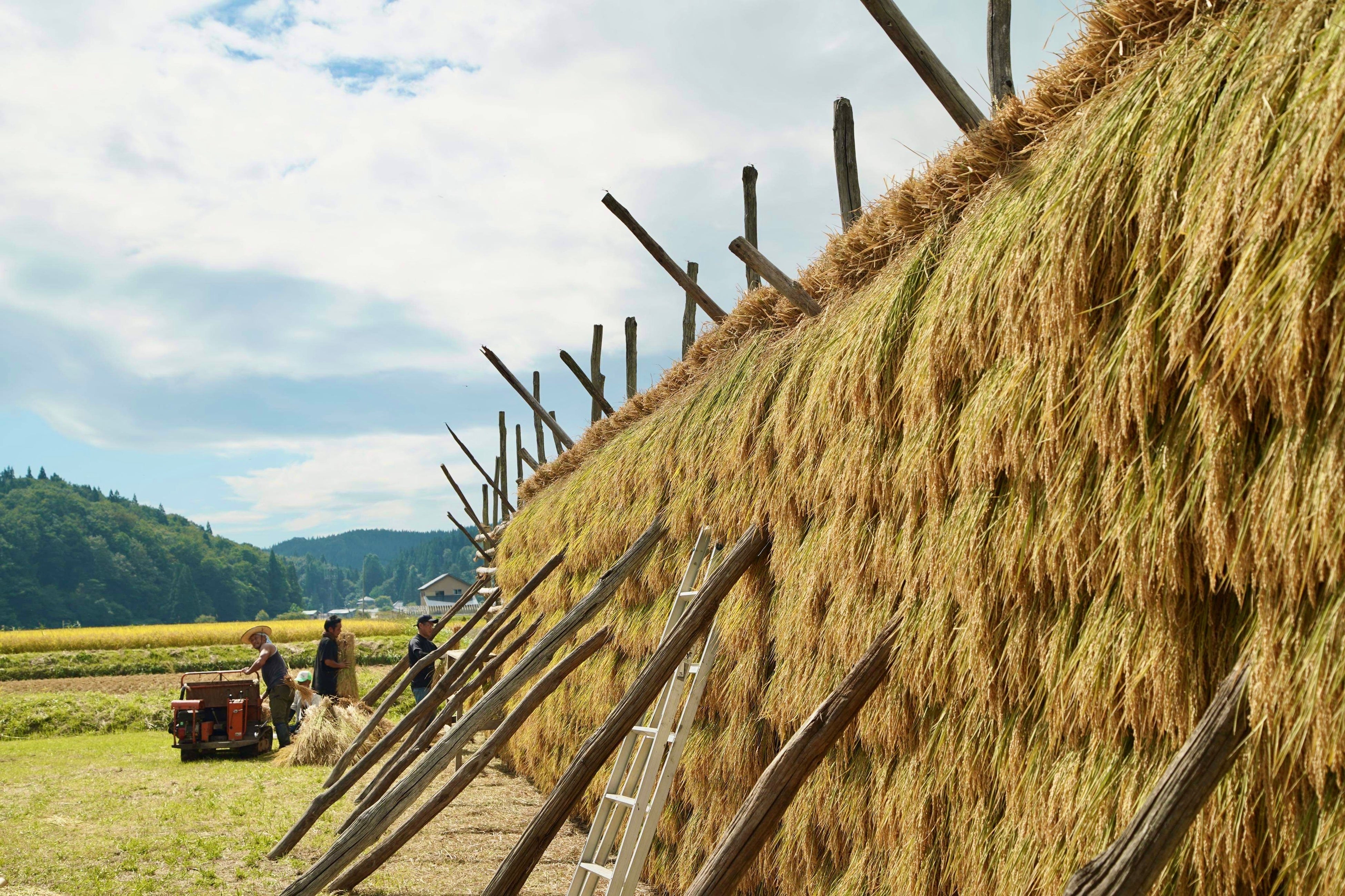
In the official photograph, harvested rice hangs with almost no gap across a long rack. Diagonal timbers brace against the ground, supporting a wall of rice far taller than a person. Workers visible in the distance make clear that the landscape did not arise by itself, but bundle by bundle by hand. Every bundle requires arms lifted and lowered. A small square of brown-rice okoshi comes after this large work.
Hanging Rice Like a Wall
Hasagake hangs harvested rice on ladder-like racks to dry naturally in sun and wind. According to Ugo tourism information, racks are assembled in Tashiro in mid-September and rice is hung from around the end of the month. Drying takes roughly three weeks. After moisture is checked, rice is removed and threshed on site. A process that could be shortened by machine drying opens instead into multiple hand tasks: tying, hanging, lowering, and dismantling.
It is important not to see rice alone. Cattle once tilled fields and transported loads in Tashiro; manure became compost and postharvest straw became bedding and feed. Even after machines and chemical fertilizer changed those roles, cattle farmers need long straw. Hasagake preserves its form rather than chopping it during harvest, linking rice farming with livestock. Official tourism information calls it a symbol of circular agriculture because the material’s destination continues beyond the paddy.
Editing a Landscape into an Edible Form
Don, the hasagake-rice brown-rice okoshi launched by Ugo Hachikayabuki, uses 100% hasagake rice grown in Ugo. Listed ingredients are non-glutinous brown rice, beet sugar, starch syrup, vegetable oil, and salt; the salt comes from Oga, Akita. A 60-gram package costs ¥432 including tax and a 100-gram package ¥648. Sales begin August 16 at roadside stations in Ugo and the reception of the company’s thatched-roof inn.
Inside a transparent bag are square pieces with visible grains. A white label bears the word Don and a line drawing of a thatched roof. Rather than adding ornament, the design places ingredient and place at the front. “New product” can pull old local work toward consumption. Here, showing the rack-drying landscape beyond the bag leaves the form of the ingredient after the food is gone.
The announcement says no preservatives, artificial colors, or chemical seasonings are used. This does not guarantee health effects or safety for everyone. Confirm allergens, manufacturing environment, and current inventory from the label and retailer. Writing about plants as food requires reading the label as it stands with the same care given to a place’s story.
Rice Returns to a Thatched House
One point of sale, Ugo Hachikayabuki, uses a Tashiro thatched farmhouse as a one-party-per-day inn. Its official site says sun-dried satoyama rice is cooked in a kamado and served in a house with an irori hearth and goemon bath. Rice does not travel straight from paddy to product. It becomes cooked rice, sake, a lodging experience, and now a portable confection. Thatch and rice straw both rest on techniques for drying, bundling, and using plant stems over time.
Tashiro’s drying racks are visible only briefly. Generally, rice hangs from late September until removal and threshing in mid-October. Farm work moves with weather and plant growth, so check that year’s information before visiting. Even when photographing the scene, remember it is a working field, not a tourist set. Receive the landscape by staying off roadsides and levees and giving farmers’ movement priority.
See the Next Autumn Through One Package
Brown-rice okoshi is astonishingly small beside a drying rack. Yet a cross-section retaining grains returns thought from ingredient to plant: see rice not only as white grains, but as plants in fields, drying bundles, remaining straw, and cattle that need it. Preserving regional culture may mean not enclosing an old landscape in stillness, but translating it into forms present life can choose.
One bag arriving tomorrow becomes an entrance to autumn in Ugo. If it is beyond reach, look again at one grain of rice in your own kitchen. Time spent with plants does not exist only inside pots. It remains in hands that dry, cook, eat, and connect to the next planting.