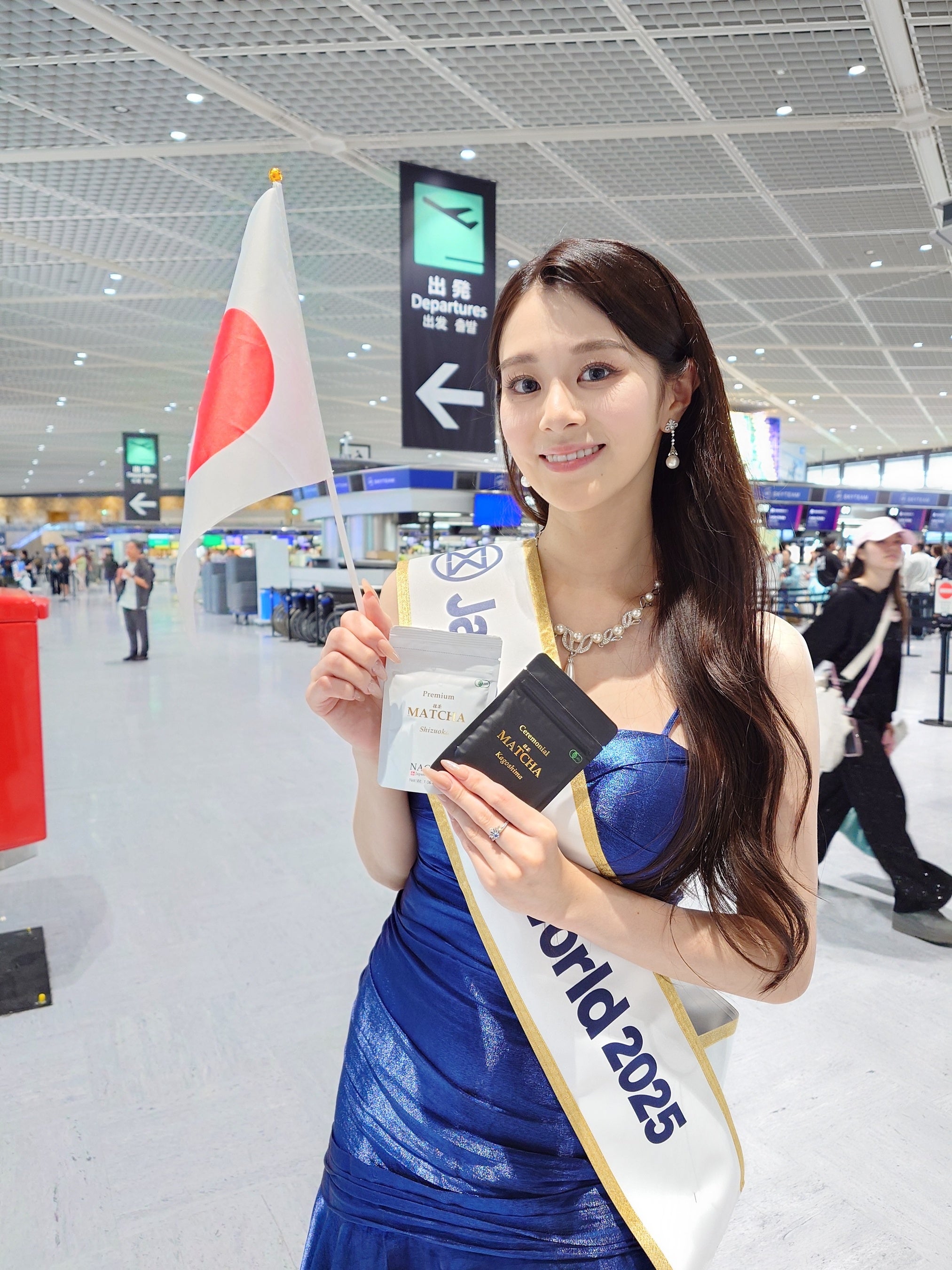
In the official photograph taken at Narita Airport, Yui Kawana’s deep-blue dress and two bags share the frame. White is Shizuoka; black is Kagoshima. Both contain matcha, but they are not merely two colors of one product. NAGOMI foregrounds “single origin”: tea from different farms is not blended.
See Each Tea Field Before the Blend
Once in a bowl, matcha appears as uniform green powder. What is written outside the bag therefore leads back to the field. NAGOMI’s official pages separate Kagoshima and Shizuoka as “single-farm” products. Regional difference is preserved first as a distinct entrance, not a forceful ranking.
The Kagoshima matcha is 30 g and ¥2,700 including tax. It is described as grown without pesticides or chemical fertilizer, and intended for matcha, lattes, and baking. The Shizuoka product is also 30 g, priced at ¥2,500; it specifies the cultivar Okuyutaka and is sold as Organic JAS certified.
The two bags do not provide equal levels of detail. Kagoshima gives origin and cultivation description; Shizuoka adds cultivar and certification. Do not immediately judge the one with more information superior. Separate what is stated from what is not. That is the most careful stance toward products that do not yet disclose grower names.
It is also important not to compress both into “organic matcha.” Japan’s Ministry of Agriculture, Forestry and Fisheries says the Organic JAS mark is required to label agricultural and processed foods “organic.” Only the Shizuoka product’s official page explicitly states certification. The Kagoshima matcha should be read within its cultivation description: no pesticides or chemical fertilizer.
A Store Opened Abroad Returns to Japanese Shelves
According to the operator, NAGOMI sells Japanese tea online to more than 30 countries and has a physical store in Brisbane, Australia. In June 2026 it opened NAGOMI MATCHA -Tokyo- in Tsukiji; on August 9 it launched a Japan-facing online store. Both matchas are available for reservation and ship sequentially from August 10.
Matcha expands overseas and returns to Japan. Rather than watching only the topicality of a “reverse import,” look at how detailed origin labeling has become. Before the brand name: Kagoshima or Shizuoka. For Shizuoka, read the cultivar too. Slowing selection slightly lets one field appear beyond the powder.
Single origin is not only a term for tasting comparisons. By keeping several regions out of one bag, it allows future choice to return to land and cultivar. Precisely because processing removes the plant’s form, provenance words stand in for leaves and branches.
Holding Two Origins on a Glamorous Stage
NAGOMI announced the same day that it became an official Miss World Japan sponsor. Miss World’s official information says Yui Kawana was chosen to represent Japan in 2025 and will compete internationally in 2026. In the August 9 departure photograph, she holds the Kagoshima and Shizuoka matchas entering domestic sale.
Do not place the photograph’s center only on celebrity or competition ranking. In glamorous dress, Japanese tea appears not as equipment for a traditional tea room, but as small packages whose origins can be read. Clothing, travel, gifts, or a daily drink: keeping the tea-growing place visible wherever it enters culture is one way of passing plants onward.
Compare the Words on the Bags Before Whisking
Official instructions for matcha call for 1–2 g powder with 70 ml water at 80°C, whisked with a chasen. For a latte, dissolve 2–3 g in a little water and add warmed dairy or preferred milk. Before accepting tasting language, compare origin, cultivar, cultivation claim, and content weight, then choose your cup.
Matcha green may look similar in every bag, but the land behind the same color need not be the same. Reading one bag as one tea field becomes a small habit returning the hidden history of a plant to hand before the drink is gone.