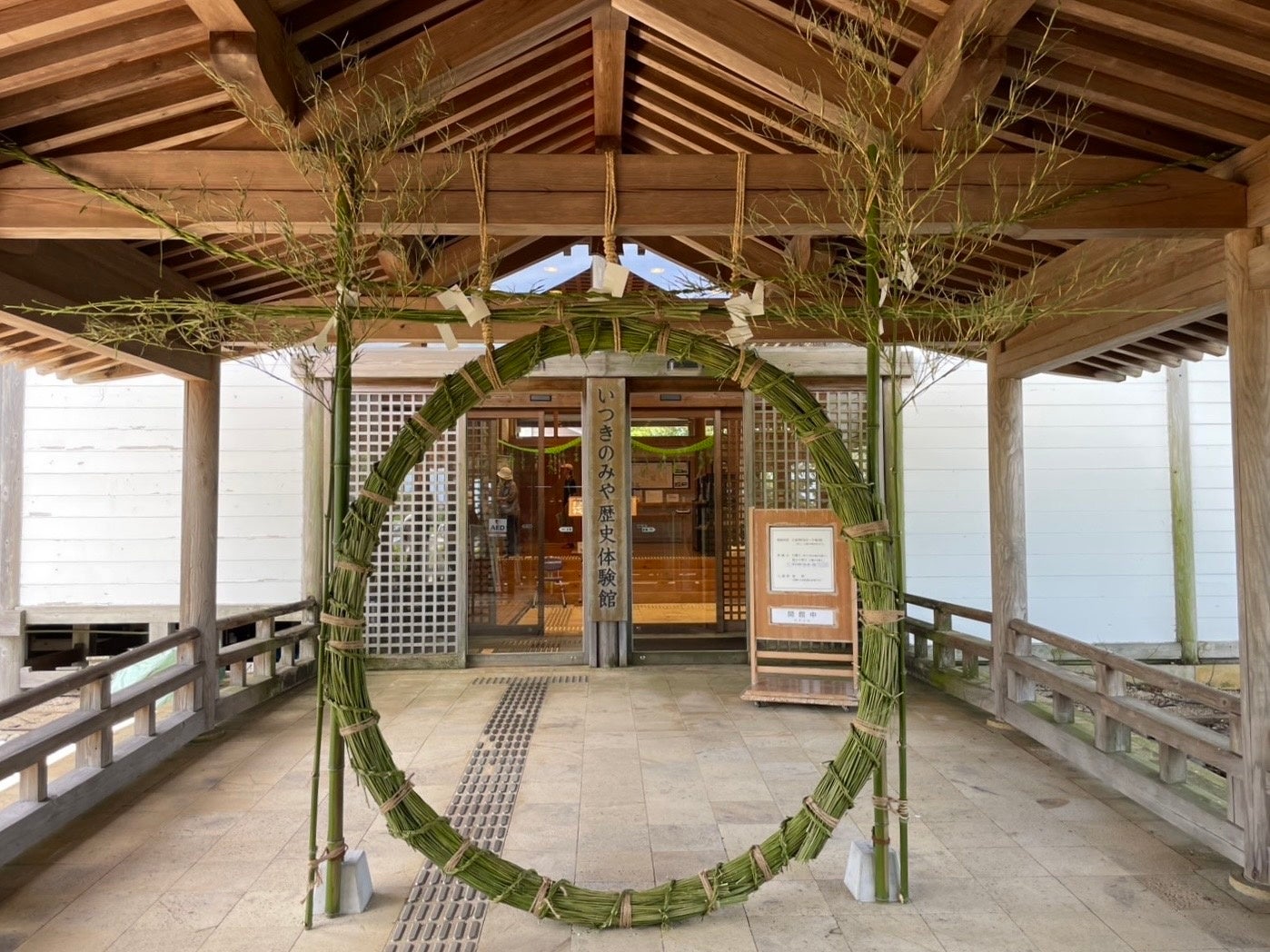
In the first image, individual stalks remain distinct within the circular outline. Thin stems are aligned, made into thick bundles, tied at intervals, and bent into a circle. Long leafless branches rise from either side almost to the roof; the wooden Itsukinomiya Hall sign is framed beyond the center. This is not an isolated botanical object, but a scale that rearranges a building entrance and human circulation.
Straight Stalks Become a Circle’s Structure
The chinowa was made by the Amatsusuga-aso Project, which works to carry hemp culture forward in Meiwa, Mie Prefecture. According to the operator, it uses 100% stalks of domestic hemp harvested from a field inside the Saiku historic site. Hemp replaces the usual grass so stalks remaining from cultivation can receive a role continuing into a local observance.
In fields grown for fiber, not every plant follows the same use. The project focused on stalks of plants retained around the perimeter for seed. Alongside harvesting, spinning, and weaving come other acts: bundling, bending, passing through. Before any phrase about using material without waste, that decision appears as a large-diameter ring.
The production record shows green stalks cut in the morning, aligned, and assembled by hand with community collaborators. In the finished ring, thin stalks overlap densely below and loosen into branch lines above. The middle of one plant becomes structure; its ends extend the outline. Rather than trimming everything uniformly, stalk length remains part of the form.
Keeping the Name Chinowa While Replacing the Material
A chinowa is a circular structure passed through during the Nagoshi no Harae summer purification. This ring layers a seasonal observance traditionally held at the end of the sixth lunar month onto the date corresponding to August 12 in 2026. Official guidance describes passing through three times and notes that “hemp leaf” appears in the words recited on the second passage. A plant name remains in language and its stalk becomes the physical ring. Text and material meet at the same entrance.
It is not enough to see it only as an exact reproduction of an old form. The photograph shows stalk thickness, curvature, and intervals between ties. Handwork does not erase irregularity; it gathers varied plants into one circle. Timber beam, stone floor, and green hemp meet at an entrance that does not leave material origin to a label alone.
From afar, the form is clear enough for anyone to pass through. Up close, the apparently single line of a circle is a gathering of many stalks. Moving between a distant symbol and individual plant differences found nearby is what makes an on-site encounter exceed a photograph.
See Field and Entrance as One Continuous Work
The Amatsusuga-aso Project is an industry-academia-government effort beginning with Meiwa’s hemp culture and pursuing traditional knowledge, environmental coexistence, and new local industry. This chinowa condenses that large concept into one approachable form. It is neither cultivation record alone nor craft display alone; growing and use remain connected within the same region.
RareDex is drawn less to the forceful phrase “domestic hemp” than to the concrete change of use. Straight field stalks become gathered lines in a bundle and, when bent, a space people can cross. When placing a plant indoors, consider not only leaf form but support, pot, shelf, and path. This ring expands that relationship to architectural scale.
Look at the Knots Before Passing Through
The Itsukinomiya Hall for Historical Experience is about a one-minute walk from Kintetsu Saiku Station. The ring is free to view and may be passed through freely. Beyond the frontal circle, look where stalk direction changes, at rope-tightened knots, and at supports on either side. Bundle and spacing raise a form one stalk could not hold.
No end date was announced, so confirm availability before traveling from afar. Seasonal observances often end after a date, but records remain of growing, cutting, and recomposing plants. The few seconds of walking through the ring leave room to imagine the season its stalks spent in the field.