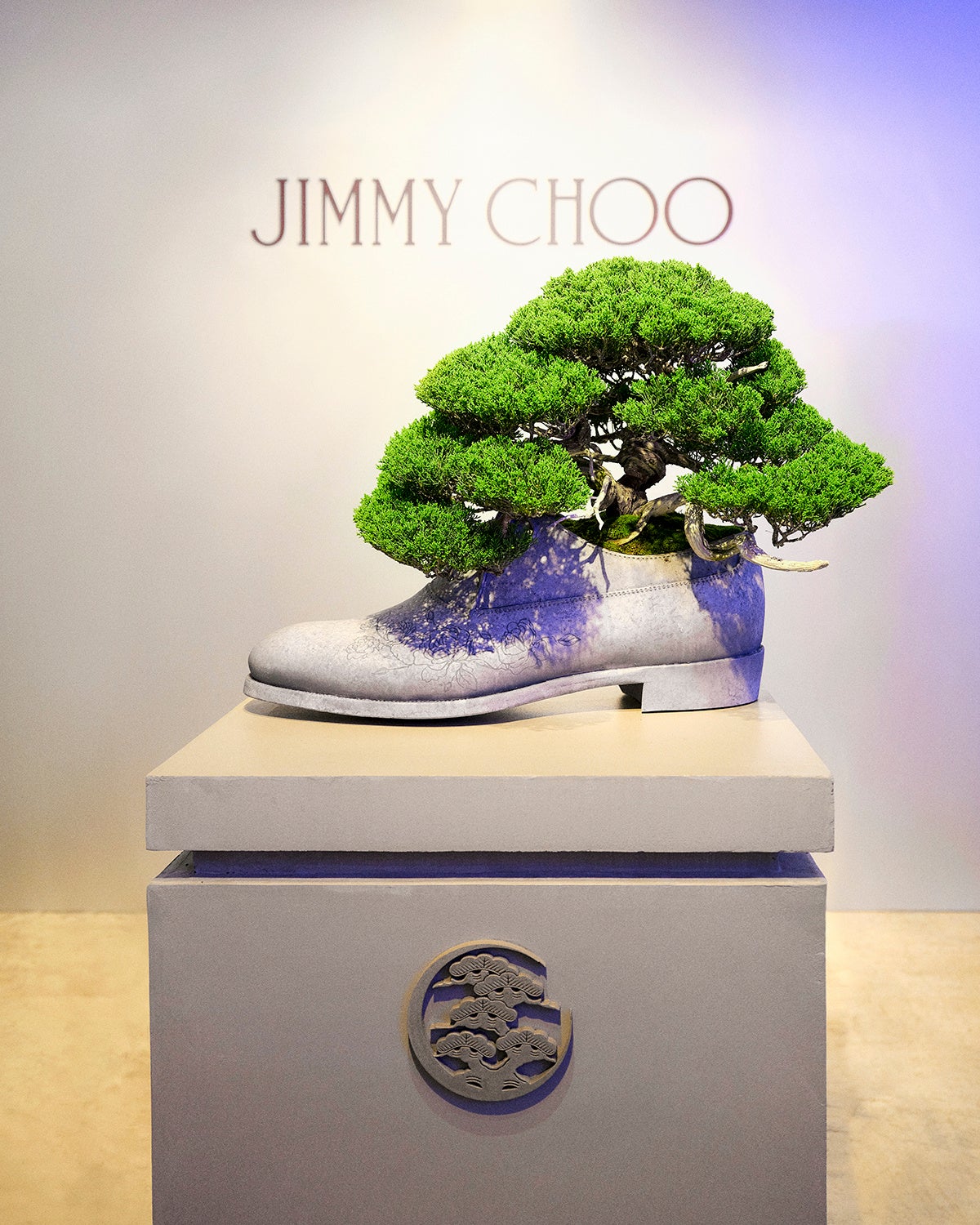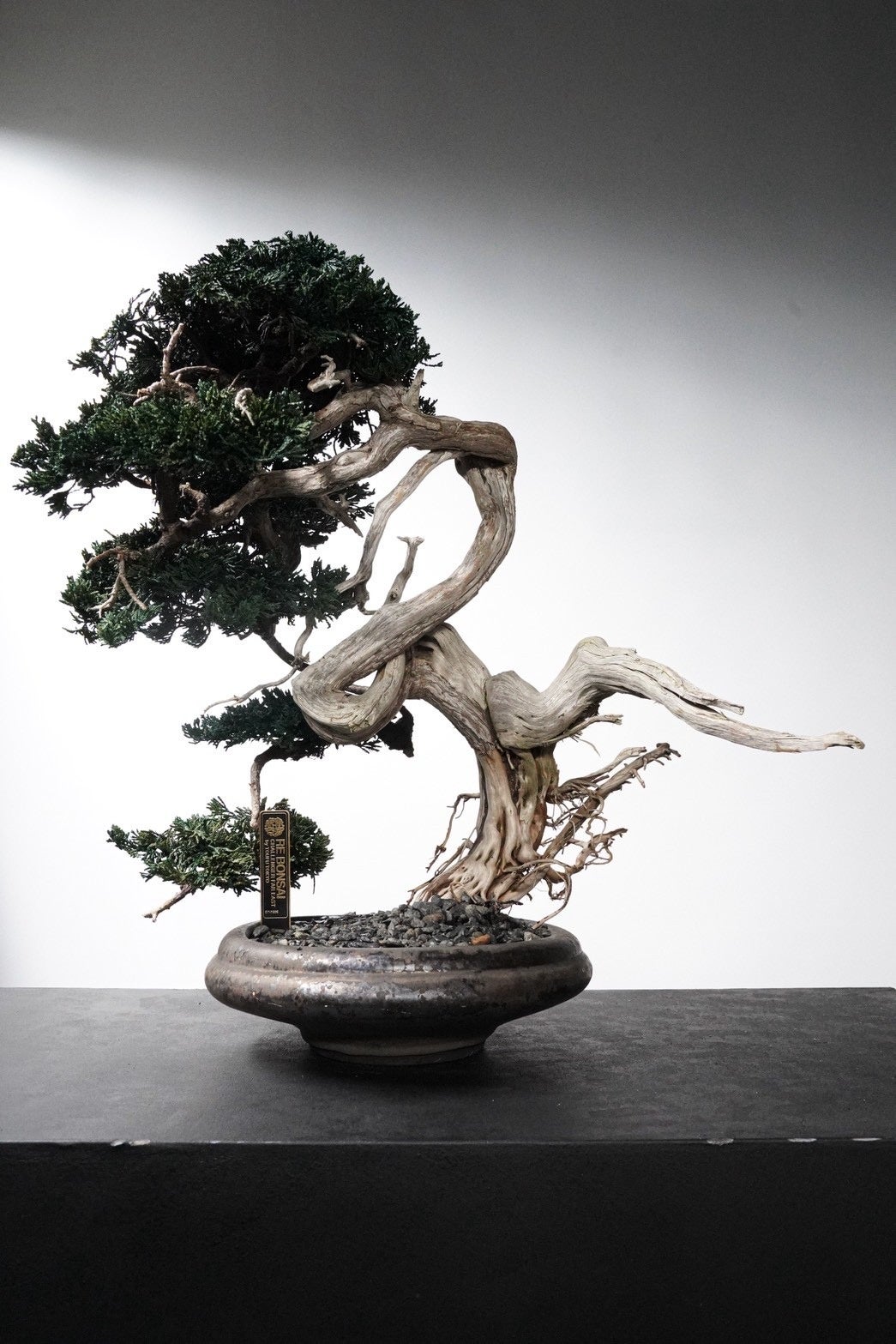
The first work shows a twisted pale trunk supporting a compact mass of dark leaves. The old trunk and newly added foliage do not blend seamlessly; their slight distance keeps the eye on where the work has been reassembled. RE BONSAI™ begins at that boundary.
Making a Cultivated Form the Beginning of a Work
The soil is removed from a bonsai that has died, and the trunk is dried and pruned. Separately dried or preserved foliage is then attached. The time a tree spent being trained remains in the bends of trunk and branches, while a different plant material supplies color and volume.
This is not restoration intended to make a dead tree look alive again. The original growth has ended. The trunk’s accumulated lines are taken as material and given another place to be seen.
The trunk and foliage therefore hold different times. One records years of cultivation; the other has been processed to retain a moment after cutting. Their meeting reverses the ordinary direction of bonsai, which is grown slowly toward a form.
Layering Indigo onto Shimpaku and Japanese White Pine
The presentation runs August 5–11 at Isetan Shinjuku, gathering roughly 50 one-of-a-kind works based on Shimpaku juniper and Japanese white pine. The trees range in age from about 10 to 250 years, and the selection includes works colored with indigo.
In the official image, a gray-white trunk rises from a nearly black round pot and carries dark foliage. The boundary between what remained and what was added is not concealed.
Compare the direction of each trunk, the intervals among branches, and the relationship between vessel and foliage. Official photographs are illustrative; confirm the works and inventory available at the venue.
Working by Hand Reveals the Space between Branches
RE BONSAI workshops last about one to one and a half hours and cost ¥11,000. Sessions begin at 10:30 a.m., 1:30 p.m., and 4:00 p.m., with a maximum of eight participants. Reservations are accepted by telephone.
Making one brings attention to branch spacing, the center of gravity, and the point at which added foliage begins. What looks finished from a distance becomes a sequence of choices made by hand.
How to Live with a Plant That Is Not Watered
RE BONSAI is not living and should not be watered. Before purchase, confirm handling, placement, cleaning, likely changes over time, and whether repair is available. Prices range from ¥30,000 to ¥2,000,000.
It offers time with a plant form after growth has ended—not by denying death, but by allowing the lines left by cultivation to be seen again.