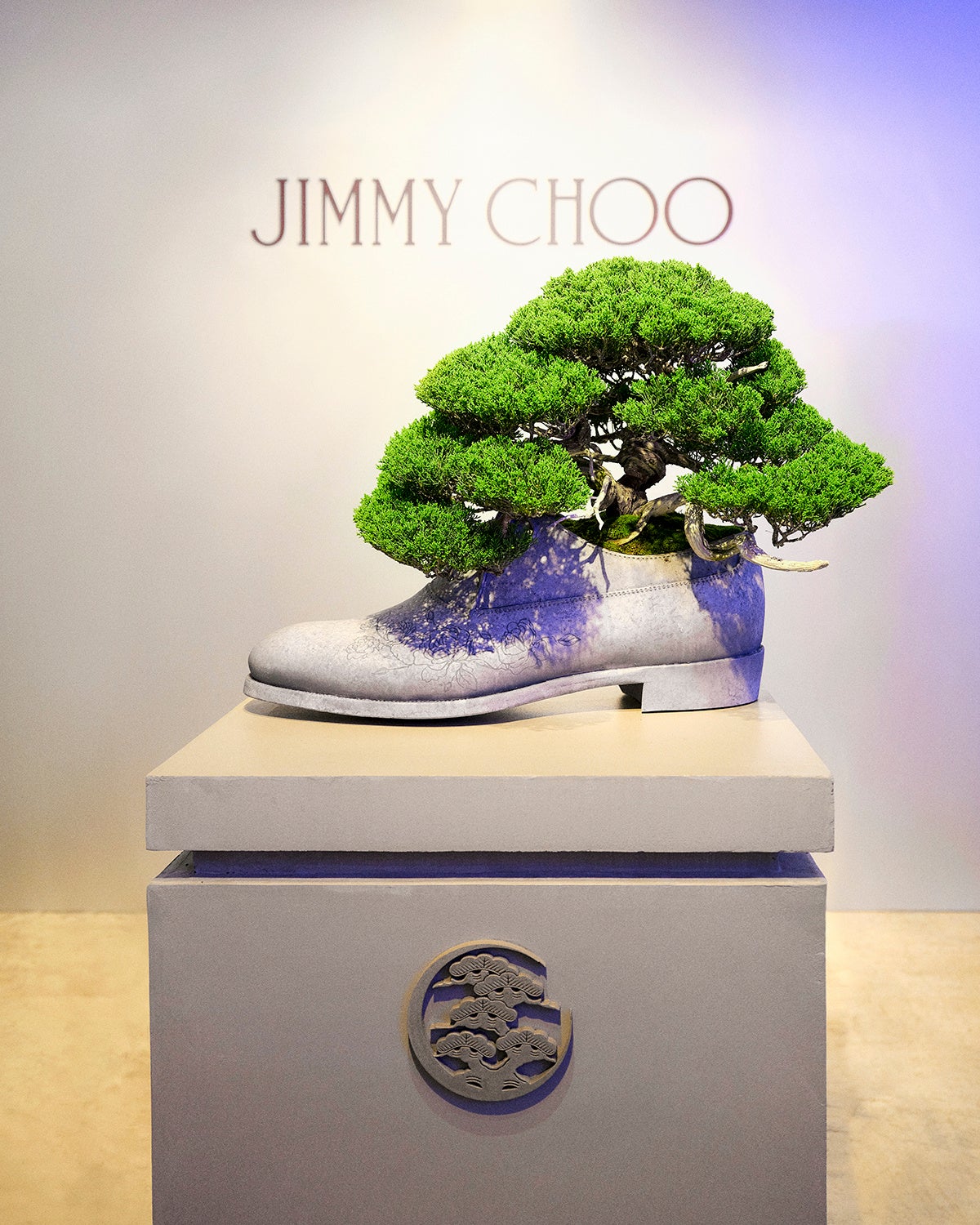
The first image begins at the boundary between shoe and vessel. A silver leather shoe retains eyelets, toe curve, and low heel, but soil fills its opening and supports a thick trunk and clipped green canopy. Plants do not decorate the shoe; the cavity intended for a foot becomes a place for roots.
Three Shoe Silhouettes Become Three Vessels
JIMMY CHOO and TRADMAN’S BONSAI made three special bonsai works based on VINE LACE UP, SUNNY TRAINERS, and EMBER MOCCASIN from the Fall 2026 men’s collection. Lace-up, sneaker, and moccasin silhouettes are each recomposed as a container supporting a plant.
The interest lies not in adding botanical print to shoes, but making the shoe itself the pot. Fashion designs flexibility around the foot and profile in motion; bonsai depends on root depth, proportion to trunk, and frontal space. A body-near product and a growing plant meet on the same stand through the vessel.
Compare not only plant size, but where each shoe form makes room for soil. A high vamp can deepen the boundary with trunk; a low horizontal form can bring foliage forward. Official information does not identify species or internal vessel structures, so cultivation cannot be generalized. Yet observing how container lines change a plant’s impression applies to ordinary pot choice.
Layering Changing Branches over a Finished Shoe
In the opening photograph, blue-violet light falls across the silver shoe pot and branch shadows cross fine laces. The toe runs parallel to the floor while foliage builds tiers outward from the trunk. Linear plinth, horizontal shoe, and upward plant form three layers within one vertical frame.
A shoe is a finished product, while bonsai remains alive during display. Foliage density changes and light reveals different lines. Because the vessel’s shoe outline persists, botanical change above it becomes clear. The time of bonsai—care continually updating a scene—enters fashion’s completed form.
Keeping Street Culture and Bonsai within Reach
TRADMAN’S BONSAI began in 2015, and Matsubaya Co., Ltd. was established the following year. Founder Teppei Kojima does not separate his background in street culture, music, and fashion from bonsai, continuing to connect tradition with contemporary life. Here he reads men’s shoe design and composes trunk and branches upon it, allowing two cultures to reveal each other’s outlines.
Moving bonsai beyond the tokonoma into windows and fashion spaces changes viewing distance. Opening and trunk, laces and twigs, leatherlike surface and leaf density can be read before species names. Fashion audiences gain an entrance to bonsai composition; plant audiences gain one to shoe design.
After Ginza, Osaka
The works remain at JIMMY CHOO GINZA CONCEPT STORE, 2-6-3 Ginza, Chuo-ku, Tokyo, through August 15, 2026. For Street Café Ginza at the same address, the official page lists 11:00 a.m.–9:00 p.m., changing to 8:00 p.m. closing from August 1, with irregular holidays. Check the store’s latest guidance for exhibition hours.
After Tokyo, the works travel August 16–September 30 to Jimmy Choo at Hankyu Men’s Osaka. After grasping the whole in photographs, compare all three from the side: how do vessel height and balance change with shoe type, and where does foliage spread? Reading silhouette rather than logo or price brings fashion and bonsai closer.
At home, consider plant and container as one profile rather than choosing the pot afterward. Does a round vessel receive spreading branches, or an angular one emphasize trunk curves? Drainage, roots, and appropriate medium remain essential, but within those conditions, looking at outline as one chooses a chair or shoe turns plant placement into quiet styling.
A plant vessel holds more than roots. Sharing a room with furniture and clothing, it determines posture and distance. These works leave more than surprise at an unlikely pairing: a familiar shoe can become a place for plants, and welcoming one home can begin with the pot’s outline.