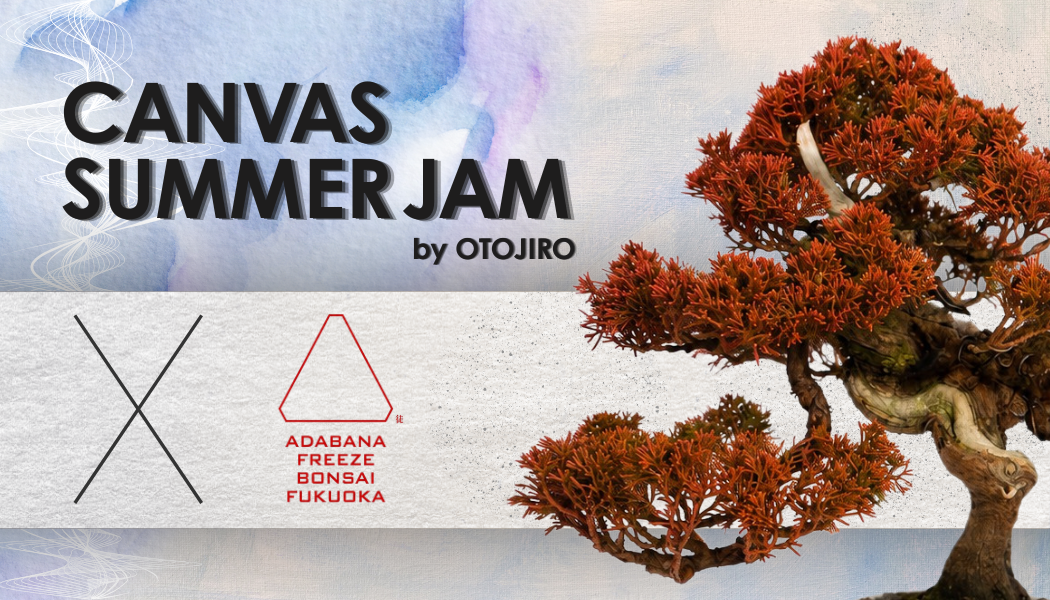
The announcement visual places a reddish-brown bonsai extending across pale blue and gray. Its trunk bends at nodes and leaf masses layer like low clouds beside black CANVAS SUMMER JAM text and the red ADABANA mark. Though not a venue photograph, it collides a music event’s lightness with form preserving a dead plant.
According to Mitsubishi Estate Hotels & Resorts’ July 28 announcement, CANVAS SUMMER JAM by OTOJIRO × ADABANA POPUP brings live music and DJs to the Canvas Lounge August 1. The ADABANA display continues through August 16, with works planned for the second-floor lounge and third-floor BAR KOMOREBI. One night of performance and roughly two weeks of display place rapidly vanishing sound beside plants whose form is held.
A Role Different from Living Greenery
ADABANA describes itself as a preserved-bonsai brand creating new landscapes from the end of plant life. It recomposes dried and preserved plants and naturally dead material—the twist of trunk, faded leaves, and leaning branches—as one-off forms. Official care requires no watering and advises avoiding direct sun, humidity, and strong impact.
Preserved bonsai should not be treated as a convenient substitute for living bonsai. There is no budding, leaf expansion, or seasonal care. Instead, the final curves of grown branches and leaves in the process of losing color can be viewed at a sculptural distance. Living change and restrained change ask for different relationships indoors.
The announcement bonsai may not indicate the actual work or species on display. At the venue, look beyond rarity of name to where branch tips stop, how they enclose empty space, and how weight balances with the pot. Showing dead color as outline rather than hiding it as weakness reveals ADABANA’s work.
Performance Overlaps a Work That Sings of Silence
Music on August 1 runs 8:00–11:00 p.m. Scheduled performers are koto player IORI with flutist Momiji as Kotobue, vocalist and pianist Mainon, and Fukuoka-based DJ S.SHOWTA. Official hotel information says the lounge has a Steinway & Sons grand piano, also used that night. Admission is free with one drink purchase required.
No guidance says each work corresponds to a piece of music or that performers take bonsai as their subject. Avoid forcing the relationship. Koto line, flute breath, piano decay, and DJ-linked beats pass while branches remain still. The evening asks whether open ears reveal even the spaces between branches.
The display remains through August 16 after the live event. On performance night, see works amid people and sound; another day, move between floors two and three and compare lighting and furniture at leisure. Changing background volume and movement alter how branch density and shadow appear.
Seeing Plant Endings in a Hotel Evoking Forest
The hotel centers Kyushu nature in its interiors. Its site introduces a Canvas Lounge facing the Hakata River, a bath inspired by Kyushu valleys, and a rooftop garden recalling an evergreen forest. Living trees changing with seasons and preserved works holding form will occupy the same building.
Rooftop leaves receive light and rain and extend branches. ADABANA leaves do not grow and are kept indoors away from sun and moisture. This is not a contest in naturalness, but a passage between two gazes: plants cultivated onward and plants retaining form after their role has ended.
A Way of Looking beyond One Night
CANVAS SUMMER JAM by OTOJIRO × ADABANA POPUP takes place at The Royal Park Canvas Fukuoka Nakasu, 5-6-20 Nakasu, Hakata-ku, Fukuoka. Live music and DJs run August 1, 8:00–11:00 p.m.; the ADABANA display runs August 1–16. Details may change, so check the hotel’s official information. The venue is about a two-minute walk from Exit 3 of Nakasu-Kawabata Station.
Time with plants is not only watching growth. After leaves stop opening, one can still witness the bends remaining in a trunk and the spaces branches made. Sound disappears while bonsai retains form. Bringing those opposites together directs attention not only to what remains, but what vanishes.