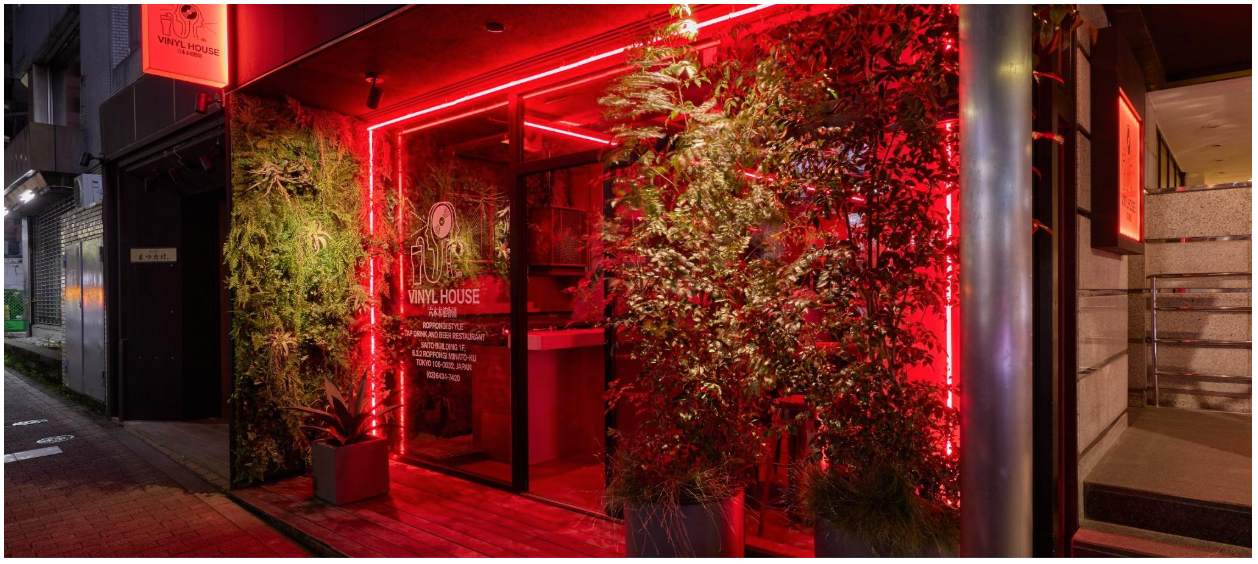
In the opening photograph, plants around the entrance catch red light, leaving their outlines dark and sharp. Beyond glass lie a long counter and DJ booth. Despite “Botanical Garden” in the name, this is not a bright imitation greenhouse. Its design begins by passing the color of the night city onto plants and changing how green is seen.
VINYL HOUSE Roppongi Botanical Garden opened July 21, 2026, near Roppongi Crossing. Official material released by the operator July 28 at 11:40 a.m. describes a beer restaurant layering record bar, lounge, and dining in one space, where plants, music, food, and drink can be enjoyed at different distances. RareDex noticed the way those elements overlap.
Plants Become an Entrance, Not a Backdrop
Official photographs show plants dispersed across the storefront wall, windows, behind DJ equipment, and beyond the counter, rather than gathered to fill one empty wall. They carry the gaze from outside in. Fine leaf lines over concrete and stainless steel create depth even under red light.
There is no need to rush to identify species. Official material gives no credits for varieties, planting designer, or care, so photographs cannot establish species or condition. Instead, observe leaf height, reception of light, and the boundaries plants make between seated guests and DJ booth. Plants can be read as spatial rhythm as well as knowledge.
Apply that view at home by dividing greenery among entry, sound source, and seating instead of declaring a room finished with one large specimen. Choose heights that do not conceal furniture and see how colored lighting shifts leaf color. VINYL HOUSE shows that connected placement, more than quantity, shapes space.
Leaves and Records Change with Distance
A permanent DJ booth stands at center. Official material lists hip-hop, soul, jazz, ambient, and rock, envisioning music that catches the ear during dining and conversation rather than foregrounding one genre. Calling the venue neither record bar nor club suggests it designs distance from music more than sheer volume.
Plants work similarly. Up close, leaf edges, veins, and sheen emerge; from a seat, multiple leaves become a wall receiving neon and metal reflection. Neither music nor plants must always lead. They recede behind conversation and step forward at moments, creating the breath of a place suited to lingering.
The official Instagram profile also states “Plants × Music × Dining” alongside the opening date. Those equally named elements shape time and view. Photographs show plants not left as a wordplay in the name, but physically placed between music and food.
Spice-Driven Food Connects the Evening
The Asian-influenced menu is supervised by Koji Azuma, using aromatic vegetables and spices across light dishes and meals paired with craft beers and tap cocktails. After work with Akasaka Ishingo Group and Shimbashi’s Bifun Azuma, he opened Chi-Fu and other Osaka restaurants; official material notes a career rooted in Chinese cuisine and Japanese ingredients.
Leaves, records, and colored glasses alone would make only a photogenic room. Food keeps guests seated after one drink, through changing tracks and light. From RareDex’s view of plants as a background to time, the menu is not incidental: it moves the space from one photograph into hours of experience.
Opening at 3:00 p.m. also matters. Enter while daylight remains and watch plants pass from natural light into red illumination as outside darkens. This is an inferred way of viewing based on official hours and photographs, not an on-site account. Compare entrance greenery, the wall beyond the counter, and plants behind the booth across time.
What to Know before Visiting
VINYL HOUSE Roppongi Botanical Garden is at Saito Building 1F, 5-3-2 Roppongi, Minato-ku, Tokyo, about two minutes from Roppongi Crossing. Official hours are 3:00–11:00 p.m., extending to 5:00 a.m. Fridays and days before holidays. Telephone: 03-6434-7420. Check official Instagram and reservation information for operating days, music, and availability.
At plant-filled venues, rare species can become the immediate search. What may return home from here is more ordinary: how leaf placement changes listening posture and distance between people. On the next night you play a record at home, move the pot beside the speaker slightly. That rearrangement continues time spent in the venue.