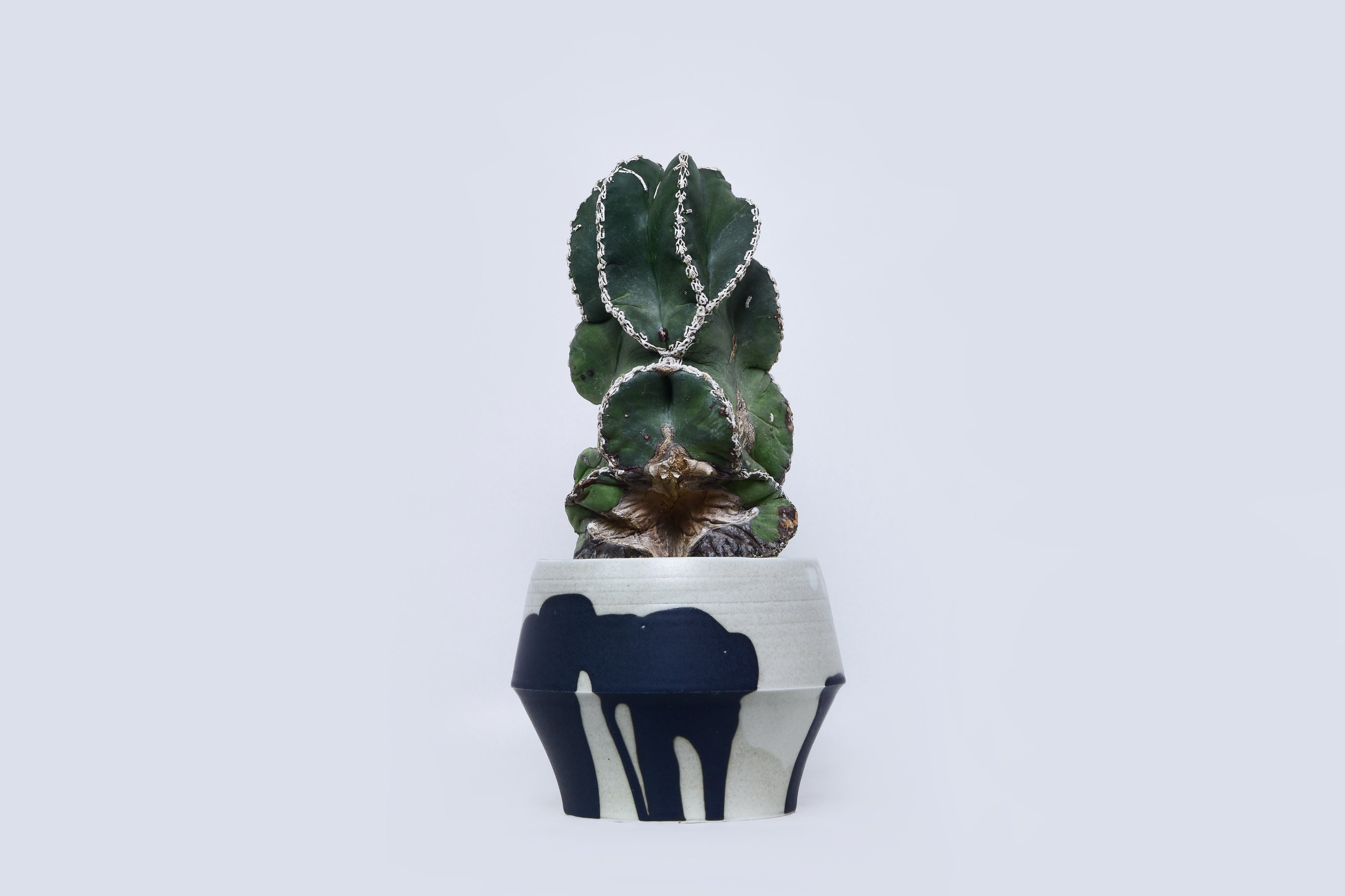
In the opening image, a rippling dark-green plant rises from a black-and-white vessel. White lines run along its ridges; black glaze flows like broad brushwork. Plant and ceramic do not simply match colors—their lines collide into a strong outline at right, while wide white space at left asks where the object might be placed.
Plants Wearing Light: Qusamura and Naotsugu Yoshida runs July 31–August 16, 2026, at CIBONE Omotesando. Plants selected by Qusamura meet vessels Yoshida made for the exhibition, alongside Kaku, Qusamura’s illuminated fixture. Plant, vessel, light, and furniture appear together as a small environment in which a specimen keeps living.
Black-and-White Vessels Receive Each Plant’s Character
Qusamura’s idea is “plants with a good face”: beauty is not limited to orderly form, but includes individual distortion, scars, and growth traces. Official guidance says plants were selected and composed in response to Yoshida’s vessels. Individual differences within one species become sharper through their distance from the pot.
Yoshida has made vessels in white, black, and gray with refined rims. For this exhibition, he worked while imagining plants entering and continuing to change, unlike tableware. The vessel neither dominates as a finished object nor retreats into background. Its function holding soil and roots also frames the plant’s outline.
Showing Light as a Condition for Growth
Qusamura’s new Kaku fixture begins with the plant’s growing environment and incorporates light. Qusamura says it had used artificial light before but found the equipment affected the room’s appearance. Here cultivation function and spatial design are treated as one problem.
Kaku begins at ¥242,000 including tax, comes in several sizes, and can be ordered during the exhibition. No claim specifies the light or says it suits every plant. Furniture-integrated lighting does not settle every growing condition; light intensity and duration, air, water, and temperature still require checking for the chosen specimen. The exhibition’s meaning lies in showing that tool beautifully without erasing reality.
Often a pot is chosen, a shelf placed, and a grow light added last, leaving wiring and fixtures detached from the room. Kaku reverses the order: create a place containing light, then consider vessel and plant within it. Seen as furniture that includes botanical needs in the room from the start—not simply hides a lamp—questions beyond price and form emerge.
Measure the Place before Choosing the Plant
To bring the exhibition home, measure available area and brightness before buying a plant: window distance, seasonal direct light, hours the lamp can run, and paths for turning the pot and carrying water. Choosing color and form stays pleasurable only when tied to continuing care in that place.
The photographed plant has uneven rises and variations of surface color. Rather than conceal them as flaws, the black-and-white vessel receives the gaze. Qusamura’s value of “living vigorously” is not a contest in rarity of form. It chooses future time as well as present appearance—light, extension, lean, and changing proportion to the vessel.
A Small Environment Beginning Tomorrow in Omotesando
The venue is CIBONE Omotesando on basement level 1 of GYRE. The exhibition runs July 31–August 16, 11:00 a.m.–8:00 p.m. An opening reception takes place 6:00–8:00 p.m. July 31, while the display opens normally at 11:00. Qusamura owner Kohei Oda and Naotsugu Yoshida plan to attend July 31 and August 1; times may change. Check official information before visiting.
Alongside Kaku orders, a limited number of Yoshida shades, now out of production, are planned for sale. Before rushing to buy, see plant form, vessel edge, and light position as one frame. Placing a plant is not filling an empty shelf, but creating with furniture and light a place where it can keep changing. That sequence can be studied beneath Omotesando.