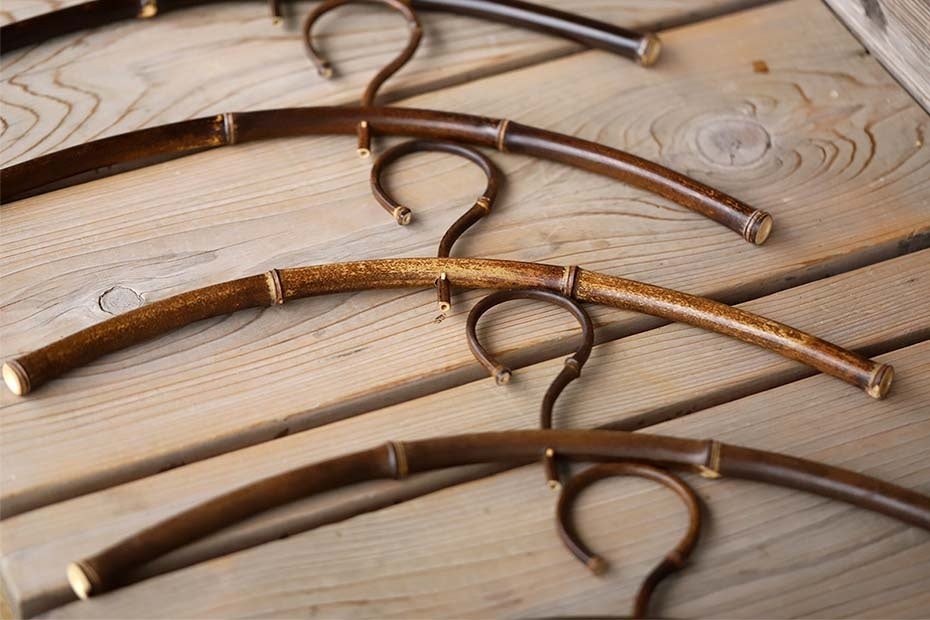
An empty hanger usually goes unnoticed. Yet a photograph of Black Bamboo Hangers on a wood floor alters that view: one nearly black, another amber, another retaining a broad skin pattern. Instead of uniform outlines, the curves hold the time in which the bamboo grew. Yamagishi Bamboo, which operates Taketora, announced the product August 3 after sales began July 31.
Keeping the Nodes to Hold Clothes in Place
Node spacing changes from the base of black bamboo toward its tip. For each hanger, an artisan studies one culm and positions nodes at both ends and across the shoulders. Their slight projection helps keep clothing from slipping. The plant’s structure remains as the tool’s function rather than being concealed to resemble an industrial product.
Despite the name, black bamboo is not uniformly black. Its tones range from purplish brown to light brown, with rings of changing color around nodes. Taketora explains that the surface changes during growth from green to purplish black or purplish brown. Differences in a finished piece are not uneven paint, but evidence of time and position within one culm.
The shoulder line bends a single slender length of bamboo. A small bamboo brace stands at center, while cut ends and node rings remain visible. Unlike metal or resin hangers that disappear behind clothing, the plant’s shape remains after a shirt is lifted away. The distinction is clearest where storage itself is part of the room, such as an open closet or traditional garment rack.
Straightened First, Then Bent into an Arc Again
Harvested bamboo is not perfectly straight. Taketora heats it with a gas burner and wipes away oil rising from within along with surface grime, a process called oil removal. Factory records also describe straightening while heat makes the bamboo pliable. The hanger reverses that technique, bending the prepared material into a graceful bow.
Its deep sheen is said to come from bamboo’s own oils brought to the surface by heating, not a uniform coat of paint. Variations in tone and remaining skin mean no two pieces in the photographs look alike. Anyone who reads nodes and color variation as material history rather than defects may enjoy choosing the individual piece as well.
The curved-bamboo technique was not invented solely for this product. The official page says it draws on skills developed for black-bamboo round windows. A curve once framing an architectural opening changes scale to a shoulder-width household tool, giving the hanger’s outline a role in ordering space.
Begin with One Lightweight Garment
The hanger is approximately 43 cm wide, 20 cm high, and 1.5 cm deep, and weighs about 55 g. Its hook rotates 360 degrees and is secured against coming loose with a bamboo peg. The price is ¥4,180. Taketora recommends beginning with light garments such as blouses rather than heavy coats; appropriate load is part of selecting a tool that preserves a slender natural line.
Store it out of direct sunlight in a well-ventilated place. Leaving it in a poorly ventilated bag may encourage mold. Parts of the skin may peel, and shape, color, and size may differ from photographs. Rather than expecting uniform finish, consider garment weight, humidity where it will hang, and each piece’s expression.
At 43 cm wide, it is suited to showing one blouse or light shirt. Ecru linen emphasizes the black-bamboo line; against a dark jacket, pale rings at the nodes become small accents. Consider not only clothing color, but the distance to wood shelves, metal rails, and ceramic pots. One hanger can begin a reconsideration of the materials within storage.
Leaving a Plant’s Outline in the Closet
Taketora was founded in 1894. Its history making everything from bamboo material to household tools appears in small decisions: where to place a node and how much heat creates a curve. The novelty is not eccentric form, but the transfer of established bamboo craft to dimensions for modern clothing.
Bringing clothing and plants into one room need not mean adding pots. Read the nodes a plant grew and add a hand-shaped culm to the morning routine. Hang a favorite blouse, then notice the empty arc after taking it down; feel the node positions each time. The Black Bamboo Hanger returns a tool usually hidden in storage to a small scene of life with plants.
- Sales began: July 31, 2026
- Price: ¥4,180 including tax
- Size: Approximately W43 × H20 × D1.5 cm; approximately 55 g
- Material: Black bamboo; made in Japan
- Sold by: Taketora, specialist in tiger-patterned bamboo