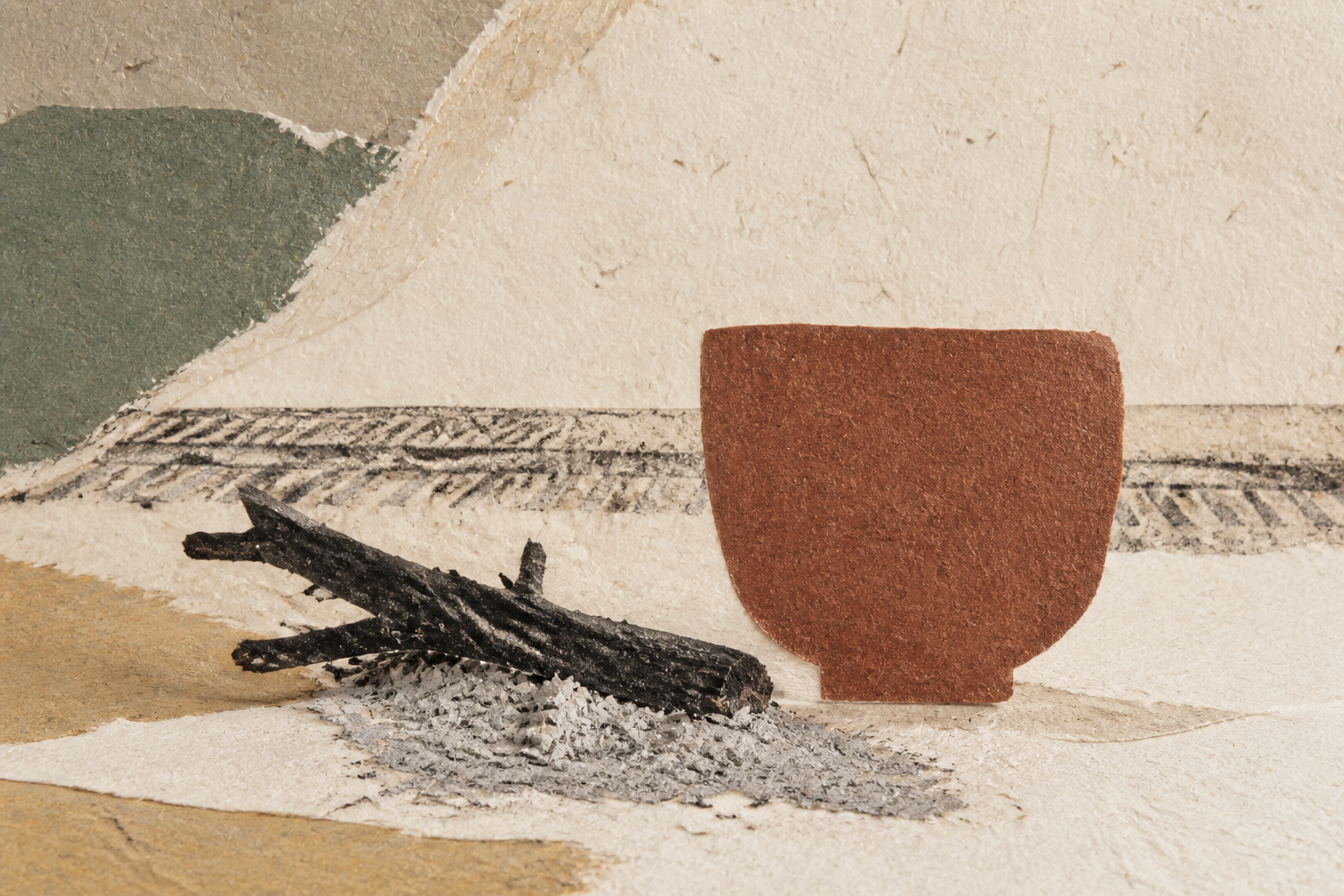
The first image layers red earth, black branches, and white ash in torn washi. It does not reproduce the vessels that will be sold. Precisely because product photographs and detailed forms have not been published, the editors focus less on finished contours than on the sequence through which one tree changes place.
Branches Become Ash Inside the Kiln
According to Okayama University’s official announcement, the material is wood removed along railway lines managed by JR West’s Okayama Branch. The railway provides it as kiln fuel, and Bizen artist Hiroyuki Matsui makes the works. Tree species, cutting locations, and amounts used in individual pieces are not given, so this article does not fill those gaps by imagination. What is certain is that wood produced by railway maintenance changes role into craft fuel.
Bizen ware is known for leaving the effects of clay, flame, and ash on its surface without painted decoration or conventional glaze. Traditional Crafts Aoyama Square explains that goma describes the landscape created when wood ash falls on a vessel and melts at high temperature into natural glaze. Here too, the wood does not simply burn and disappear. The announcement says its ash becomes natural glaze and produces new patterns on the works.
The actual objects must reveal which colors and flows appear. Inside a kiln, position, exposure to flame, and the fall of ash divide expression. Knowing the wood’s origin does not predict firing color; it opens a way to see the material route that helped create chance.
Three Landscapes in One Vessel
The brand is BIZENYAKI NEO KESHIKI. At its center is a student idea: “connecting three landscapes.” The view from the train window where trees stood beside tracks; the view that kiln flame and ash leave on a vessel; and the landscape of life in which the vessel is used. Material, making, and user are gathered as one movement rather than explained separately.
Students handled concept, brand development, and logo design; Okayama University faculty reportedly developed packaging that reveals the vessel’s expression. The university adds knowledge, the railway transfers material, and the artist fires it. With three different roles together, “regional resource” returns to concrete handwork: carrying branches, feeding a kiln, wrapping a vessel.
What drew the editors was not transferring a train-window view as imagery, but putting the tree that made the view into production. Railway and pottery are not joined by symbols. Material from trackside management reaches a table through fire. That connection offers another way to describe land.
Lowering Price Can Also Be Design
Okayama University expects works previously priced around ¥18,000–¥20,000 to sell around ¥10,000–¥12,000. Providing fuel, student branding, and packaging design is intended to reduce price by about 40%. The comparison objects’ forms, dimensions, and quantities are not public. This is not a price applicable to all Bizen ware, but a planned range for this project.
Beginning with cheapness can obscure time spent with clay and fire. Yet designing a reachable distance is essential for household vessels. Can material flow and packaging be reconsidered without cutting maker value, bringing the work closer to the table? Once sold, inspect form, touch, use, and differences alongside price.
When several vessels appear, compatibility with existing plates and wood tables may guide choice beyond pattern intensity. One may strongly show an ash flow; another may preserve space around food. A new brand’s value depends less on collecting matching named vessels than on choosing one landscape worth keeping in your life.
Return the Eye for Trees to the Vessel’s Surface
Time with plants is not confined to pots. A tree beyond a window, branches cut for maintenance, firewood, ash, and a table vessel form a continuum. Once known, a ceramic surface appears not merely patterned, but traced by a plant moving into another material. Even without holding flowers, the vessel retains time with wood.
Next time you hold Bizen ware, begin with form and price if you like. Then move close to spots and flows, and consider what touched it in the kiln. The three landscapes joined by BIZENYAKI NEO KESHIKI will not shrink a distant train-window view onto the table; they may return the gaze from a familiar vessel to the trees of a place.