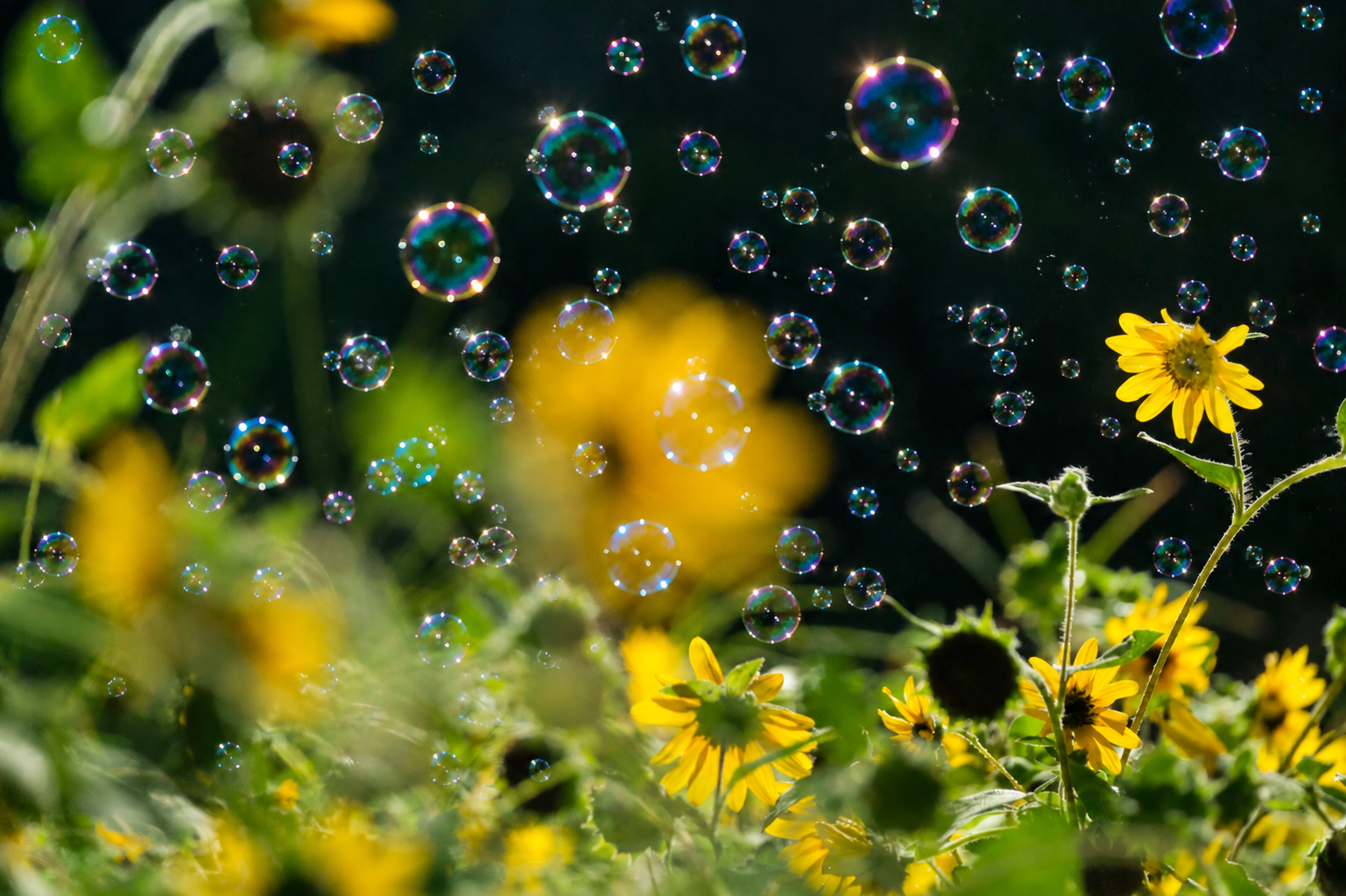
In the official press photograph, yellow sunflowers bloom in a row before a dark background. Bubbles of different sizes drift among them, leaving round reflections in the air. It shows the organizer’s Night Bubbles, not a scene observed by the editors, so flower scent and night breeze cannot be described. Still, the arrangement makes plants not a lighting backdrop, but a place to which playful attention returns.
Starting a Daytime Flower Garden at 1:00 p.m.
Ibaraki Flower Park’s first full-park Flower Night runs August 8–23. Hours during the period are 1:00–8:30 p.m., with final entry at 8:00. The ordinary flow of seeing flowers from morning to evening is reversed: visits begin in the still-hot afternoon, with highlights after sunset. Along with illuminated flowers, Night Bubbles run before the restaurant from 6:00 to 7:00 p.m. Visitors also decorate a Botanical Flower Tree with sunflowers after the 4:00 p.m. activity, with lighting planned at 6:00.
The important thing is that nighttime production does not cover the flowers. Sunflower yellow tightens against darkness, while bubbles move above their height. Plants underfoot, carried lights, and distant trees share one path at different scales, letting a garden seen bed by bed during the day be reconsidered at night through walking order. Even as event apparatus increases, plants remain the visual measure.
Handmade Light Beyond the Sunflowers
On August 15 and 16, Part Two of the Flower Night Market—the Hoshizukiyo craft market—runs from 4:00 to 8:00 p.m. It is the third year for the night market, while this is the first two-week nighttime opening. Glass, ceramic, tsumami-zaiku, and other crafts appear, with activities for making origami-crane lanterns, floral lanterns, and tsumami-zaiku.
On a daytime shelf, ceramic and glass first reveal material color and glaze. Outdoors at dusk, attention shifts to hand scale, cast shadow, and surfaces receiving light beside plants. Craft is not a souvenir row, but neighbors the act of looking at flowers. Make a lantern, walk the path, return to sunflower decoration: before owning an object, the market lets visitors see material in a planted place.
In a River of Flowers, Instruments from Different Lands
The musical combination carries this place outward. On the 15th, Yasato no Yama no Ongakutai is scheduled at 4:00 p.m.; Mongolian morin khuur with shinobue and shakuhachi by the Mongolian-Japanese unit Chikuba at 6:00; and quena player Daisuke Watanabe at 7:00. On the 16th, Yasato no Yama no Ongakutai returns at 4:00, followed by erhu from 5:05, a band at 6:00, and singing at 7:00.
We cannot decide how a performance will feel before hearing it. Yet a Yasato-named ensemble and instruments rooted in Mongolia, Japan, China, and South America sharing one evening is compelling. It keeps sunflowers and satoyama from closing into one nostalgia, making a stage receptive to the breath of different lands. Music in a botanical garden is not accompaniment decorating scenery, but a test of how far that scenery connects with cultures outside it.
Choosing a Yasato Dusk
Admission August 15–16 is ¥900 for adults, free for junior-high students and younger, and ¥200 for pets. Adults visiting in yukata receive 20% off. The Hoshizukiyo sticker rally begins at 4:00 p.m.; Night Bubbles and handheld fireworks run 6:00–7:00. Outside fireworks may not be brought in for safety; use those sold at the venue. Programs may change with weather, so check the organizer’s latest notice before leaving.
A flower destination is not only a count of full bloom. Entering at an unusual hour and reconsidering lights, vessels, and instruments against sunflower height is another way to know plants and place. At home, viewing a windowsill pot later than usual may reveal overlapping leaves unseen by day. A night in Yasato places a distant garden visit and return to nearby plants within the same weekend.