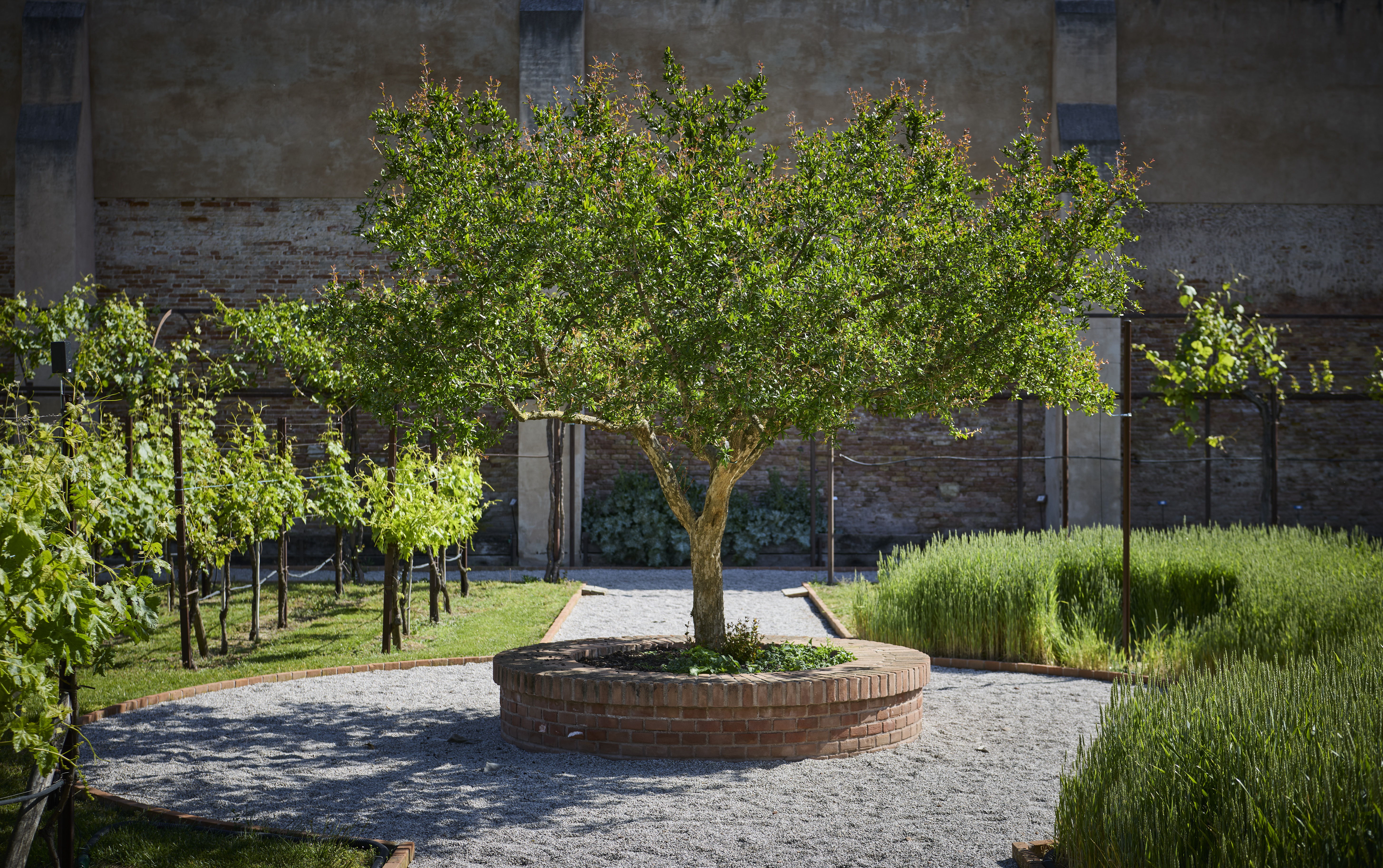
The first garden has no flamboyant stage set. One tree stands at center, a narrow path crosses planting, and brick walls separate the city outside. This is the garden of the Discalced Carmelite monastery in Venice’s Cannaregio district: Giardino Mistico, the first venue of The Ear Is the Eye of the Soul, the Holy See Pavilion at the 61st International Art Exhibition of La Biennale di Venezia.
Listen to the Monastery Garden as One Instrument
Invited musicians are not the only source of sound. According to the official account, a device developed by Soundwalk Collective captures plant bioelectrical activity and converts it to sound. Through headphones, visitors hear those changes layered with new works by participants. Rather than adding recorded nature to a garden, the state of plants present contributes to the work’s resonance.
Notably, the project does not translate plants into human emotion. Signals from leaves and stems are not proof of a plant “voice,” but an entrance to activity invisible to human eyes. When viewing a garden, we readily receive flower color and tree form first. Here sound opens the act of seeing plants into another sense.
From Hildegard of Bingen to 24 Participants Today
The pavilion draws on Hildegard of Bingen, the 12th-century abbess, composer, healer, and visionary who did not separate garden from sound or spirit from body. Curators Hans Ulrich Obrist, Ben Vickers, and Soundwalk Collective pass that view into contemporary expression. The 24 participants include Brian Eno, Patti Smith, FKA twigs, Devonté Hynes, Jim Jarmusch, Meredith Monk, Terry Riley, and Suzanne Ciani.
Despite famous names, the pavilion’s interest is not sequential consumption of stars’ works. Different generations and fields join one sonic composition sharing a garden. More than recalling a name before one tree, notice how the same leaf appears after listening. Returning the center of viewing to plants is the collaboration’s strength.
Two Venues Connect Garden and Memory
The Holy See Pavilion has two venues. The Mystical Garden offers a seven-stage sonic experience; at the Complesso di Santa Maria Ausiliatrice in Castello, a “living archive” gathers works, books, and architectural proposals. It includes Alexander Kluge’s final work, an artist book by Ilda David’, and monastic-architecture projects by Tatiana Bilbao Estudio with MAIO and DOGMA.
The singular sound received in the garden is reconsidered at the second venue through words, drawings, and objects. It resembles preserving a plant not only in photographs, but with place and season. Present form and a record available later together turn one day’s impression into continuing memory.
Leave Room in the Itinerary to Listen
The 61st exhibition runs through November 22, 2026. The Mystical Garden requires reservation; the second venue does not. Both are free. Hours are 11:00 a.m.–7:00 p.m. through September 30 and 10:00 a.m.–6:00 p.m. from October 1. Check official information for closures and exceptions. The venues are in different districts, so allow travel time without shortening time to stand in the garden.
Many spaces treat plants as decoration. Here plants are not backgrounds enhancing works, but sources of changing signals and presences that set viewing speed. Look at leaf form, wait for change through the ears, then return the gaze to the plant. That circuit can come home to a room’s pot. The same leaf still holds many entrances to observation.