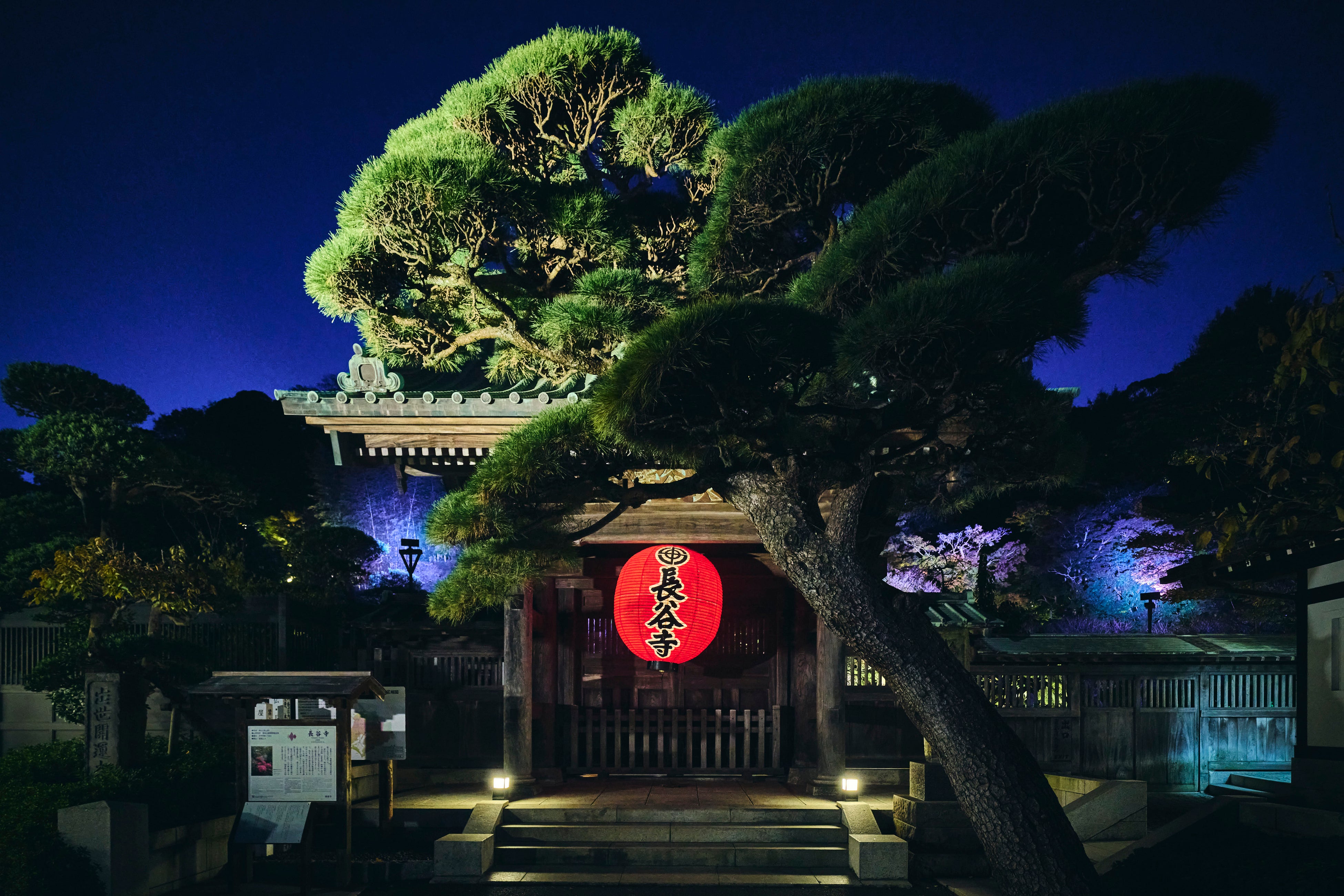
In the opening photograph, temple greenery has an outline unlike daylight. Blue-green light layers across branches beneath a dark sky, while a vermilion lantern and timber gate retain warmth. Illumination separates trunk, branch, and leaf rather than brightening the tree evenly. Though the temple is the stage, botanical depth appears before the building.
From the Garden to Kannon Hall after Closing
Hasedera NIGHT TABLE 2026 invites guests to walk the grounds after regular visiting hours, hear music in Kannon Hall, and move to a garden dinner. It runs October 2–4 for only 55 guests per evening. Begun in 2023, the program returns with a different performer on each of three nights.
Entry begins at 5:30 p.m., with the Kannon Hall concert at 6:00. A buffet with free-flowing drinks follows from 7:00–9:00. Guests view the grounds, sit for music, then dine in the garden. Because the evening is not confined to one venue, moving through the grounds becomes part of its composition.
Night openings at flower temples can be reduced to illumination colors. Here, the significant order is deep green, then sound in Kannon Hall, then an outdoor table in its afterglow. Plants become a passage between music and food rather than stage scenery, shifting sensory attention through leaf density and stone steps.
By day, visitors often choose paths toward blooming flowers or views. At night, ground lights, branch shadows, and building entrances determine direction. Follow not only which plant receives which color, but how the apparent quantity and distance of leaves changes with every transition from brightness to darkness; the garden’s structure becomes clearer.
Songs and Instruments Change across Three Nights
October 2 features Kyoto pop duo Flat♭. On October 3, Miyuki Hatakeyama performs with Maki Nakano and Kazuma Fujimoto. On October 4, 2VOICE appears with Hiroki Morioka. Official information gives performers and dates, but not songs or running order. Wait for that evening’s music rather than binding lyrics or titles to the plants in advance.
Kannon Hall differs in material and purpose from a conventional live venue. Before the large Kannon statue, surrounded by timber pillars and ceiling, music extends beyond lighting and amplification. Foliage seen outside, stone steps before entry, and the change from night air prepare the ear. Enjoy the sequence of spaces without inventing its exact acoustics or scent in advance.
Kamakura and Shonan Ingredients at a Garden Table
Dinner is supervised by chef Makoto Ogawa of Kamakura Italian restaurant Ristorante La Luce. Plans call for a casual garden-style buffet using ingredients from Kamakura and Shonan. The specific menu had not been announced, so dishes and origins cannot be stated in advance.
Even so, dining in a garden matters. Plants watched in daylight become dark outlines; vegetables become texture and flavor on the plate. The distance differs among plants that grow, compose scenery, and are eaten. Layering all three in one evening is the event’s distinctly RareDex interest.
Rather than take much from the buffet at once, notice how the view changes each time you return to the garden. When the remaining sky color at opening disappears and only illuminated leaves float, the same seat sees a different temple. An outdoor table measures the night’s progress as well as serving food.
Admission is ¥17,850 per person, including a ¥350 ticketing fee. Sales began August 1 through Hasedera’s online store and end when capacity is reached. With different performers each night, choose by the evening you want to hear as well as availability. Confirm sales status and day-of guidance officially before purchase.
Before Entering the Night Garden
The venue is 3-11-2 Hase, Kamakura, Kanagawa Prefecture, about a five-minute walk from Hase Station on the Enoden line. The event is planned to proceed in rain but may be canceled in severe weather. Bring a layer suited to an early-October evening and shoes comfortable on stone steps.
Access from reception to the venue is uphill by stairs, with no ramp or elevator. Elementary-school-age children and younger may not attend, pets are not permitted, and parking costs extra. Confirm these conditions before planning with companions. Late arrival may mean missing part of the service.
By day, Hasedera’s plants direct attention to floral color and variety. At NIGHT TABLE, light separates layers of leaves and places song and table beyond. Pause once on the way to Kannon Hall instead of photographing only the brightest point. When branch depth appears in darkness, the evening’s landscape has formed before the music begins.