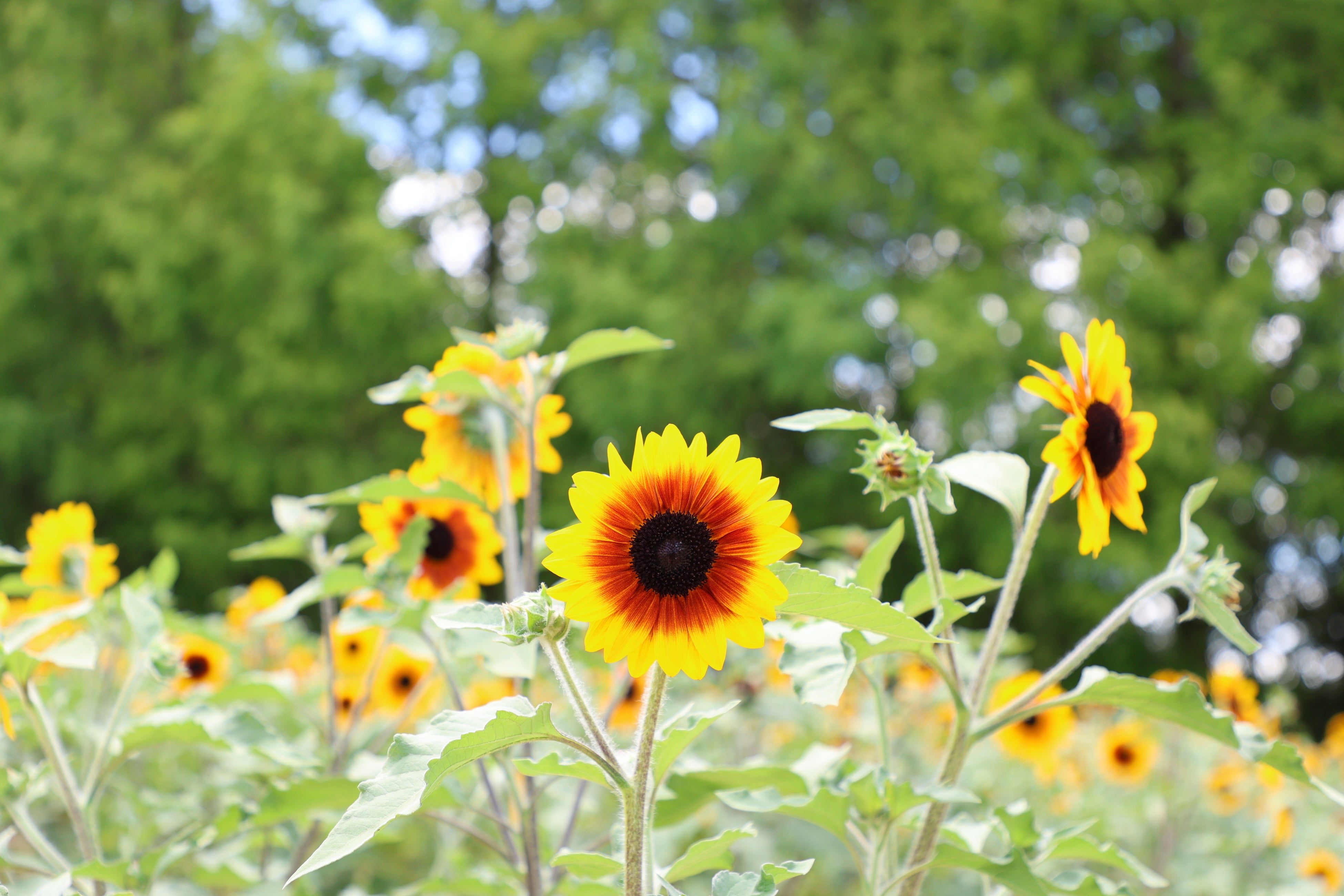
The first image shows Sunfinity Yellow Red Bicolor, introduced as a new cultivar. Bright yellow outer petals surround a reddish-brown ring, stepping toward the dark center. From afar, a summer field of yellow; close up, three layered colors. Sera Kogen Farm’s sunflowers gain expression as visitors move between those distances.
Walk Differences, Not a One-Color Field
At 2:00 p.m. August 8, 2026, Sera Kogen Farm officially announced peak sunflower bloom. The Sunflower Festival runs July 25–August 23. Across 65,000 square meters, familiar forms and unusual cultivars with different characters are planted. More than pursuing scale, finding one flower’s differences becomes the way to spend time here.
Current highlights are Sunfinity, which produces successive multiple blooms; Sunfinity Yellow Red Bicolor, holding yellow and red in one flower; and double Tohoku Yae. Each shifts the eye from reducing a sunflower to yellow and a simple circle. Petal count, boundary with the center, placement of flowers at stem tips: viewed in sequence, the field becomes a gathering of small forms rather than one large photograph. See the whole first, walk toward a compelling color, and finish by reading petal lines. The order of looking edits the field like an exhibition.
A Yellow-Red Ring and the Density of Double Flowers
Read a bicolor bloom as you would clothing color. Yellow dominates, blending it into the field until approach reveals the red ring. Instead of placing two strong colors side by side, another color enters on the way to the dark center, tightening the outline under sunlight. Photograph both an isolated bloom and its position among the yellow group to convey its interest.
Tohoku Yae layers fine petals through the center, creating density unlike a typical sunflower. Instead of a flat disk viewed frontally, the eye moves into flower thickness. If bicolor shows a boundary of color, this shows accumulated lines. Even within yellow, the number of light-catching surfaces differs. Seeing them in succession reveals the formal range of the sunflower motif beyond cultivar description.
Peak Bloom Shifts from Field to Field
The August 8 release says the field with the windmill had not yet begun flowering and was expected to bloom later. Not every area reaches the same state at once. While current flowers peak, the remaining green plane holds the next landscape. Natural flowering does not advance uniformly like an event schedule. Receive the offset as the field’s time difference, not a flaw.
Some older information remains on the official site, while the operator’s August 8 release says the festival is underway and at peak. Use the newest dated bloom report and reconfirm same-day operation, rates, and weather. Visitors seeking a particular cultivar should also confirm that day’s condition and accessible areas.
From One Commemorative Photograph to Photographs That See Plants
In a broad flower field, it is tempting to preserve only the panorama. Instead take one image of the expanse, one bloom of a chosen cultivar, and one close view of overlapping petals or color boundary. The panorama remembers place; the close view records the flower selected that day. With companions, compare the single bloom each chose in the same place.
Time with plants is not measured by how many unusual names we learn. Finding a red ring or double density among flowers that looked alike from afar, and pausing: that change of gaze turns a summer field into personal memory. Even when displaying one flower indoors, you may look again beyond color to lines moving outward from its center.