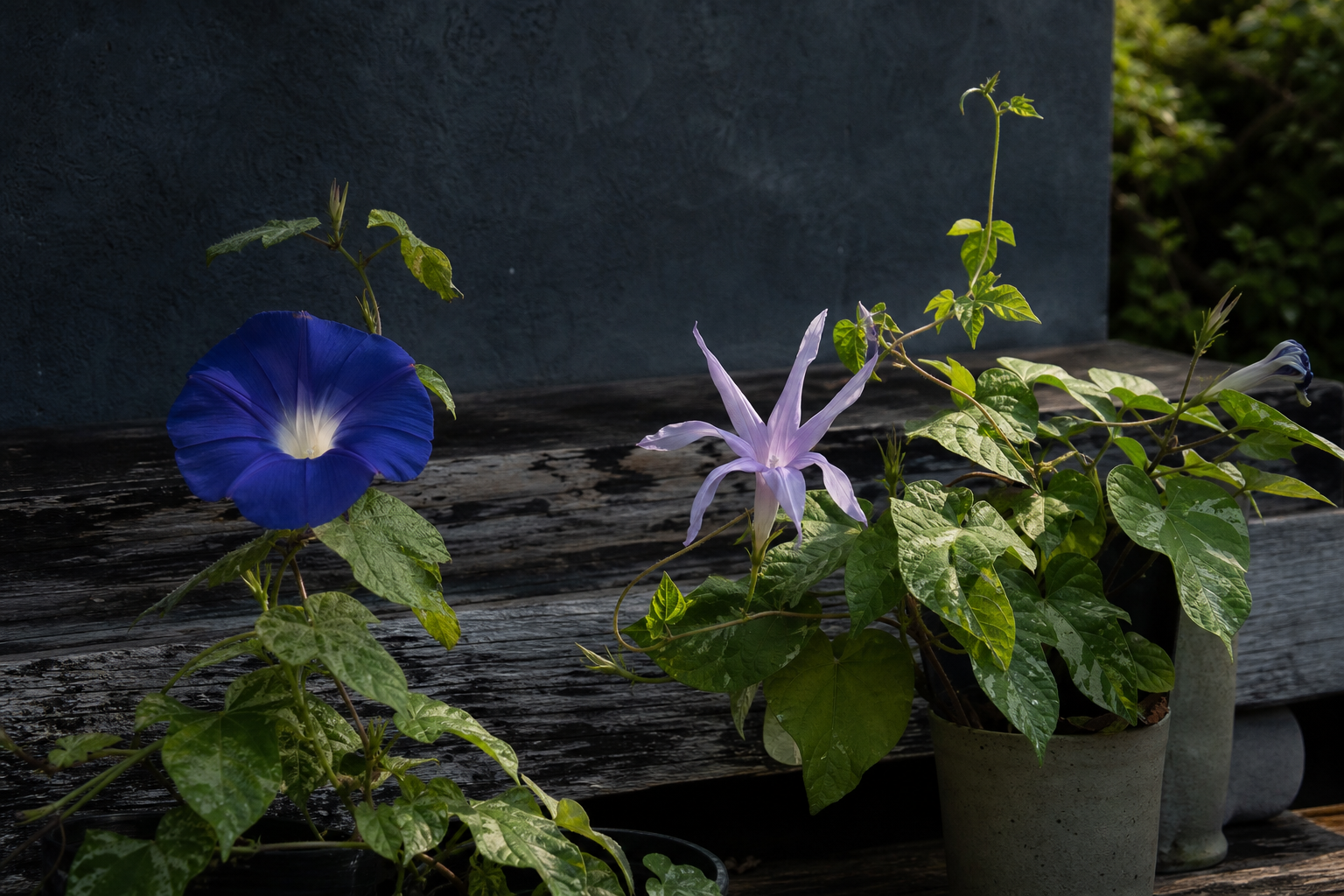
Morning glories are more than orderly trumpets. Official guidance introduces large-flowered morning glories over 20 cm across and mutant forms with altered flowers or leaves. One direction pursues the largest possible circle; another loosens the circle into different lines. Displayed together, their outlines invite comparison before color.
The exhibition runs July 24–28 at Tsukikage Teahouse on the Central Plaza in Sankeien’s Outer Garden, daily 9:00 a.m.–noon. About 40 displays change each day. It is organized by the Sankeien Hoshokai Foundation and Yokohama Morning Glory Society, with cultivation consultations and seed and seedling sales. At 10:00 a.m., seedlings are distributed by lottery to ten people daily, connecting viewing to a next pot.
Placing Two Aesthetics Side by Side: Size and Mutation
Large-flowered morning glories can draw attention only to diameter. Yet the impression changes when seeing how smoothly petal edges close a circle, how color moves from center outward, and the ratio of leaf to bloom. Size is an outcome preceded by daily care and growers’ decisions reading change.
Mutant morning glories have carried forward forms such as narrowly split petals, increased layering, and leaves departing from the familiar heart shape. Each pot unsettles the boundary of what feels like a morning glory. Rather than dismissing them as strange against an orderly standard, follow where flower and leaf lines travel, reading them through verbs such as rounding, pointing, curling, and overlapping.
RareDex notices that large and mutant forms can be seen the same morning as different acts of editing rather than ranks: the skill of aligning form and the skill of preserving departure from it both remain within a familiar plant.
From Edo-Era Illustrated Books to Today’s Pot
Japan’s National Archives explains that an 1816 competition in Asakusa helped trigger an Edo boom in morning-glory cultivation. The multicolor illustrated volume Asagao Muragari, prefaced that year, collected unusual forms and cultivation methods. Culture included not only the blooming morning, but recording, naming, and carrying form into the next season.
The National Diet Library introduces 36 unusual flower and leaf forms in the 1854 Asagao Sanjurokkasen. Some are now lost. An illustrated record and continued seed saving are not the same, but both carry a one-season flower into another time. Seeing changing pots at Sankeien is seeing the present point in that long selection.
There is no need to memorize names immediately. See flower and leaf together; compare the neighboring pot. If a form holds attention, ask at the cultivation consultation what care preserves it. Imagining the next flower from seed is part of choosing a pot; a small question becomes an entrance to horticultural culture.
On the Weekend, Walk from Lotus to Morning Glory
On July 25–26, the exhibition overlaps Sankeien’s Early-Morning Lotus Viewing. The garden opens at 7:00 a.m.; after lotus viewing during the recommended 7:00–9:00 window, the morning-glory exhibition begins at 9:00. See broad lotus surfaces rising from water, then fine altered morning-glory lines in pots—moving between scale and training in one walk.
Sankeien is a 175,000-square-meter Japanese garden created by businessman Sankei Hara, with historic buildings moved from Kyoto, Kamakura, and elsewhere among seasonal plants. Its Outer Garden opened publicly in 1906, making 2026 the garden’s 120th anniversary. Beyond flowers, see pot height, teahouse material, and garden depth to understand where a specimen is placed.
The exhibition lasts five days and closes at noon. Today’s forms may not appear the same tomorrow. Leaving early to preserve one outline in memory or photograph is also a way of carrying a brief bloom into another time.