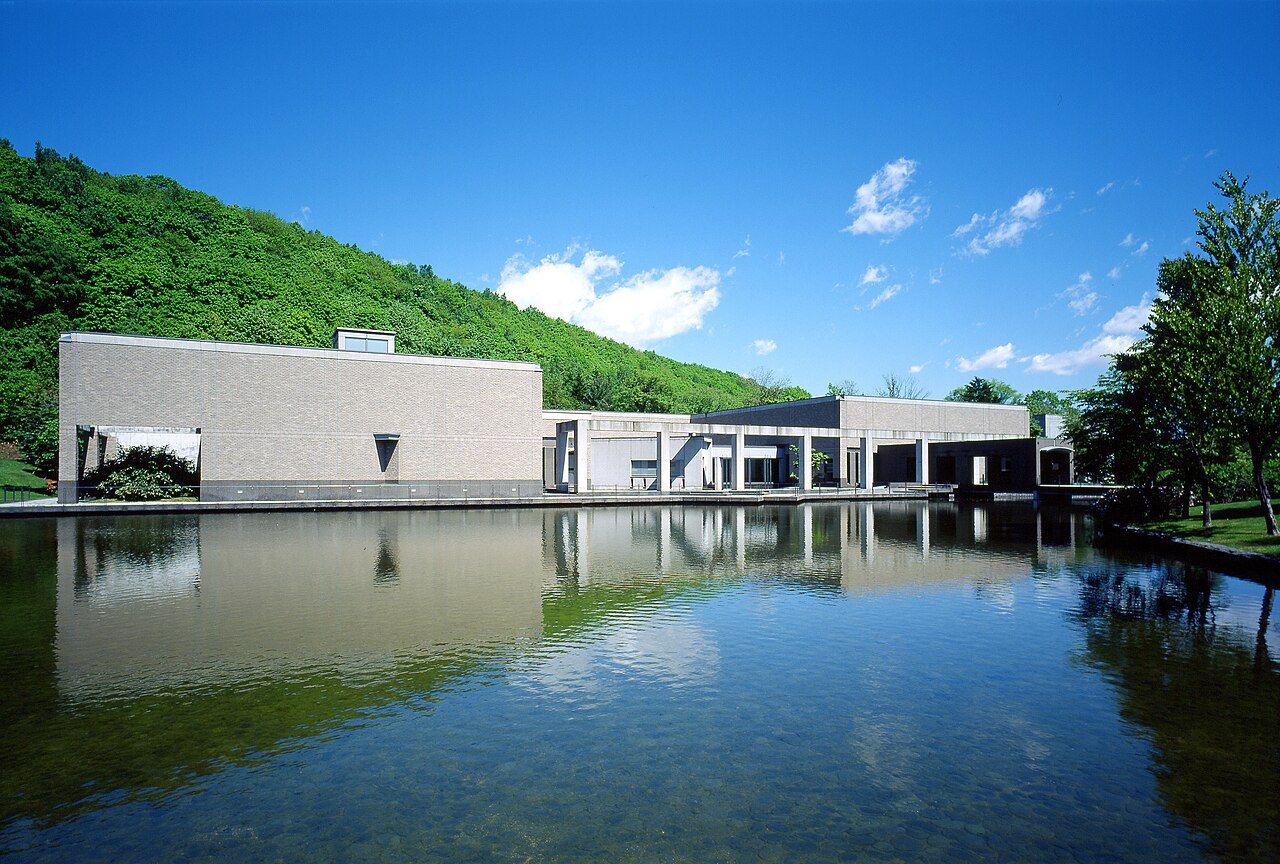
The venue is not one room. The exhibition extends through Sapporo Art Museum, the Open-Air Museum, the former Takeo Arishima Residence, the Churyo Sato Memorial Children’s Atelier, and connecting spaces. Open the official map first and it becomes clear that viewing works and moving through forest were designed as one experience.
Flowers and Beasts: Colors and Forms opened July 11, 2026, for Sapporo Art Park’s 40th anniversary and runs through September 27. Painting, sculpture, photography, and installation about plants and animals appear indoors and out. The forest itself shifting from midsummer to early fall creates a distance unlike viewing isolated works.
Floral Color Appears through Changing Materials
Artists include Mika Ninagawa, Meiko Kinoshita, Akira Ishiguro, Ai Kumehara, and Keiko Inokuma. Materials introduced officially show plant images escaping one expression. Ninagawa’s Liminal Pathway (detail) uses colton film; Kinoshita’s Kusou uses cyanotype, silver pigment, gold leaf, mineral pigments, and washi; Kumehara’s Garden of Bubbles uses mineral pigments, pigment, animal glue, Sina plywood, and washi.
Depicting flowers is more than copying outline. Translated into light-transmitting film, mineral particles, metal reflection, and paper fiber, the same “flower” changes viewing speed. Some works draw viewers close by color; others ask a pause over surface layers. RareDex looks beyond identifying species to the maker’s choice of material prompted by botanical form.
Camphor, Glass, Driftwood: Walking the Distance between Beasts and Forest
Animal images retain forest relation through material. Yoshimasa Tsuchiya’s Deer uses camphor, crystal, and color. Takeki Fujito’s Bear and Wolf Attacking a Deer is carved from walnut. Fukuo Tanaka’s Selfish-6.2 [Core] combines scientific glass and camphor. Mio Hashimoto’s Taro and Jiro are also carved in camphor. When wood becomes animal bodies, plants are not background but the works’ mass.
In the Open-Air Museum, Kenta Kunimatsu’s LAOCOÖN uses elm, while Daisaku Ueno’s Shichito Rikizu uses clay from Mt. Moiwa and the hill. The site notes that published images may differ from actual exhibited works. Remember materials and venues rather than overstudying screens, leaving room to first discover scale within the forest.
Along the route, Toshihiko Shibuya’s installation divides between museum and Arishima Residence, while an exhibit by Sapporo City University’s Akio Shiino Laboratory occupies the zigzag stairs. Because works are not confined to galleries, building uses and level changes enter sight. Travel is not blank: leaf density, ground material, and domestic scale loosen one impression before the next.
Opening the Day beyond the Gallery
Check the official map for five display areas before visiting. July and August hours are 9:45 a.m.–5:30 p.m.; September closes at 5:00. Final admission is 30 minutes before closing, and the exhibition is open daily during its run. Admission is ¥1,600 adults, ¥1,000 high school and university students, ¥500 elementary and middle-school students, and free for preschoolers. Age- and disability-related terms apply; check details officially.
Alongside original exhibition goods, the museum shop carries artists’ bamboo fans, handkerchiefs, bookmarks, and more. Botanical and animal imagery translated into summer tools, cloth, and paper carries the exhibition gaze to desks and bags.
After seeing art about plants, the forest changes the use of the eye. Do not reduce leaves to one green or bark to brown; reconsider the boundary between ground and sculpture. What returns is not only titles, but questions about what materials can receive botanical lines and how closely familiar trees and flowers have been seen. The forest changes during the run; this summer, Sapporo Art Park becomes both an art venue and a long path for reconsidering nearby plants and materials.