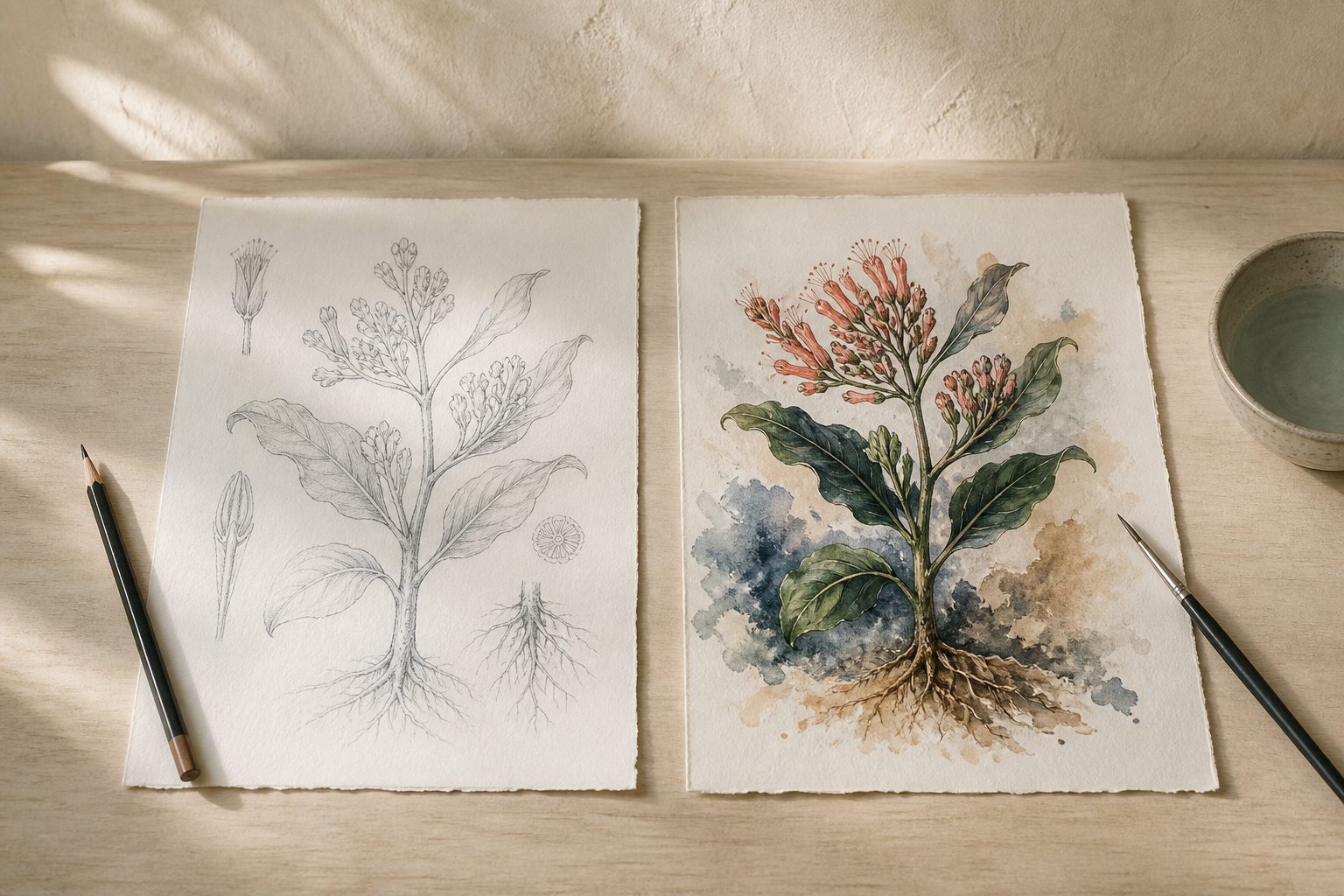
The opening image places two sheets of the same fictional plant side by side. Pencil at left locates roots and buds; watercolor at right layers deep green, coral, and indigo. It does not show exhibition works, but represents two modes of looking that botanical art asks us to move between: where leaves attach and which lines support plant identity; then how to preserve that structure while composing color and empty space.
Thirty-Nine Botanical Works Connect Two Lands
Botanical Art from Japan and Indonesia, now at Nerima City Makino Memorial Garden, grew from exchange between the Japan Botanical Artists Association and the Indonesian Society of Botanical Artists. According to the Garden, the Japanese association was established in 2025; this exhibition introduces works by members of both organizations and younger artists. Thirty-nine works allow comparison not by classifying plants by country, but by what each artist selected from one specimen and retained on paper.
Botanical art asks for scientific accuracy and artistic attraction together. Royal Botanic Gardens, Kew describes its ability to record structures photographs cannot readily separate and its historical use in plant research. Singapore Botanic Gardens’ Botanical Art Gallery likewise collects work where botany meets art. Accurate form and a beautiful sheet are not opposites. Deeper observation gives reason to omissions in line and selections in color.
With artists from Japan and Indonesia—lands of different climates and floras—differences in those reasons may emerge. This article will not preempt the works by describing colors or plant names. Before the originals, move first beyond spectacular flowers to leaf undersides, sepals, stem nodes, and seeds. Where an artist spent time, clues to identification overlap with beauty they did not want to miss.
See Precision of Line in Tomitaro Makino’s Garden
The setting matters: the former home where Tomitaro Makino spent his later years. Official Garden materials note his precise botanical drawings for works including Illustrated Flora of Japan and attention to overall balance. Accurate lines do not arise simply from adding information. How much overlap should remain, and what should another angle make clear? Leaving the gallery for garden plants reveals outlines still uncollected in one specimen before you.
When photographing, we seek beautiful light and balanced composition. Botanical art lets those decisions be decomposed slowly: lines following contours, colors making value, space left blank. As when inspecting material joints in pots or furniture, look where observation switches into expression within one sheet. The work becomes something slightly different from both book illustration and room decoration.
If Choosing One Work, Include What Was Not Drawn
Rather than seek a favorite flower immediately, ask why the eye stopped before one sheet. Was it color or stem lean? What breath lies between dense leaves and remaining white paper? Imagining it in a room extends the question to how a framed outline would resonate with living window leaves and wood furniture. A plant and its image need not compete; each can lengthen time spent looking at the other.
The accompanying catalog contains all 39 works in 66 full-color pages for ¥2,000 including tax. The Garden lists 200 copies, plus 400 clear folders at ¥500 including tax. Sales hours differ from opening hours: 9:30 a.m.–noon and 1:00–4:30 p.m. With limited quantities, confirm inventory before visiting. After viewing one sheet at a time, the catalog offers another way to compare density of line.
Carry One Line Home from the Summer Garden
Smartphone screens inevitably quicken plant viewing: identify the whole flower, read its name, move on. Botanical art stops that flow and returns the gaze to veins and bud direction. If, after 39 works from Japan and Indonesia, one garden plant can be watched longer than before, the exhibition does not end on paper. What returns home is not only botanical knowledge, but a pace that keeps details from being missed.