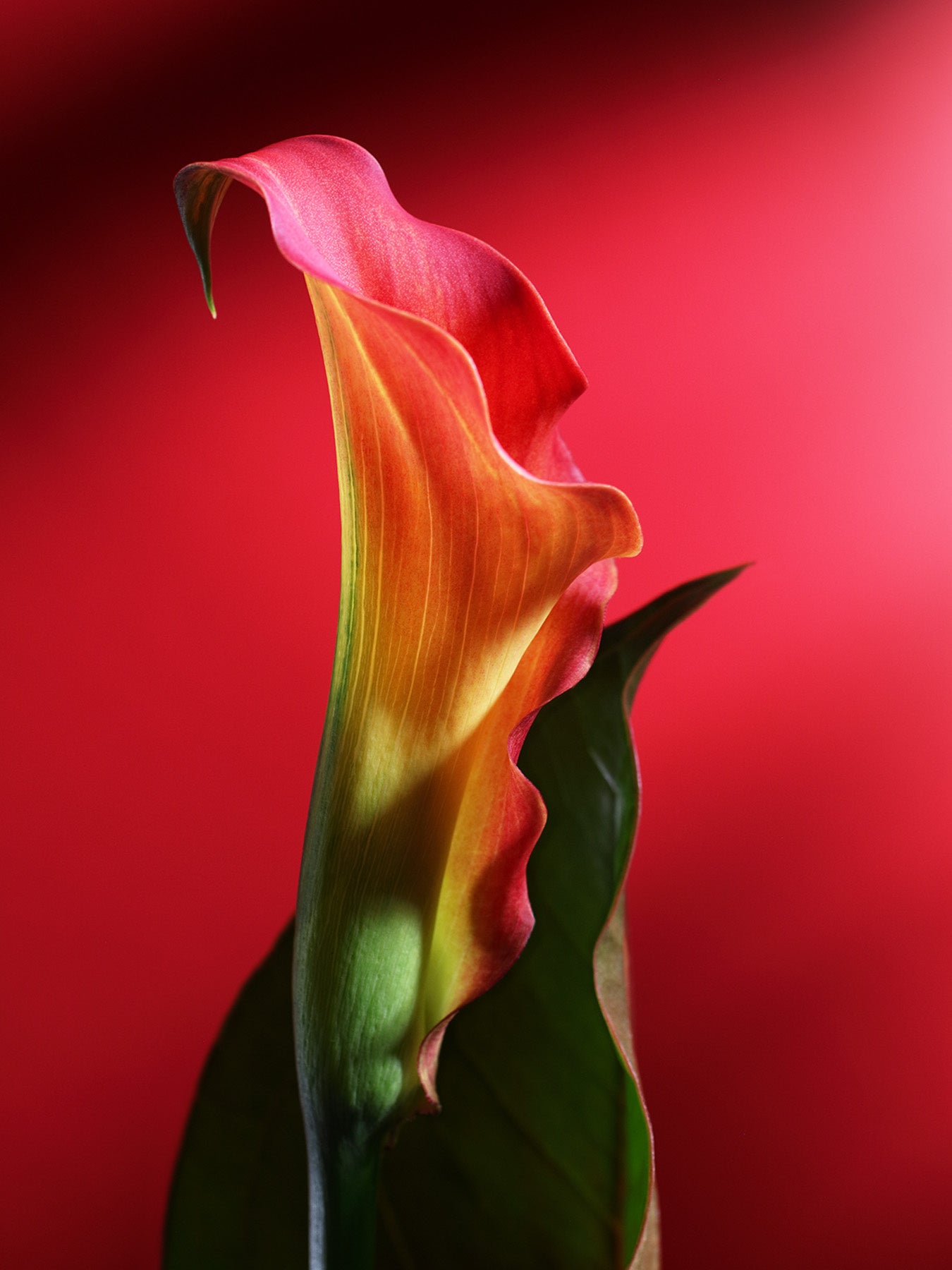
The opening image raises one calla lily from a red plane. Its edge shifts from pink to orange and loosens into green at the base. Because background and flower colors are close, light and shadow running over the curved surface push the outline forward. This is not a botanical-guide explanation of form, but a photograph finding sculptural, even automotive, tension inside softness.
The photographer is Yoshifumi Ogawa, who has worked primarily with automobiles for more than 40 years and turned to flowers about 15 years ago. On July 27, 2026, his first solo exhibition of flower photography, Selected Beautiful Flowers, was announced. It runs September 13–19 at Gallery Goto in Ginza, Tokyo.
An Eye Trained on Automotive Lines Turns to Flowers
The beginning, he says, was a potted plant at his studio window. Photographing it in natural light revealed that the eye for form developed over his career could meet a different subject. He continued photographing flowers apart from commissioned work; the exhibition gathers those 15 years in one venue for the first time.
Cars and flowers differ in hardness, scale, and formation time. In photographs, however, light sliding over surfaces, transitions between curves, and volume between front and profile resonate. The calla feels sculptural not because it impersonates something else, but because a bloom usually understood first by color and name is reconsidered through line and plane.
Advertising photography requires reading design intent and transmitting a vehicle’s shape accurately. Ogawa’s flowers retain a distance that tests where line rises and plane recedes instead of moving so close that outlines dissolve. Looking at form without surrendering only to emotion strengthens the flower’s presence.
RareDex notices this reconsideration. When welcoming a plant, look beyond color and care to the relation between furniture legs and stem, pot curve and leaf arch, window light and shadow. Ogawa’s photographs deepen observations plant keepers already possess.
Not Making Only the Moment of Bloom Beautiful
Published works do not select only perfect bloom: a flannel flower whose stem and branches are fasciated into stone-like form, parrot tulips with intricately folded petals, and cymbidiums followed from bud through decline. He has kept one iris even after photographing it.
A living flower does not keep a completed form. Stems lean with water, petals open, and color slowly settles. Photography stops change, yet Selected Beautiful Flowers places stopped moments together to reveal time. It refuses to declare only opening best and attends to the following day’s line with equal density.
Bring that gaze to cut flowers and pots. Look at layered stems from the side rather than seeking only the most lavish front. Do not immediately call color approaching the end a failure. Time with a plant cannot be preserved in one peak image.
Two Flower Photography Exhibitions, from Daikanyama to Ginza
Alongside his own work, Ogawa has long taught flower photographers. His students’ group exhibition, Hana Kiwamu, reaches its 12th edition August 27–30 in the Exhibition Room at Daikanyama Hillside Terrace, showing work by 22 photographers and their different choices and distances.
Selected Beautiful Flowers follows September 13–19 at Gallery Goto in Ginza 1-chome. Hours are noon–6:00 p.m., ending at 4:30 p.m. on the final day. This is the central exhibition for seeing how an eye formed in automotive advertising moved into privately sustained flower work.
Visiting both could begin with the breadth of 22 perspectives in Hana Kiwamu, then follow Ogawa’s 15 years. One is in Daikanyama, the other Ginza; their dates do not overlap, allowing a personal comparison of how flower sight changes from late summer into early fall.
Keeping the Profile of One Flower after Returning Home
While waiting, view a room’s flower or pot from the side instead of the usual front. Compare how morning and evening light turns across leaf and petal surfaces. Alongside a photograph recording the name, make one following only line and shadow.
When an eye refined for automobiles meets flowers, one bloom appears at another speed. Selected Beautiful Flowers does not decorate flowers into special objects, but loosens the assumption that a familiar form is already known. Time with plants also remains through that small reconsideration.