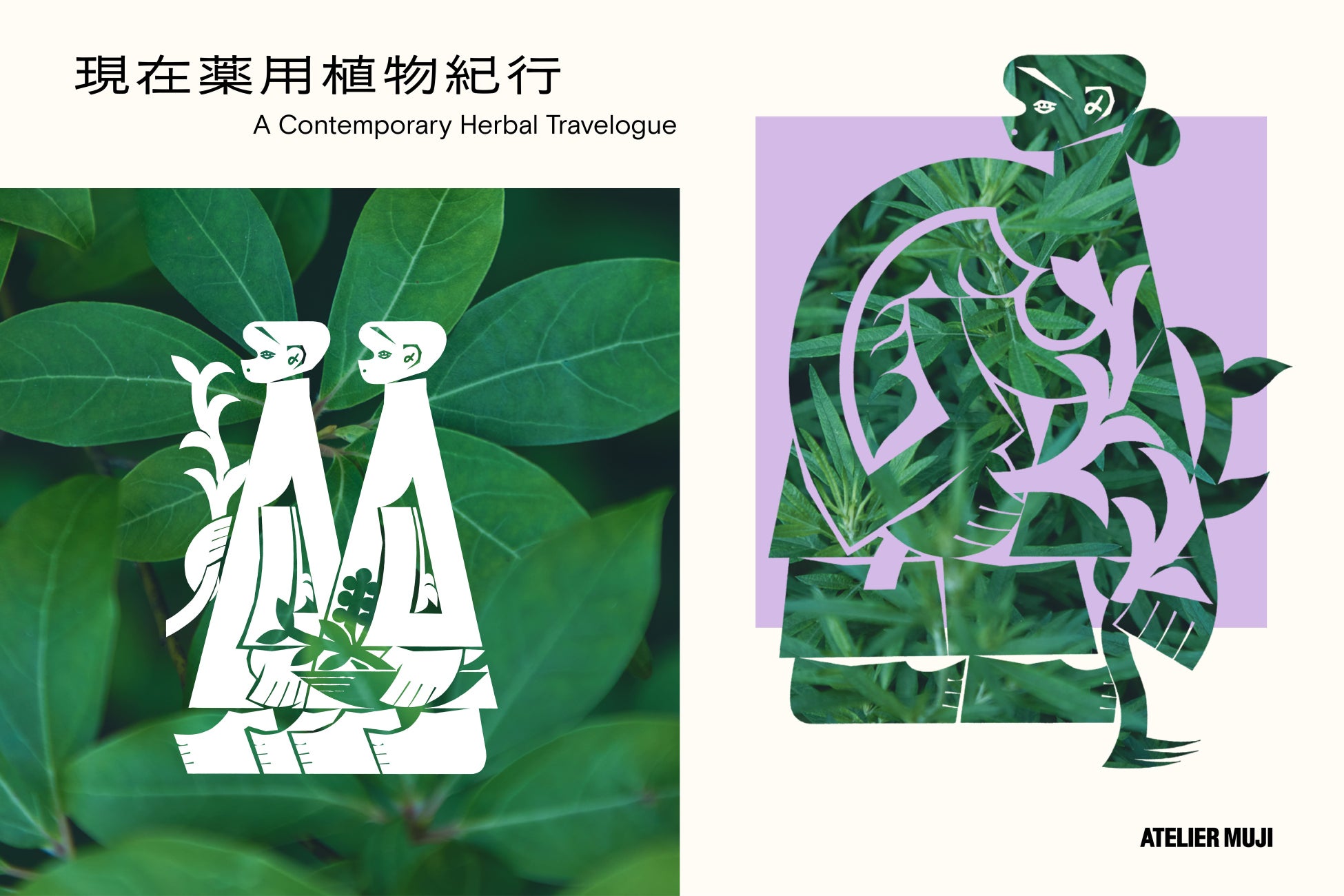
Against a field of white, photographs of leaves sit beside small figures carrying plants. A neighbouring panel pairs a person wrapped in greenery with a plane of violet. The title A Contemporary Herbal Travelogue seems to lift medicinal plants out of a list of effects and return them to the space between people and place. Now at ATELIER MUJI GINZA, the exhibition brings together medicinal plants from all 47 Japanese prefectures, travel records and inherited forms of handwork.
Returning plants to 47 places
Gallery 1 presents living or material examples of medicinal plants from across Japan alongside records from their regions. Medicinal-herb researcher Lyie Nitta, who supervised and helped plan the exhibition, travelled the country to meet growers and people who carry local practices forward. Rather than collecting names alone, the exhibition asks where a plant grows, whose hands tend it and how it has remained part of a particular way of life.
The phrase medicinal plant almost immediately prompts a question: what is it for? In front of the plant itself, however, the first things visible are the thickness of a leaf, the posture of a stem and the colour of a dried surface. A name and a use may fit on a small label. Add the place where it grows, the season of harvest and the labour of drying, and the plant no longer offers a short answer. The exhibition is compelling because it does not hurry that answer.
North and south, coast and mountain village give different meanings to a familiar plant. Some grow wild, some are cultivated, and others survive through regional work. Forty-seven is not merely a number of local specialities. It opens onto more than 47 tempos of attention between people and plants. Comparing form as one might compare specimens, while holding landscape and handwork beside it, brings the herb closer to kitchen and roadside.
Human hands remain in the journey
A second axis of the exhibition is Nitta’s journey and the conversations gathered along the way. The figures in the key visual carry leaves and branches through a field of plants. They suggest more than a moment of discovery: meeting the person who grows a plant, the person who processes it and the person who knows when the season is right, then carrying those words home with the record.
The journey photographs move from hands working among green growth to a snow-covered waterside and a cup of herbal tea. Abundant green is not the only landscape of herbs. There is a season of snow, a period of drying and a sequence of preparation before drinking. By refusing to fix a plant in one image, the exhibition makes the word travelogue concrete through climate and procedure.
A book bearing the exhibition’s title has also been published. It introduces herbs encountered on the journey and people who have kept them within daily life. Open it after seeing the plants and the outline of a leaf becomes less a diagram of knowledge than an entrance to time spent growing, choosing and passing it on. Exhibition and book form a route back and forth, allowing one plant’s background to remain in view for longer.
Looking again before bringing something in
Gallery 2 introduces seasonal handwork and contemporary practices that connect medicinal plants with present-day life. It is important not to turn the exhibition into a source of self-directed treatment. Plants can require care according to constitution and use, and the gallery is not offering individual medical advice. What RareDex takes from it is not a quick chart of effects, but a way to see a familiar name again within land and labour.
To bring plants into daily life often sounds like adding something new. This exhibition points instead toward returning attention to what is already nearby. When does it emerge, who gathers it, how is it kept, and in what setting has it been used? Before use comes waiting for the season, recognising condition and respecting the people who have carried the knowledge forward.
The exhibition runs through November 23. After looking across specimens and travel records from all 47 prefectures inside a Ginza building, a planted verge or a leaf on the table may sit at a different distance. A medicinal plant is neither an exotic material nor a tool reduced to a result. It is a relationship among place, hands and season. Taking time to see that relationship may be the quietest thing to carry back into contemporary life.