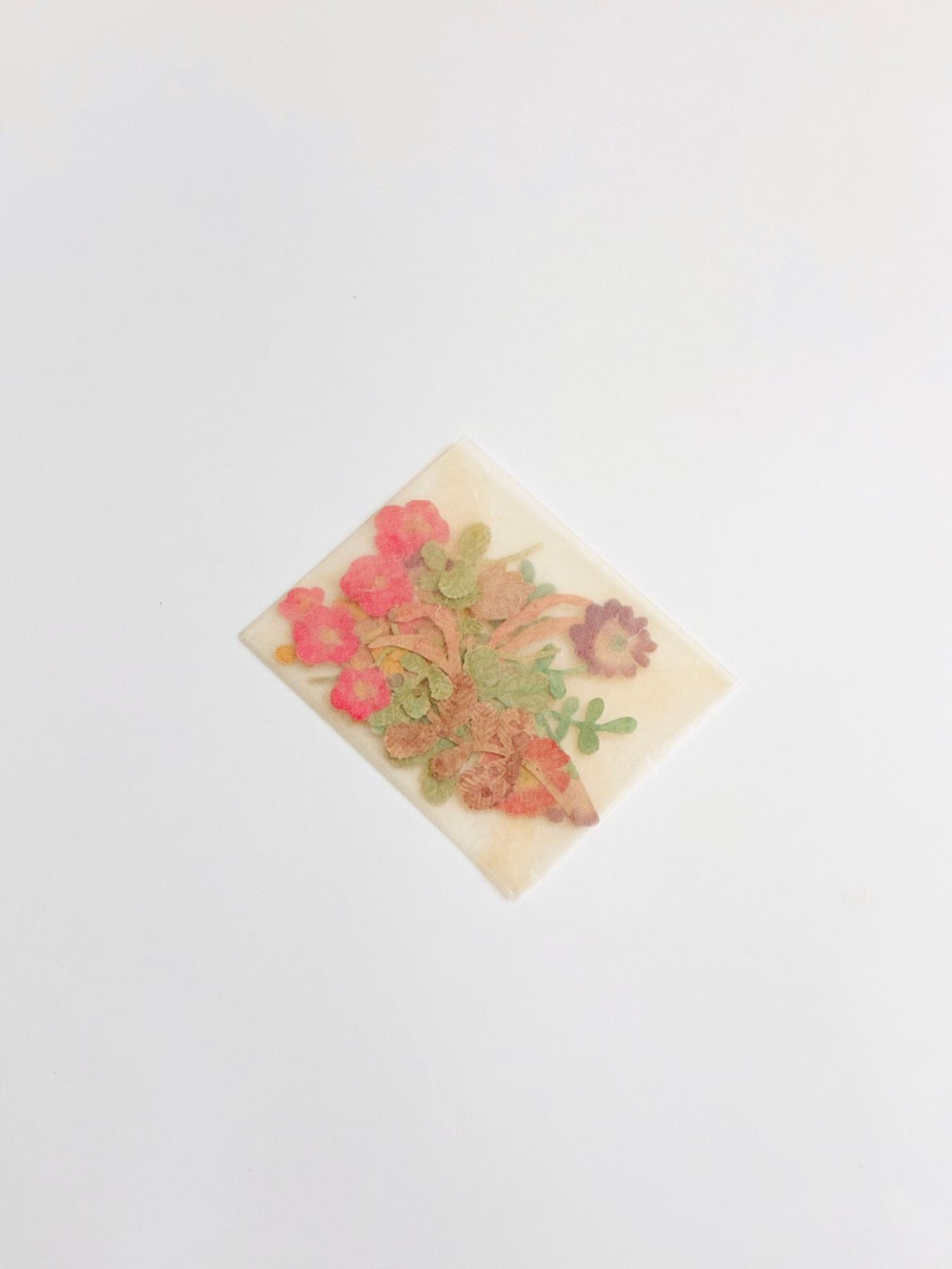
When giving flowers, we may remember the bend of a stem or the overlap of leaves before a name or symbolic meaning. In Fumi Imamura’s Flower Language, opening at Shibuya PARCO on 30 October, a single bloom is painted in watercolour, cut along its botanical outline and suspended on translucent glassine paper. It is neither a fresh flower nor a pressed specimen. Yet it carries something of the distance held just before a flower is handed to someone.
Like a pressed specimen, without being one
Imamura has long worked primarily with flowers and plants, using watercolour collage as well as encaustic, in which pigment is mixed with beeswax. For the new Flower Language installation, she paints on translucent glassine and cuts the form free along its outer edge. With the conventional background removed, details resembling branch, leaf and root hold a thin pocket of air between paper and wall.
The red work used for the exhibition image does not explain a species like a botanical plate. Its red branches and leaves spread upward, while lines below loosen like roots. Even the small pins holding the paper remain visible, keeping plant form and the labour that supports it in the same view. The invitation is not to identify a name, but to notice where the sense of a plant begins.
Choosing one flower becomes part of the work
The title begins with the idea of sending a flower in place of words. Selected single-flower works from earlier installations will also appear, and each purchased piece is placed in a glassine envelope. A visitor chooses one flower, then decides whether to pass it on or bring it into their own space. That movement allows the work to continue beyond the gallery.
A bouquet opens, changes scent and eventually has to be undone. A paper flower does not wilt, but its mode of presence is not fixed. It can be framed, kept in a box or placed in a drawer. Moving between visible and hidden positions gives it a different intimacy from a fresh bloom.
That flexibility does not reduce the plant to decoration. The edge of the thin paper is not a perfect contour; it carries slight irregularities from cutting and handling. Following a fine vein or root shifts attention from colour to structure, and from the whole image to the reach of a hand.
Meeting a stored flower again
The exhibition also introduces Imamura’s first art book, A Warm House. Its 112 A4-format pages carry Japanese and English text, moving works from the wall into the sequence of a book. Separate from choosing one flower in the gallery, it offers a way to look across multiple works and reconsider how botanical forms have connected over time.
During the same period, Imamura is also included in Seeds and Roots: The Ways We Cultivate Cities at Tokyo Opera City Art Gallery. A broad question about how plants are seen in the city and the small gesture of choosing one flower in Shibuya occupy separate but neighbouring contexts. It is a moment when her current practice can be read beyond a single solo exhibition.
Flower Language runs through 23 November at OIL by Bijutsutecho Gallery, from 11:00 a.m. to 9:00 p.m., with free admission. Online sales are scheduled from 4:00 p.m. on 9 November, though availability and conditions may change. In the gallery, it is worth looking past red, yellow or green to the instant when one line becomes stem, leaf and loosened root. The chosen flower may carry not a substitute for words, but the shape of someone’s attention.