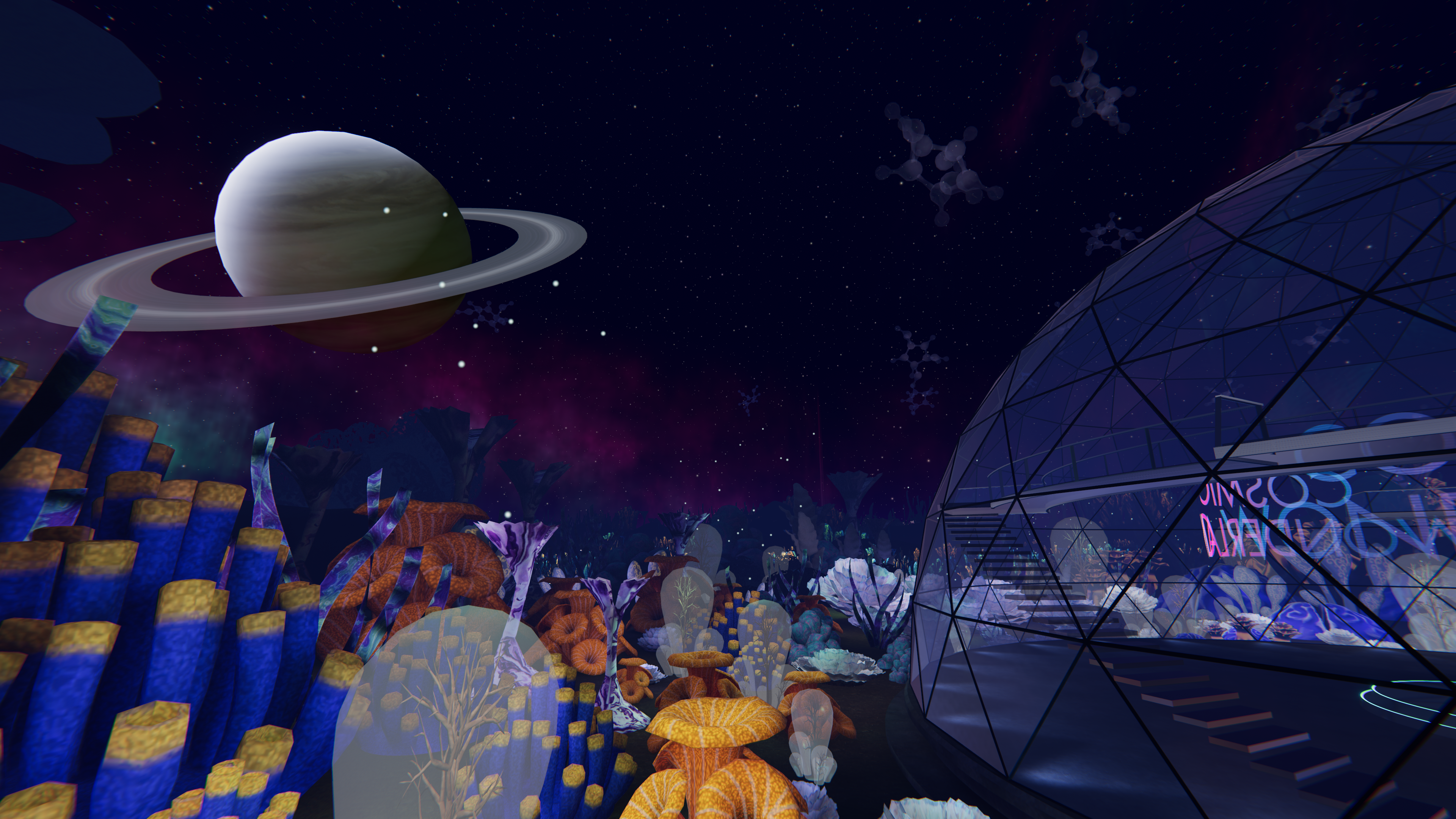
Roots leave the ground and flower-like organs hover in a dark interior. Cosmic Wonderland, an official VRChat world by plantica, arranges twenty-four plants that do not exist as a botanical garden on an unknown planet. A listening event will accompany its public opening on 23 October 2026, inviting visitors to walk through ambient sound. This is not a catalogue of rare species. It is an opening question: if the environment changed, how far might the form of a plant change with it?
Reading an environment backwards from form
“Imaginary plants” could easily become a licence for decoration without consequence. What makes Cosmic Wonderland more interesting is the question that follows each silhouette: what kind of environment would require this form? Does a narrow structure reach because light is distant? Does a thick surface protect against dryness? According to the official description, each plant has an imagined habitat and morphology on the unknown planet. These are not scientific species descriptions. They form a speculative field guide for reconnecting shape with growing conditions.
Gravity in the world is set to one fifth of Earth’s, allowing avatars to jump high. A plant can be seen from above, then from underneath. The viewing height fixed by soil and pots in a physical garden is temporarily removed. The undersides of leaves, the direction of roots and the spacing within a colony all become visible, while the idea of a single “front” begins to loosen. Low gravity is theatrical, but it is also a device for reading plant-like form from another angle.
Moving between catalogue and landscape
The world is divided into four zones: CORRIDOR, HALL, TRAIL and LAB. Visitors encounter plants within broad scenes, then use the LAB’s Japanese and English panels and catalogue to examine the settings of all twenty-four species. You may read first and look afterwards, or be drawn to a shape before returning for its name. Like a label in a botanical garden, the information need not close the landscape with an answer. It can become a reason to revisit the plant.
plantica planned and produced the project, with creative direction by Takashi Kimura, artistic direction by Shigetoshi Furuya, and world direction and production by V Inc. plantica has long moved flowers into spatial design, fashion and products. Here, the work does not try simply to reproduce the texture of cut flowers. It turns instead toward lines, repetition and patterns of gathering that make an invented organism feel botanical. Because there is no physical specimen, the experience leaves a useful question behind: what did we see that made us call it a plant?
Sound changes the pace of the path
An opening listening event is scheduled from 8:00 to 11:00 p.m. JST on 23 October, the day of the public release, with music by Yusuke Shioya. It will take place in a Group Public instance of the official group; joining the group is not required. Capacity is limited, and the event itself is listed as PC-only. Anyone planning to attend should check the official group and world pages on the day for the latest conditions.
Sound changes the speed at which plants are seen. Leave the sequence of explanatory panels and stay beside one organism through a sustained tone: the overlap of leaf-like surfaces and the distances between floating organs begin to register. The same question can travel back into physical life. Consider the angle of a leaf at the window, the gap chosen by a root, or the thickness stored by a dryland plant. Ask what environment made a familiar form, and the imaginary garden connects quietly to an everyday pot.