At four on Friday afternoon, the first phase closes at Nihombashi Takashimaya. The following morning, the second phase begins and the same hall turns toward a different set of flowers, branches and vessels. The 107th Sogetsu Ikebana Exhibition, Ikeru. Ikiru. (To Arrange. To Live.), runs from October 21 through 26 and plans 512 works across the headmaster’s contribution, collaborative pieces and individual works. More revealing than the size of that number is the decision not to show everything at once. Dividing the exhibition into two phases makes clear that plants are not fixed components of a finished object; they produce an expression that exists for a limited time.
One night between two phases
The first phase runs from October 21 to 23 and the second from October 24 to 26. Doors open at 10:30 a.m.; the first phase ends at 4 p.m. and the final day at 6 p.m., with last admission thirty minutes before closing. Arrive one day later and the works encountered under the same exhibition title will have changed. The announced total of 512 covers the complete run, not one immense assembly meant to be seen in a single visit.
Ikebana uses cut plant material yet remains answerable to weight, moisture and the direction of light. A branch bends, the two sides of a leaf respond differently to illumination, and a flower opens. The change from the first phase to the second is more than an operational reset; it can also be read as a structure that renews the expression according to plant time. That is RareDex’s interpretation of the official programme, but it follows directly from the exhibition’s two-part form: here, “finished” lasts for less time.
A visitor beginning with the second phase need not search for a reconstruction of the first. Choose one work and follow where its plant material rises, how it crosses the rim of the vessel and where it leaves open space. In an exhibition with so many works, counting them is less useful than pausing at the moment when one stem or one leaf determines the direction of the surrounding air.
Another hand enters the history of a vessel
In a special area, Sogetsu members arrange flowers in ceramic and glass vessels made by headmaster Akane Teshigahara. The separation between the hand that shaped the vessel and the hand that selects and places the plant material is compelling. The weight of clay, the colour of a glaze, the transparency of glass and the width of an opening establish conditions before any stem arrives. A second maker then uses flowers and branches to turn the vessel from a completed object into a place that can receive another decision.
With clay, will a thin stem answer the vessel’s mass, or will a heavy branch press against it? With glass, will water and stems remain visible, or will leaves interrupt the transparency? The official material does not explain every pairing in advance. That leaves room to look first at balance: whether vessel and plant material lean in the same direction or seem to resist one another.
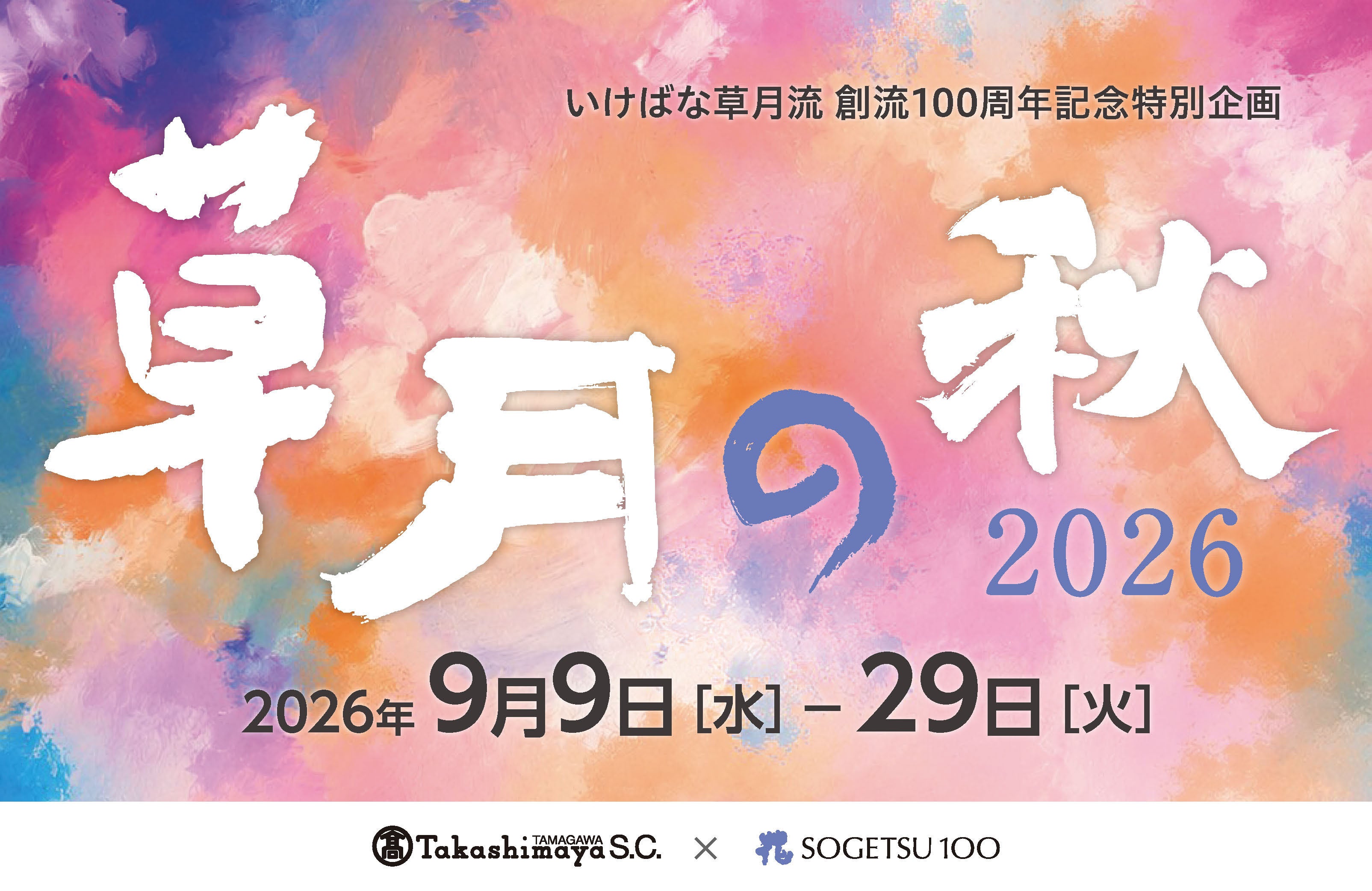
A related special display is installed on the first floor from October 14 to 26. Seeing it before going up to the eighth-floor hall—or returning after the exhibition—allows the distance made by plants to be compared between a department-store passage and a dedicated exhibition space. The image used here is not a photograph of the hall. It is the official main visual distributed for the 107th exhibition. Rather than presenting a photograph from a previous year as the current scene, it identifies this edition through type and colour alone.
A first exhibitor stands at the edge of a century
The theme Ikeru. Ikiru. is positioned just before Sogetsu’s centenary in 2027. The school was founded in 1927 by Sofu Teshigahara. Yet an exhibition with such a long history also includes places for first-time exhibitors. The language of an approaching hundredth year is not reserved for established names; it is handed to people placing plant material in public for the first time.
A debut work may not arrive with a long explanation or unusually large materials. Still, choosing a vessel, cutting one branch and deciding which side faces forward all contain the time a person has spent with plants. The announced total of 512 is sustained not by repeating one form, but by separate hands accepting separate moments of uncertainty. With first exhibitors and the headmaster’s vessels inside the same exhibition, tradition begins to look less like a completed style and more like a system for passing decisions forward.
The 107th exhibition remains at the eighth-floor hall of Nihombashi Takashimaya S.C. through October 26. General admission is ¥1,000, while university students and younger visitors are listed as free. From October 24, there is no need to consume the number of works quickly. Look instead at the mouth of a vessel, the point where a branch turns, and the angle that reveals the underside of a leaf. Return to the first-floor display afterward and the flowers will occupy another distance. What changed between the two phases is not only the work, but the order in which a viewer moves closer to plants.