Look obliquely across the deep-green leaves and a blue sheen rises between the veins. Return to a frontal view and the blue is no longer an even field of colour; it dissolves back into green. The leaves of Begonia pavonina are not painted with a blue pigment. Their iridescence appears and disappears with the viewing angle, revealing something about how a forest leaf receives weak light.
Blue returned from layers inside the leaf
Near the leaf surface are specialised chloroplasts known as iridoplasts. Inside them, the photosynthetic thylakoid membranes form fine, regular layers. The blue is light reflected by this multilayer structure. Unlike paint, which returns a similar colour from many directions, the effect becomes strong only when light and viewpoint align.
A 2016 Nature Plants study measured this optical structure. It showed that the layers reflect blue wavelengths while increasing the capture of green light, which is more available on a shaded forest floor. Under very low light, the quantum yield of photosynthesis was 5–10 per cent higher than in ordinary chloroplasts. The decorative blue and the work of gathering light belong to the same leaf.
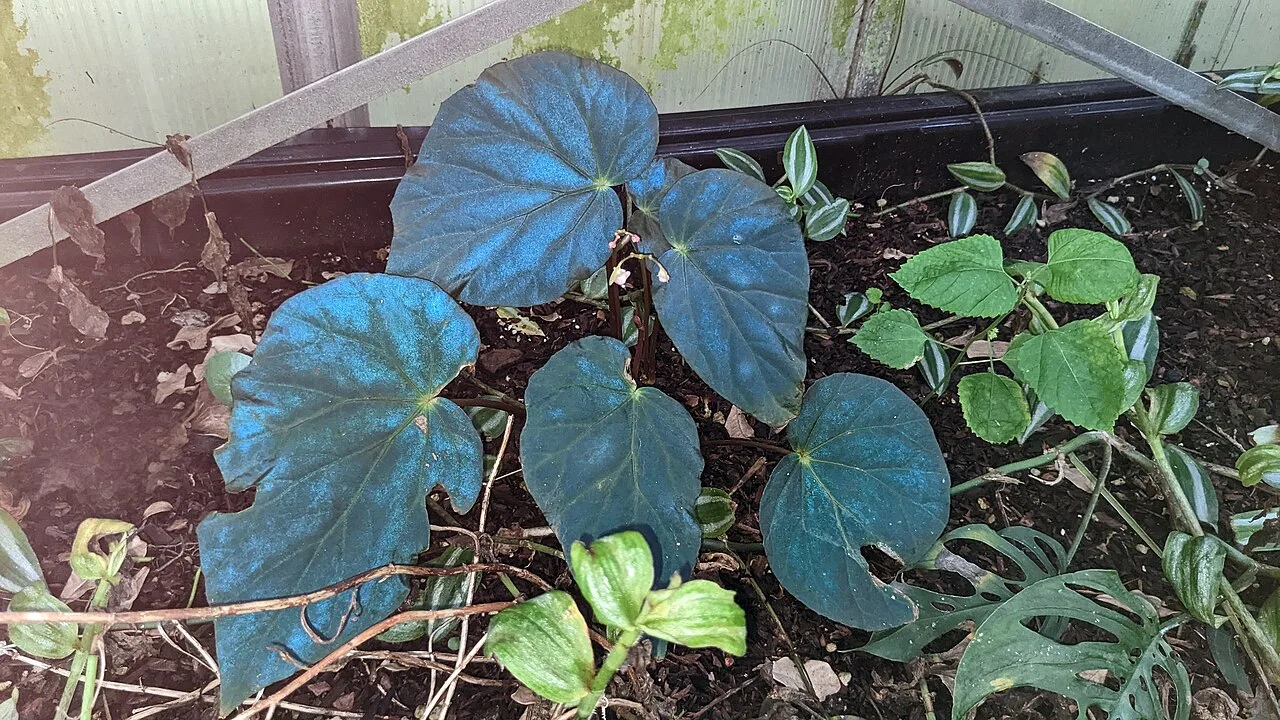
In the photograph, blue does not cover the entire leaf. Its intensity changes from one vein-bounded surface to another. The plant need not move: a small shift by the viewer changes where the reflection appears. Looking at a blue begonia is less a matter of confirming a colour than finding the angle between leaf and light.
A leaf shaped by weak forest light
Kew records Begonia pavonina as a rhizomatous plant native to Peninsular Malaysia. Gardens by the Bay places it on the moist, cool and deeply shaded floor of montane forest. Its broad, asymmetric leaves did not evolve as signs made for full sun; they have worked beneath the small portion of light that passes through a canopy.
The University of Bristol team also observed that leaves developed their blue sheen in near-dark conditions and slowly lost it in brighter light. The strength of the blue, however, is not a complete measure of a pot’s health. Growing conditions, leaf age and viewing angle all intervene. The colour is better treated as one expression of a leaf responding to light than as a single instruction for watering or placement.
This reverses a familiar assumption that more light must make an indoor plant’s colour more vivid. The leaf is not painted blue by brightness. Microscopic layers that help it work with weak light happen to return blue to the eye. Begonia pavonina becomes most compelling where appearance and adaptation are not separated.
Change your position in front of the pot
To photograph the blue, adjust the light and camera position before increasing saturation. A leaf that reads as green head-on may return a metallic blue from the side. In the Commons photograph used here, not every leaf carries the same blue. Reflective and deep-green surfaces share the frame, making clear that structural colour is not a fixed pattern.
The image shows a cultivated plant photographed in 2022 and released by Cs california under CC BY-SA 4.0. It is not a record of the species’ current wild habitat, but it allows blue reflection, asymmetric leaves and the spreading rhizomatous form to be compared in one frame. In front of a living plant, moving your own position rather than handling the leaves is also the gentler way to find the effect.
As the angle of window light changes from morning to evening, the same pot can show blue differently. The point is not to make today’s leaf bluer than yesterday’s, but to notice where the reflection begins. A Begonia pavonina leaf is neither only green nor only blue. It continues to make colour in the space between weak light and the moving eye.