The jelly-clear tips are not decoration. Turn a Haworthia cooperi toward the light and brightness seems to pass through each leaf “window” and settle inside. This small South African succulent forms a rosette close to the ground, transforming the end of a leaf into an entrance for light. To look at its translucence is to see not only the plant’s outline, but part of its interior design.
Only the tip is translucent
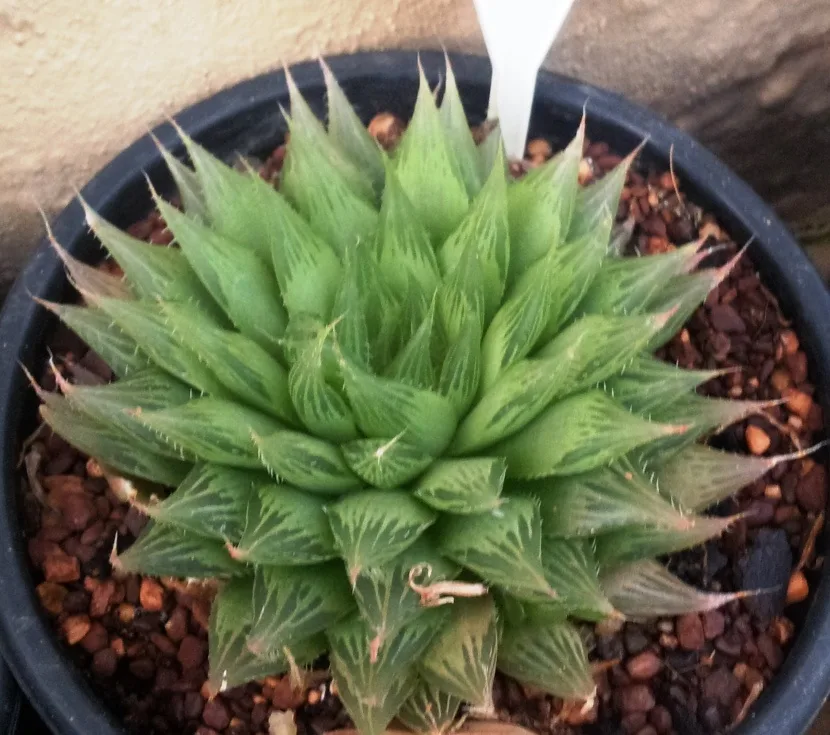
Haworthia cooperi is a perennial succulent native to the Cape Provinces of South Africa. Short leaves radiate from the centre to make a small rosette close to the ground. Each blue-green leaf swells toward its tip, where the rounded end becomes translucent. In the photograph, a pot full of offsets shows dark veins inside every window, like the frame of a small piece of glasswork.
Gardeners call this translucent area a leaf window. It is living leaf tissue, not an opening. Compared with the more strongly pigmented tissue around it, the window admits light and provides a route into the leaf. Seen from above, the plant looks like a cluster of rounded beads. From the side, the clear tip resolves into a thick green leaf below.
Leaf windows do not take one shape across Haworthia. Some species look as though their tips have been cut flat; others present a triangular pane. H. cooperi swells into a rounded, drop-like tip, so its veins do not sit on a flat surface. They follow a curve and gather toward the centre. Before naming a species, it helps to ask whether those lines cross a plane or wrap around a volume.
If translucence is treated only as a dramatic cultivar trait, half the structure disappears from view. Follow the vertical lines across the window, the haze between them, and the boundary where the tip returns to green. A single leaf holds an exterior view and a glimpse inward. Rotate the pot slightly and the lines change weight and overlap because the window is a volume, not a printed pattern.
Light enters the window and spreads inside
In the wild, some windowed Haworthias keep much of the leaf close to the soil among sand and stones, exposing the tip toward the light. They do not need to lift a tall stem to bring light into the leaf. Their low profile can look withdrawn, yet it also places a limited entrance where light can reach it.
A 2008 study of the related windowed species Haworthia truncata measured strong scattering inside its thick leaves; in places, internal light levels exceeded the incident light. Light entering a window did not fall as a single beam. It spread through the leaf and changed the light environment around photosynthetic tissue. That result gives a useful way to read the rounded window of H. cooperi: not as a transparent cap, but as a structure that distributes light through depth.
The two studies do not simply cancel each other. Mapping light inside a leaf and measuring how much carbon dioxide a plant takes up operate at different scales. A route for light can be observed while its effect still depends on light level, leaf position, hydration and the period measured. When a clear tip prompts the question “why,” resisting a quick one-to-one answer between form and function keeps the observation open.
The window should not, however, be reduced to a device that simply “boosts photosynthesis.” A separate experiment published in 2000 did not find that light entering through leaf windows increased net photosynthetic rates under its test conditions. Changing the route of light and increasing the performance of the whole plant are not the same claim. Alongside its visual beauty, the window retains a question that science has not compressed into a single slogan.
A window reveals the height of the rosette
Abu Shawka’s photograph shows a cultivated plant, not a wild habitat. Even so, it clearly shows the windows occupying the highest points of the leaves while opaque green tissue descends below. Younger leaves stand upright in the centre and older leaves open lower around them. The rosette gathers windows of different sizes into a shallow vessel facing the light.
The windows do not sit at one height within a plant. Small, tight leaves overlap in the centre; mature leaves push rounded tips around them; older leaves open lower toward the rim of the pot. From above, the windows look like a field of points. From the side, they become layers of time. In a clump, parent and offsets place several rosettes together, multiplying those small light-facing surfaces.
When looking at a plant in hand, follow not only how clear each window appears but also the height at which each leaf receives light. Vein shadows change between morning and evening; the same tip can look milky from one angle and transparent from another. A photograph taken at leaf level, as well as from above, records the thickness continuing beneath the window.
The appeal of Haworthia cooperi is not translucence alone. One leaf holds clear and green tissue together, making a route for light within a body that stays close to the ground. Look into the windows and the rounded beads above the pot become a small architecture that includes the space inside every leaf.