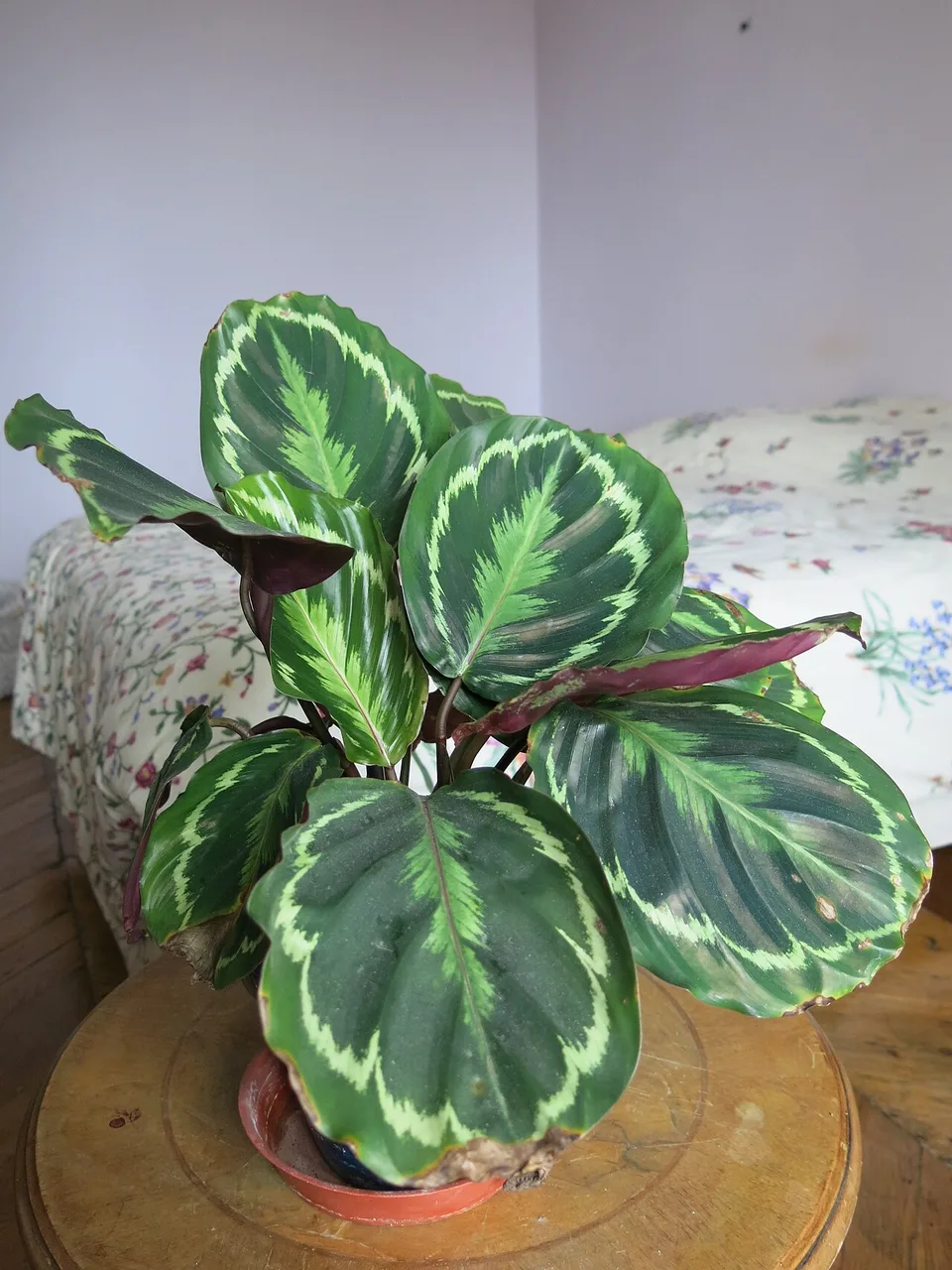
Towards evening, the leaves of Maranta leuconeura begin to lift. Blades that sat almost parallel to the floor by day stand higher at night, revealing undersides washed with purple. The pose inspired the name prayer plant, but the more useful detail is the changing angle. Compare the same leaf morning and night and a daily rhythm appears inside the pot.
A daytime plane becomes a vertical line
Maranta leuconeura is native to the wet tropics of central and eastern Brazil. Indoors it spreads sideways, layering patterned oval leaves. NC State Extension describes leaves held parallel to the ground by day and moving into a perpendicular “prayer” position at night.
Not every leaf reaches the same angle. Young, old and window-facing leaves may travel through different ranges. Instead of searching for a perfectly arranged plant, choose one leaf you can identify by its veins or a small mark and follow that leaf.
A quiet bend begins at the base
Reversible leaf movements of this kind involve a swollen motor organ at the base of a blade or petiole called a pulvinus. Plant physiology research shows that shifts of ions and sugars can move water through pulvinar motor cells. The resulting change in turgor bends the organ without requiring new growth.
The finest details of cell-wall mechanics have mostly been studied in legumes and other plants, not proven point for point in Maranta. It is safer to keep the claim modest: a swollen joint at the leaf base supports a reversible, water-dependent movement, while species can differ in how that movement is built.
Darkness is not a single switch
The nightly rise is not merely a one-off reaction to a dark room. A day–night rhythm and cues from light work together. The leaves do not all close the instant a lamp goes off; their angle can begin shifting through the evening and open again with morning light.
One quiet night therefore does not establish a problem. A recently moved pot, a cold draft or a change in how the medium dries can all make the pattern less even. Only when time and conditions are recorded together does the plant’s usual range become visible.
Separate a praying leaf from a wilting one
During a healthy nightly movement, a blade may stand upright while keeping its firmness, then open again from morning into the day. Drought or root trouble tends to bring other signs: a limp petiole, curling margins, fading colour, very dry medium or a pot that remains saturated.
Do not water because of the upright angle alone. Feel below the surface, lift the pot, check drainage and note the firmness of the leaf. Bright indirect light, warmth away from sudden drafts and medium that does not dry out completely create a steadier background for observing its daily movement.
Photograph one leaf at three times
Three frames are enough: morning, evening and before bed. Keep the pot and camera in place, then identify one blade by its veins or markings. Add the time, the previous watering and how moist the medium feels. The sequence helps distinguish a change towards light from the return of a daily angle.
At night, a Maranta leaf seems less asleep than newly outlined. Follow the same blade until it opens again and the plant’s day becomes visible in a way its pattern alone could never show.