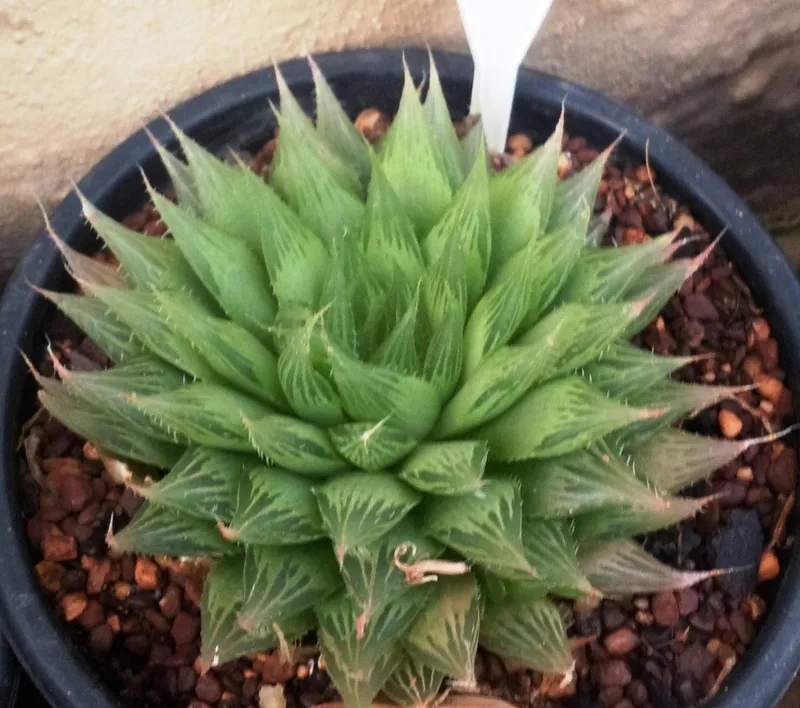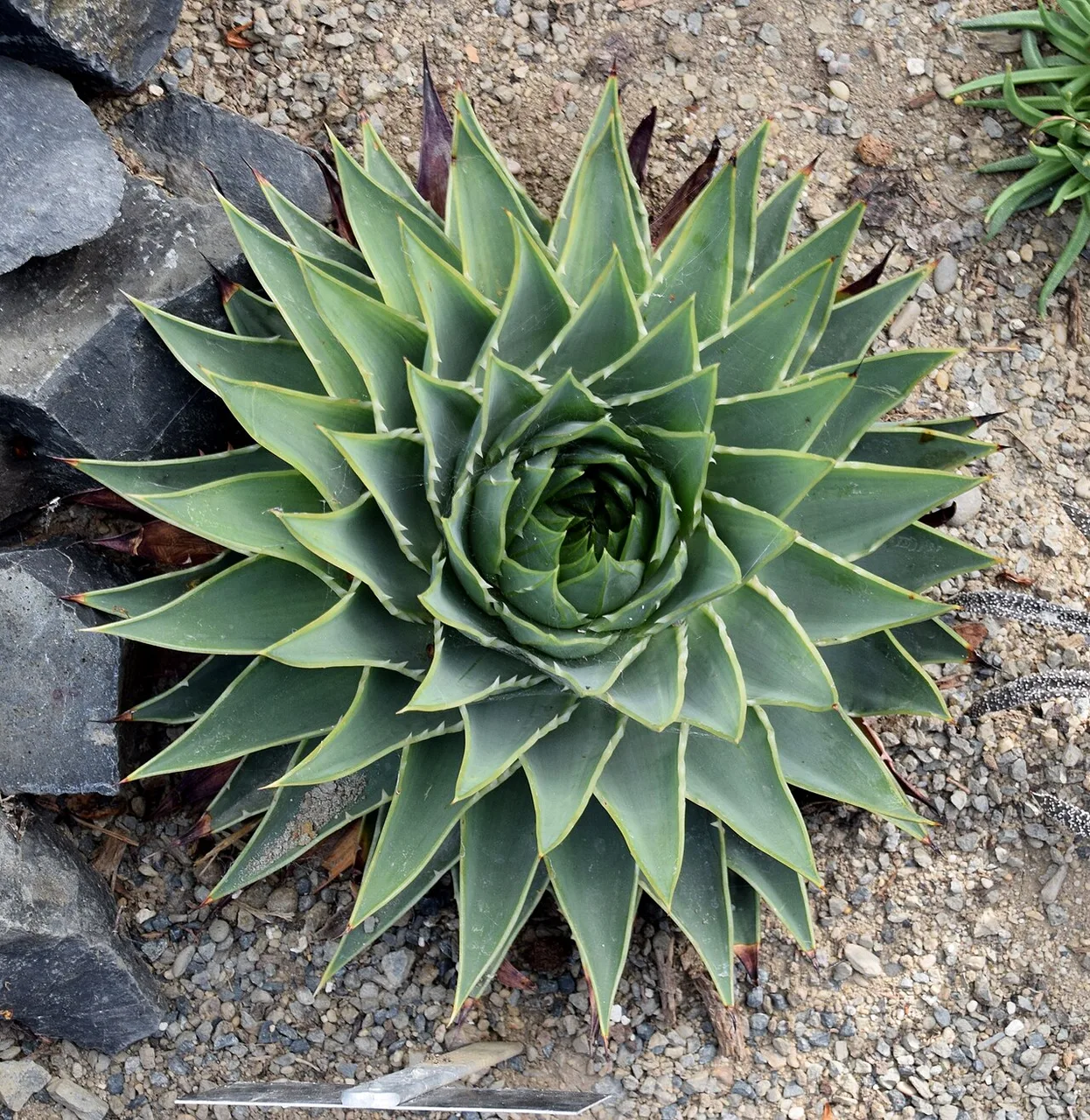
Seen from above, grey-green leaves overlap as if they are being drawn into the centre. The spiral of Aloe polyphylla may turn clockwise or anticlockwise. Neither direction is the correct one. About 150 leaves hold their places in five ranks as they grow outward, giving each plant its own orientation. The eye travels from the centre to the rim before the pot itself has made a turn.
Five ranks, one spiral
Each leaf is broad, pointed and fleshy. White to pale-green teeth line the margins, and the terminal spine is brown. The Royal Horticultural Society describes the pronounced spiral formed by these leaves. Movement comes not from making a single leaf extravagant, but from repeating similar forms with a small shift between them.
PlantZAfrica, published by the South African National Biodiversity Institute, explains that five ranks form the spiral, with 15 to 30 leaves in each. A plant carries about 150 leaves in all. The name “polyphylla” also means many-leaved. The number is less a test of completion than a way to imagine the time required for repeated leaves to become one large outline.
The spiral may run clockwise or anticlockwise. When comparing plants or photographs, guessing the direction matters less than looking at the spaces between leaves, the condition of the growing point and whether the rosette has collapsed to one side. The order created by repetition remains visible without assigning a geometric label first.
A high landscape of mist and snow
This ordered form does not come only from a hot, dry lowland. Kew records the native range of Aloe polyphylla in the Maluti Mountains of Lesotho. Cambridge University Botanic Garden places it at roughly 2,000 to 2,500 metres, where winter brings snow and temperatures below freezing and mountain mist is common.
PlantZAfrica describes high-altitude grassland, steep slopes and cracks in basalt. Rain may be abundant, yet a slope and a rock fissure do not keep water in one place indefinitely. Cool air, mist, rainfall and drainage occur together. Reducing every aloe to a hot, arid scene leaves out half of the landscape in which this species evolved.
A container cannot simply miniaturise that mountain. The RHS starts with sun and free-draining soil, moderate water in growth and still less in winter. Its H2 hardiness rating also warns against freezing, but one temperature figure does not reproduce a highland climate. Avoiding trapped heat and persistently wet compost while watching how light and air move through the room is the more useful boundary.
Choose the form with its provenance
The force of the spiral has made Aloe polyphylla a collectors’ plant. PlantZAfrica also records declining wild numbers and illegal removal, while Cambridge University Botanic Garden names climate change and illegal collecting among its threats. Choosing only for rarity can separate the form from the mountain population that made it possible.
If you bring one home, look for a cultivated or propagated plant and a seller who can explain its provenance. Avoiding roadside or uncertain material does not diminish the pleasure of collecting. It keeps the question of clockwise or anticlockwise from being answered at the cost of a wild plant. With a young plant, the completed spiral need not be rushed; the unfolding of new leaves is part of what is being kept.
The photograph here was made in 2017 at Dunedin Botanic Garden in New Zealand. From almost directly above, it holds the ranks of leaves and the direction of the centre in one frame. Gravel and stone remain visible around the cultivated plant, so the spiral reads as a gathering of living leaves rather than a detached diagram.
Move your gaze from the centre to the edge, then look from the side at the thickness of the leaves. Right and left, order and growth, high mountain and interior room: moving between these pairs turns the spiral into more than a sign of rarity. It is the record of many leaves joining the same plant over time. Choosing that provenance with the form is the first tactile act of collecting Aloe polyphylla.