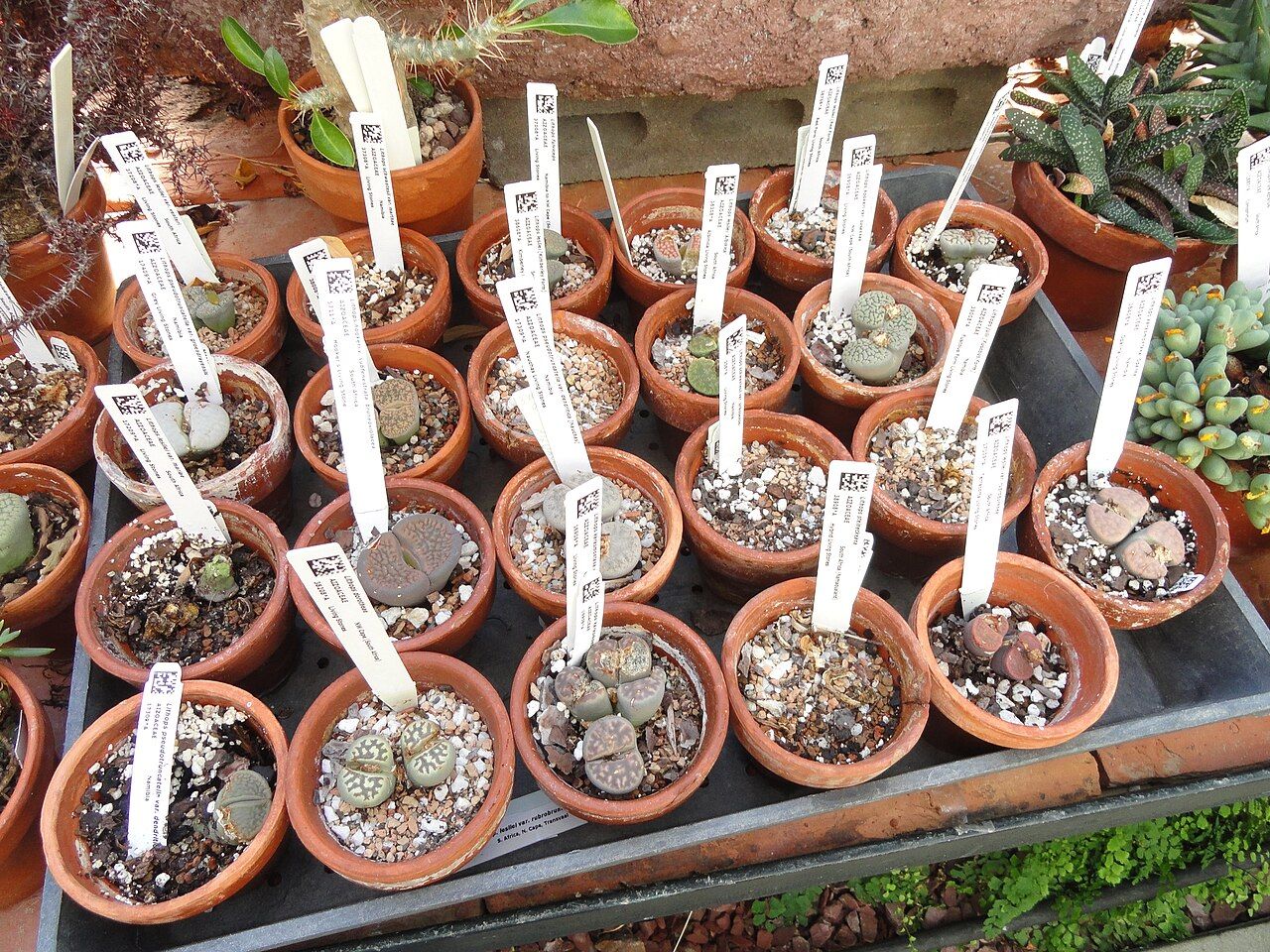
Grey, green and brown pebbles seem to cover a row of small pots. A closer look reveals that each one is a plant formed from two leaves. From 14 to 20 September 2026, the University of Latvia Botanical Garden is presenting “Supersukulenti – dzīvie akmeņi” (“Supersucculents – Living Stones”) in its Palm House in Riga.
The stone is a pair of leaves
Lithops are small succulents in the ice-plant family. The rounded body visible at ground level is made from two swollen leaves. They are joined almost to the base, while new leaves and a flower can emerge through the fissure between them.
The upper surfaces carry translucent patterns, lines or spots. According to the South African National Biodiversity Institute, these “windows” admit light into the leaf, where internal cells photosynthesise. Their colours and markings also blend with dry, stony ground.
A single flower rises from the gap between the leaves. Seed capsules open when they become wet, and raindrops disperse the tiny seeds. The plant stays low and closed for much of the time, then shows its movement when light and rain arrive.
Living stones extend beyond one genus
The exhibition’s “living stones” are not limited to Lithops. It brings together ice-plant relatives including Aloinopsis, Conophytum, Fenestraria, Frithia and Pleiospilos, alongside cacti and desert roses.
Kew’s Plants of the World Online recognises 38 Lithops species. The genus is native to southern Africa across Botswana, Namibia and South Africa. The leaf windows, lines and colours differ even though all share a stone-like outline.
The displayed plants have been raised by enthusiasts from the Latvian Cactus and Other Succulent Society, with a small number also offered for sale. The compact show places Lithops beside plants that have met similar dry conditions with different forms.
A low body on dry ground
Wild Lithops grow among quartzite pebbles, on dry slopes and flats, and in calcareous soils. Much of each plant remains below ground while only the top of the leaves is exposed. This form admits light while the thick leaves hold water in an arid setting.
Their popularity in cultivation also creates pressure on wild plants. Kew warns that illegal collecting for horticultural trade is pushing some species towards extinction. A plant for the windowsill should therefore come from documented cultivation, not from the wild.
Check the season before adding water
The Garden recommends bright light and restrained watering. Growth and dormancy, however, do not follow one schedule across Lithops and their relatives. Before watering at a fixed interval, identify the genus or species and consider the season and the state of its renewing leaves, seeking specialist advice when needed.
The exhibition is open from 10 a.m. to 7 p.m. each day, with a collectors’ cultivation consultation scheduled for noon on 19 September. Rather than sorting each pot immediately into “stone” or “plant”, follow the leaf windows, the central fissures and the boundaries with the gravel—the living stones slowly come into view.