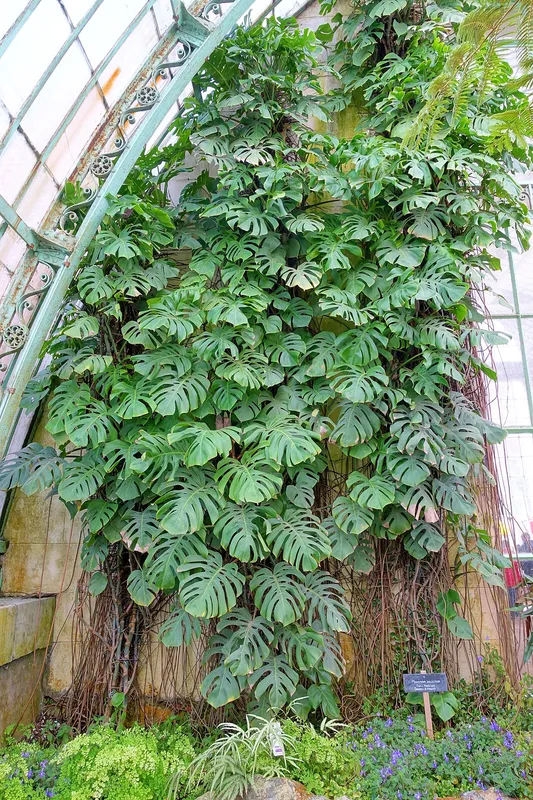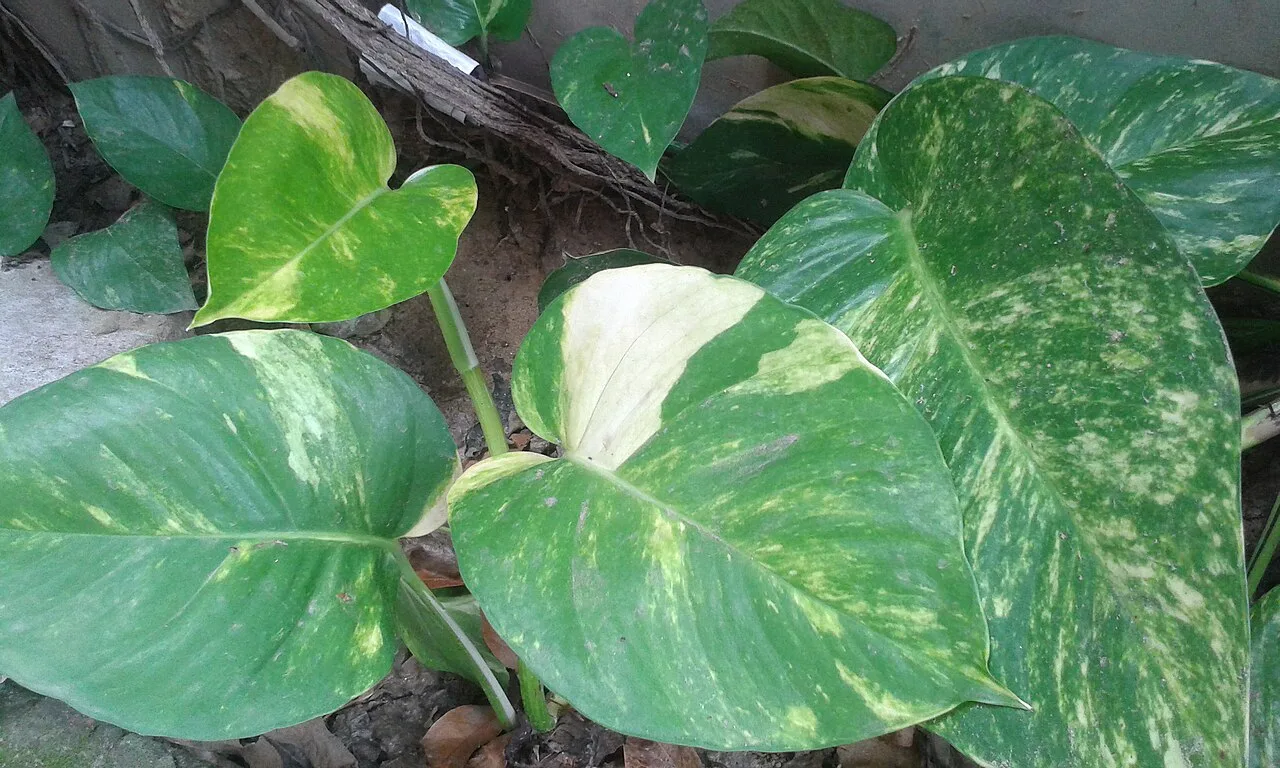
A pothos trailing from a shelf adds one small, heart-shaped leaf after another. On a plant climbing a tree-like support, the same species can make much larger leaves with deep divisions at their edges. The selected photograph holds both scales near one stem. Before cutting a vine simply because it has grown long, there is another choice: let it descend or guide it upward. What a room can change is not the plant’s need to grow, but the direction in which its next leaves open.
Small leaves are also a young form
The plant widely sold as pothos is Epipremnum aureum, a climbing member of the arum family. Plants of the World Online at Kew accepts that name, records the Society Islands including Mo‘orea as its native range, and describes it as a climber of the wet tropical biome. The glossy leaves familiar from a pot are not the only form the plant can take.
North Carolina State University Extension explains that container plants generally retain their juvenile leaf shape, while adequate light and a support to climb can lead to larger, mature leaves. Wisconsin Horticulture likewise distinguishes small juvenile leaves with smooth margins from mature leaves that become much larger, deeply divided and sometimes perforated near the midrib. What looks like two different plants can be two stages of the same species.
The photograph shows the contrast without turning it into a promise. Smaller variegated leaves sit below much larger leaves whose edges divide. Not every indoor plant will reach the same size or degree of division. Cultivar, light, temperature, nutrition, root condition, continuous support and time in active growth all matter. Adding a pole cannot guarantee a mature leaf on a timetable.
Trailing and climbing are two different designs
A trailing pothos has the lightness of overlapping leaves falling past the edge of a shelf. North Carolina State notes that container plants often hold their juvenile form and that vines can be pruned to maintain a bushier habit. If length is the concern, cuts can be made with the nodes in view, and rooted cuttings can return to the pot to add density. Trailing is not a failed version of climbing; it is a complete form built from smaller leaves.
To encourage climbing, provide a surface that aerial roots can keep contacting instead of tying the whole plant tightly. Pothos produces brown aerial roots from its nodes. Place the support on the side the vine is already approaching, then hold the stem with soft ties. Binding the petioles restricts the movement of leaves as they orient themselves. The part to support is the stem linking one node to the next.
The New York Botanical Garden notes that indoor pothos can spill from a pot or be trained onto a moss-covered pole. A support, however, is only one condition. The plant prefers bright, filtered light. It can persist in shade, but prolonged low light may weaken variegation and slow the plant. Support and light should be read separately; adding one does not substitute for the other.
Do not rush a change at the winter window
By late October, moving a plant indoors changes both light and air movement. The New York Botanical Garden advises watering only as needed through the lower-light months from October to February, while avoiding cold windows and blasts from heating vents. Keep the potting mix from drying completely, but do not preserve a summer schedule simply because the weekday has arrived. Watch the pot and the movement of new leaves together.
A long vine does not need to be forced toward larger leaves immediately. First record whether the gaps between leaves have widened, whether variegation is fading and whether nodes directed toward a support are still active. Pulling a vine upward without enough light can emphasize stretched growth rather than maturity. Preparing the position of a support now can be enough; more active training can wait for stronger growth.
Observation is just as useful when no support is added. Follow one vine through node, aerial root, petiole and new leaf. Notice where leaves became smaller and which window they face. A pruning cut then has a reason. It does not erase the plant’s climbing habit; it selects where the next branches will enter the room.
Pothos is interesting for more than its tolerance. Between the small leaves flowing from a shelf and the broad mature leaves climbing a surface, the plant makes time visible. There is no single correct answer to trailing or climbing. Separate light, season, available support and the scale of leaf you want to live with, and a long vine becomes a line from which to choose the plant’s next form.