Rearranging leaves alone will not keep a Monstera in shape for long. The more useful clues are the thick vine running above the pot and the aerial roots reaching away from it. Monstera deliciosa is a climber that naturally uses other trees for support. Reading the direction in which the plant is already trying to climb can prevent its leaves from being forced into a bundle.
The stem’s route determines support
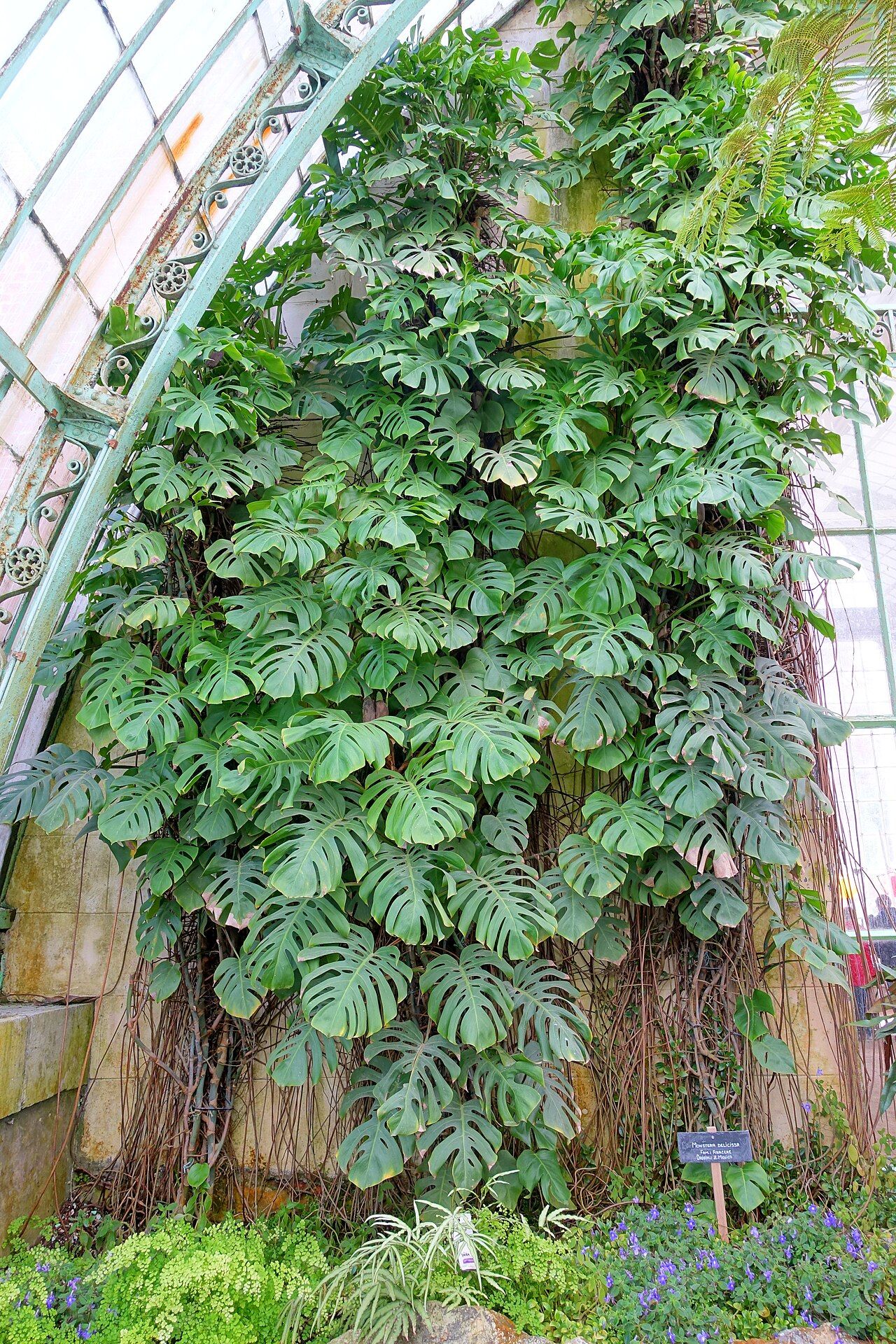
Each leaf is held on a long petiole that returns to the thicker main stem. Leaf positions repeat along that stem, with aerial roots nearby. The climbing stem is the part that needs support. Petioles continue to orient leaves toward light, so they need room to move rather than being gathered tightly.
The University of Connecticut’s cultivation guidance describes staking lengthening vines with garden stakes or mounting them on a moss pole. A moss pole imitates the porous surfaces that Monstera climbs in the wild. The material matters less than aligning the support with the existing back of the vine and the direction of its aerial roots.
The photograph shows a mature plant in Belgium’s Royal Greenhouses of Laeken. It is not a step-by-step image of a houseplant trained on a pole. It was selected to show leaves, stem, and aerial roots as parts of one climbing form; indoor size and care conditions are not inferred from the greenhouse specimen.
Let aerial roots indicate direction
Aerial roots are not merely visual clutter. They reveal the plant’s climbing habit. Place a support where existing aerial roots can meet it without strain. Following the vine’s current curve is gentler than twisting the whole stem sharply toward the opposite side.
Training does not have to be completed in one session. Leave slight space between stem and support, then reconsider each tie as new nodes extend. Keep thin petioles and unfolding leaves out of tight loops, supporting the thicker stem at a few points and checking that ties do not bite into growth.
When inserting a support, remember that underground roots are hidden. Do not force a pole through a densely rooted pot. If necessary, choose its position during repotting, while also checking that both support and container resist tipping.
Young leaf holes do not measure support
North Carolina State University describes Monstera as an evergreen climbing vine in the arum family. Its perforations and deep splits belong to mature foliage. One young leaf remaining whole does not by itself show that the support has failed.
UConn notes that leaf size typically increases once vines have attached to a support. Yet light, maturity, and root condition also shape new growth. A pole should not be treated as a universal prescription; follow several successive leaves before drawing a conclusion.
Watering remains a separate decision. UConn advises allowing the upper layer of potting mix to dry and using a well-drained medium. The surface moisture of a moss pole should not be used as the sole measure of water in the entire pot.
Support is a frame for continued observation
Leaves may not face one direction immediately after training. First check that the stem remains stable, aerial roots point toward the support, and petioles can move. Watch where later leaves open, then adjust only the positions that need it.
North Carolina State University notes that Monstera contains irritating calcium oxalate crystals and lists risks to people, cats, and dogs. Work where children and pets cannot chew the plant, and wash skin after contact with sap. Seek medical or veterinary advice after ingestion or significant symptoms.
A support is not a device for arranging leaves into a wall. It gives the climbing stem and aerial roots a stable direction while leaving petioles to do their own work. Reading that structure again when the next leaf opens is part of the care.