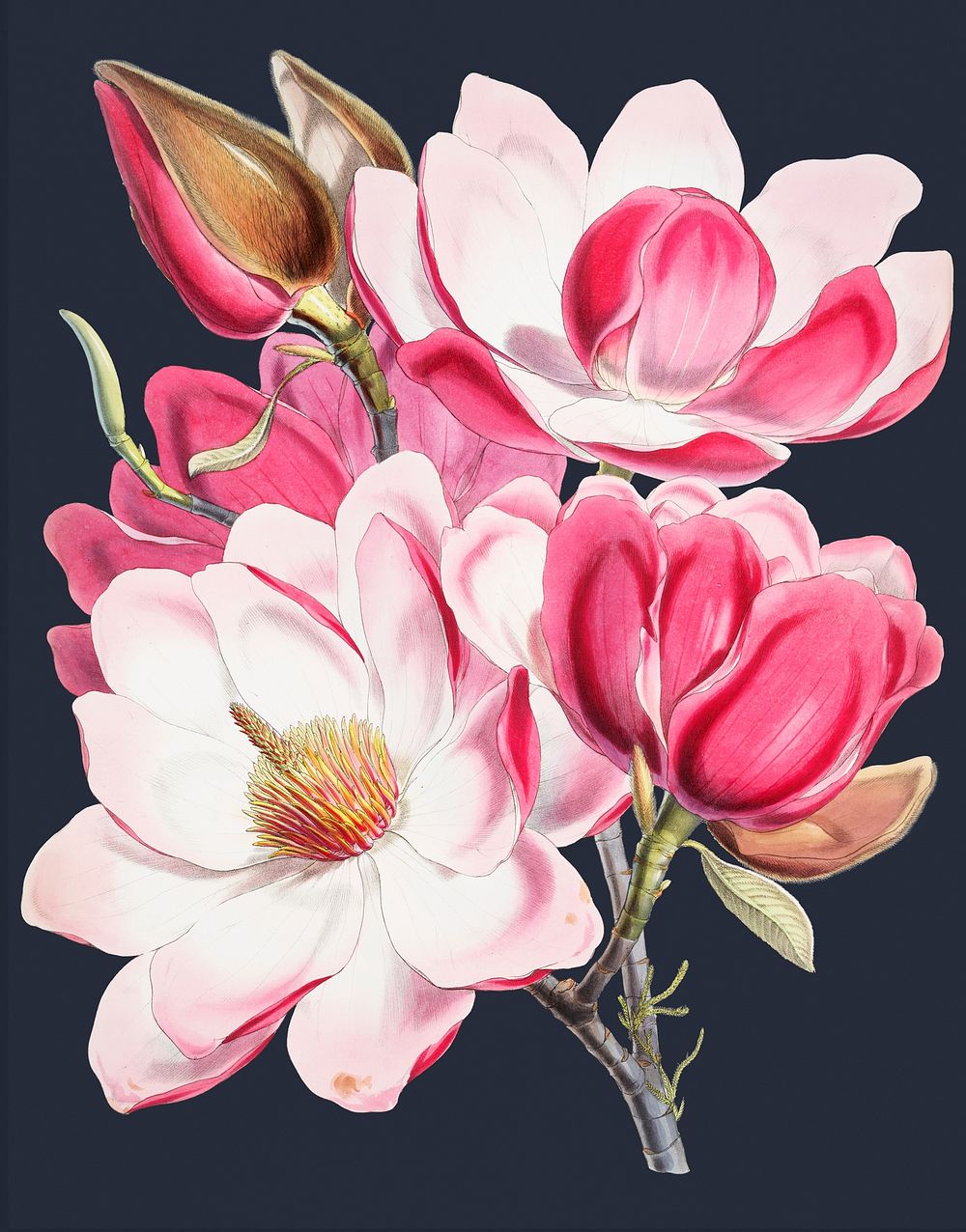
A large magnolia opens from bud to full flower. Joseph Dalton Hooker and Walter Hood Fitch recorded it in the 1855 Illustrations of Himalayan Plants. Flowers in Everyday Life: Botanical Art and Design opens at Fuchu Art Museum on 19 September, following the line of botanical observation into framed pictures, tableware and wallpaper through about 150 works.
One magnolia links observation and display
The plate of Magnolia campbellii gathers overlapping petals, leaves on the branch and several stages of bloom into a single composition. Its precision serves identification, yet the pale pink and white flowers also have the presence of a picture made to be viewed on a wall. The exhibition traces how images first used to classify and record edible and medicinal plants came to be enjoyed as portraits of flowers.
Interest in imported plants and gardening rose in Britain in the late eighteenth century, and illustrated books became a way to encounter unfamiliar species. The exhibition includes Curtis’s Botanical Magazine and The Temple of Flora. The Persian iris from the first issue of Curtis’s magazine in 1787 appears alongside mountain cornflower, Ixia chinensis, cyclamen and lotus, allowing different plants and different ways of drawing them to meet.
From iris to tableware, flowers enter the dining room
The flowers of illustrated books did not remain on paper. A Derby plate from around 1795 carries Gladiolus puniceus and a daylily. Arranged around the usable face of the plate, the blooms are reorganised for a table rather than shown with every feature needed for description. The shift asks how an observed plant can inhabit the form of an everyday object.
Wedgwood’s Water Lily plate dates from about 1808 to 1811. Plants associated with the water’s edge become a pattern that follows the curve of the dish. Seen after a botanical plate, it shows how the same flower can change when the purpose moves from naming its features to carrying an impression through daily use.
The plant is more than raw material for ornament. The direction of a petal, the edge of a leaf and the bend of a stem determine how an image sits within the empty space of a plate. Botanical accuracy remains the starting point, while the object selects which qualities of the plant should remain visible.
Daisy wallpaper builds a garden across the room
In the mid-nineteenth century, William Morris brought garden plants into wallpaper. In Daisy, designed in 1864, small flowers and leaves repeat in a continuous rhythm. It contrasts with an illustration that isolates one specimen, but careful observation still appears in the angle of the flowers and the way leaves attach to stems.
The exhibition also includes Golden Lily wallpaper by John Henry Dearle from around 1899 and textiles by Morris. Across walls and cloth, plants extend with the dimensions of a room instead of drawing attention to one centre. Moving from the enlarged magnolia to repeated daisies reveals how botanical form can alter the scale of an interior.
Follow about 150 works one flower at a time
Botanical illustrations, ceramics, wallpaper and textiles can be read as more than separate groups. Begin with petals and leaves in a plate, then notice how a dish uses its rim or how a wallpaper repeats. When a work names its plant, that name becomes a route through the galleries, linking scientific record with the design of domestic space.
The exhibition runs until 29 November. It is open from 10 am to 5 pm, with final entry at 4:30 pm. Admission is ¥1,000 for adults, ¥500 for high-school and university students, and ¥250 for primary and junior-high-school students; preschool children enter free. It is generally closed on Mondays, with listed holiday openings and compensating closures.
Admission is free from 10 to 12 October for Fuchu’s Civic Culture Days, when entry may be restricted during busy periods. There is no planned tour to another venue. Dates and conditions may change, so check the museum’s latest official notice before travelling.
Drawing one magnolia with precision and repeating daisies across a wall may appear to be distant tasks. Both begin by looking closely at a flower. As the line of botanical art follows the curve of a plate and expands into the rhythm of wallpaper, a life with flowers becomes not only a matter of arranging blooms but a way of continuing to notice their forms indoors.