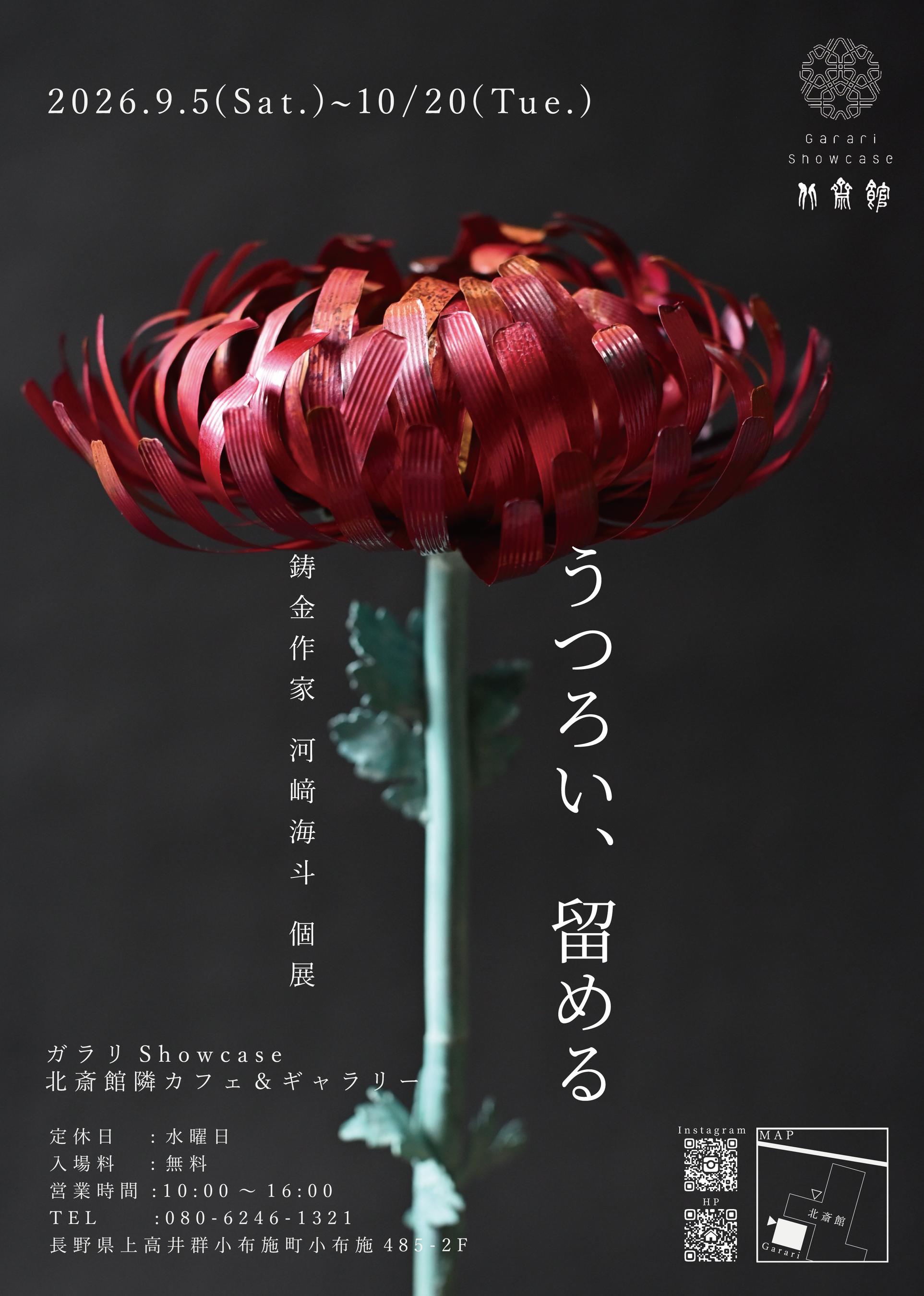
The exhibition runs from September 5 through October 20 at Gallery Showcase beside the Hokusai Museum, with free admission. At the centre of Kaito Kawasaki’s Utsuroi, Tameru is Kyokyo no Kiku, made for this presentation. Its point of departure is Tomoe Nishiki, a historic chrysanthemum cultivated in Obuse since the Edo period. Deep crimson appears inside its petals and gold at their outer faces. The work begins not by reproducing that colour, but by asking how its two-sided quality might move onto a metallic surface.
From Hokusai’s painting to a three-dimensional flower
A chrysanthemum thought to be Tomoe Nishiki appears at the centre of Chrysanthemums, a late hand-painted work by Katsushika Hokusai in the collection of the Hokusai Museum. Kawasaki uses that flower not as a contour to trace, but as an opening for thinking again through another material. Given a mould, weight, and reflected light, the flower leaves the flat surface and creates distance around the viewer. Preserved in a painting, it gains shadow in sculpture and changes expression as one approaches from another angle.
Hokusai’s late visits to Obuse and a living artist’s present-day hand belong to different eras. Yet both turn toward plants as changing form and colour rather than as decoration. The exhibition neither keeps the old painting at a reverent distance nor overwrites it with contemporary technique. It passes the flower into another material. That measured distance gives the presentation its quiet tension.
Receiving two-sided colour in metal
For Kyokyo no Kiku, Kawasaki does not add colour with paint. He works from shaku-do, a technique in which highly pure copper is heated and rapidly cooled so that its oxidised surface develops colour, drawing red from the metal itself. Material proportion, heat, and cooling each change what appears at the surface. A flower shifts with seasonal light and condition; metal finds its colour through making. They are related, but not the same. Leaving that difference visible is a careful way to carry a plant into a work.
Tomoe Nishiki cannot be read from one frontal view: colour separates across the inner and outer faces of its petals. The work also resists one fixed reading. Red seen close up, darkness received at a distance, and brightness along an edge under light do not settle into one image. Before turning the flower into botanical knowledge, walk around it and notice where colour changes. The hardness of metal does not erase floral softness; it gives the fleeting impression of flowering another pace.
The two durations held by an Obuse chrysanthemum
Tomoe Nishiki carries the time of cultivation in its region, while Hokusai’s painting holds an Edo-period gaze. Kawasaki’s work does not quote only one of them. A living chrysanthemum changes its flowering each season, a painting holds time on paper, and cast metal gains another duration through heat and oxidation. Together, these three times suggest that preserving a plant is not only a matter of making a specimen. A seen memory can also be entrusted to change in another material.
Kawasaki has worked with familiar forms of life, including goldfish and frogs, in cast metal and resin. His official statement describes an approach that reconsiders conditions of existence through the relation of material, environment, body, and perception. This chrysanthemum is not simply a subject for exact imitation. It places plant, painting, metal, and the viewer’s distance in one room, quietly asking what we receive as living.
A contemporary maker beside the Hokusai Museum
Gallery Showcase introduces contemporary makers connected to Obuse as well as artists who reconsider Hokusai through present-day materials. After meeting history in the museum, one can face a current artist’s flower next door; the town’s culture becomes more than a preserved past. Moving among the original image, the land that has cultivated the chrysanthemum, and a new metal work makes visible how the same plant changes form in different hands.
Seeing a flower while travelling need not merely add another destination. Learning where a material’s colour begins and what memory a maker brings into a work can change the town seen after leaving the gallery. Beginning with an Obuse chrysanthemum, this exhibition offers a small, precise detour for receiving a plant’s time beyond a garden or field.
Pause before one flower through October 20
The gallery is open from 10 a.m. to 4 p.m. and closes on Wednesdays. There is an exception during the exhibition—September 23 is open and September 24 is closed—so check the organiser’s notice before travelling. There is no need to decide the work’s front at once. Move slightly to one side while thinking of the petal’s two faces, and look again where light changes the metal’s colour. It is unlike a flowering chrysanthemum, yet it does not let us forget botanical transience.