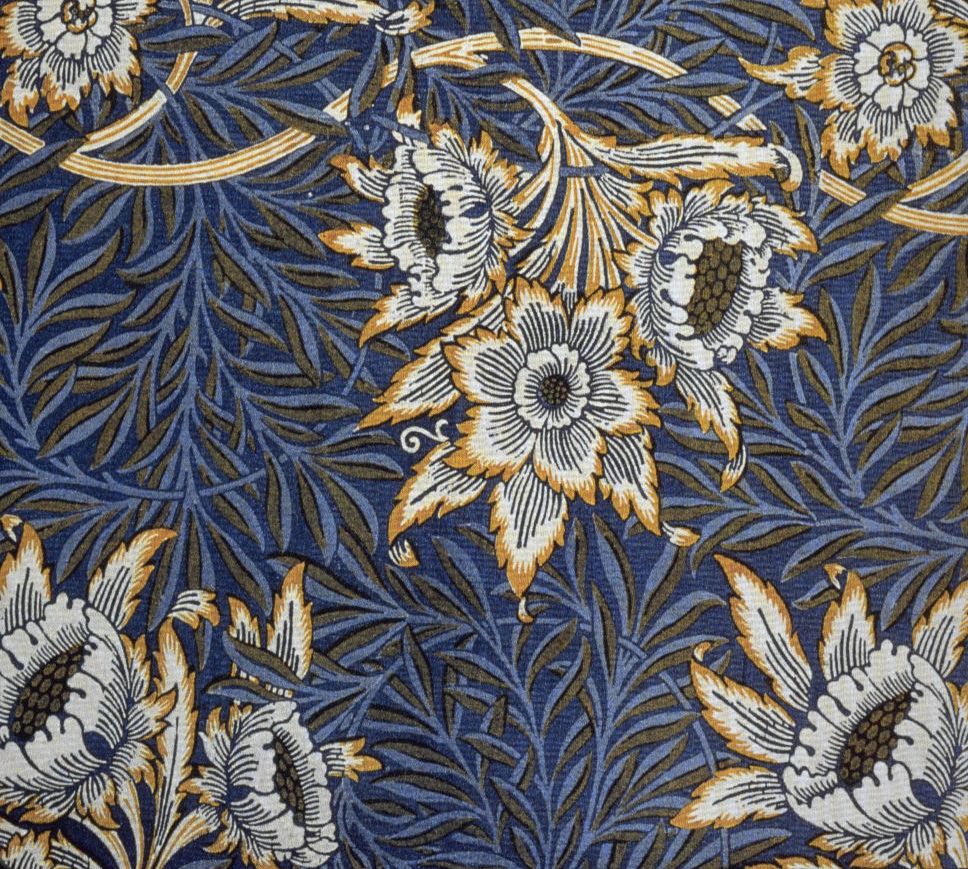
The opening image is William Morris’s 1873 printed linen Tulip and Willow. It is not a photograph identifying a work in the exhibition, but an example of the plant design by Morris that the exhibition addresses. Slender leaves fill the background as a field, while strongly outlined flowers appear at regular intervals. The plant has left the form of a single specimen and become a composition that can repeat across a room.
Lines That Draw Roots Become Portraits of Flowers
Fuchu Art Museum’s introduction locates botanical art’s beginnings in the classification and recording of edible and medicinal plants. Lines bringing petal count, leaf arrangement, and the forms of stems and roots onto one page first served to distinguish one plant from another. Botanical art later became something to appreciate as a “portrait of a flower,” without surrendering accuracy.
A key to that change is Curtis’s Botanical Magazine, founded in 1787. Royal Botanic Gardens, Kew describes it as the world’s longest-running periodical to publish richly colored botanical plates continuously. It still combines writing on botany, horticulture, conservation, and ecology with meticulously rendered original art. When viewing older plates at the museum, look beyond the beautiful blossom and ask how much of the plant the artist sought to preserve on one page.
A photograph captures a moment’s light and background together. Botanical art can select necessary forms and present them with equal clarity. Kew cites its ability to show stages from flowering through fruit on one sheet and to isolate the subject from its background. The white of the page is not leftover space; it keeps the plant’s structure legible.
Turning One Flower into a Repeating Pattern
As botanical art became widely admired in 19th-century Britain, plants appeared on decorative surfaces. The exhibition includes The Temple of Flora, tableware by Derby and Wedgwood, and wallpaper and textiles by William Morris. Seeing a botanical plate, a tabletop vessel, and a wall-covering pattern together allows comparison of how plant forms were reselected for different uses.
In Morris’s textiles, plants do not stand isolated like specimens. The V&A notes his repeated use of familiar garden flowers, including tulips, irises, bluebells, honeysuckle, roses, and thistles. In the opening textile, slender willow-like leaves create density and flowers float as white outlines. Maintaining life-size scale matters less than ensuring that the flow of plants continues when the cloth is cut.
Even so, pattern does not become entirely free of the plant. A slender leaf can fill a background; a curving stem can connect one flower to another. Observation developed through botanical illustration trains the eye not only to copy form accurately, but to decide which features preserve the sense of a plant.
A Flat Image Moves onto a Vessel’s Curves
On tableware, pattern moves closer to the motion of the hand. Lift a plate and the flowers change direction; on a cup, front and back cannot be seen at once. How much stem and flower can fit along rim, well, and handle? If wallpaper is plant life surrounding the field of vision, tableware is plant life turned in the hand.
The V&A’s Wedgwood manufacturing archive includes pattern books used at the factory in the 18th and 19th centuries. Numbered references to small border ornaments and plate designs helped maintain consistency in production and were also used to take showroom orders. As botanical lines moved from one artist’s sheet into products, they became design information shared by makers and buyers.
Attend to the surface bearing the plant: the same flower becomes record on paper, repetition on cloth, and three-dimensional rhythm on a vessel. White paper, glossy ceramic, woven texture—each material alters line weight and overlapping color even for the same leaf. Seen not merely as an exhibition of plant images, but as one in which plants assume different work in each material, the distance among 150 objects begins to close.
Choose One Leaf Before You Go
The exhibition runs September 19–November 29, 2026. Hours are 10:00 a.m.–5:00 p.m., with entry until 4:30. Admission is ¥1,000 for adults, ¥500 for high school and university students, and ¥250 for elementary and junior-high students; advance and group rates are available. The museum is closed principally on Mondays, though it opens September 21, October 12, and November 23, with substitute closure dates immediately afterward. Free admission is planned for Civic Culture Days, October 10–12. Check Fuchu Art Museum’s latest information, including anticipated crowds, before visiting.
Before visiting, choose just one plant near home. Is the leaf margin smooth? Where do the veins divide? Is the stem straight or curved? There is no need to find the same shape in the galleries. The leaf becomes a reference for comparing what a plate preserves, a textile repeats, and a vessel bends around a curved surface.
Look at the chosen leaf once more after returning home. Even without drawing it precisely, record its outline and veins on one sheet. Lines once used to copy plants eventually became patterns for rooms and vessels for the table. After tracing that long passage, the leaf nearby appears as more than a form that simply indicates its name.