Cactus, lily, persimmon leaf, and pear appear on different papers and in different media. The 29th Annual International Exhibition presented by the American Society of Botanical Artists and the Society of Illustrators opened in New York on September 10, 2026. Its 50 works extend botanical attention beyond flowers in full bloom to leaves, fruit, and other identifying forms.
Fifty works name plants and media
The venue is the third-floor Garden Gallery at the Society of Illustrators on East 63rd Street in Manhattan. The official page says the exhibition runs through January 9, 2027, and marks ASBA’s second biennial appearance in the historic townhouse. This article does not infer gallery size or visitor response; it stays with the confirmed group of 50 works and their published object information.
The public list includes Olga Ryabtsova’s beavertail pricklypear, Deborah Friedman’s Lilium henryi, Yan Ji’s persimmon leaf, and Gaye Grossman’s pear. Flowers are not the only subjects; leaves and fruit appear as subjects as well. Because plant names remain attached to the works, viewers can ask what was observed rather than stopping at color or composition.
Copyright in the contemporary works remains with the organizers and artists. ASBA’s catalog page expressly prohibits saving or republishing artwork without the artist’s permission. RareDex therefore reproduces none of the exhibition images. The opening photograph is a separate CC0 record of a plant that connects to the exhibition’s botanical subject.
Rudbeckia keeps its dark center
The 2026 catalog identifies its cover artwork as Jessica Daigle’s “Rudbeckia hirta, Last.” The title alone does not establish the image’s appearance or the artist’s intent, so the cover is not reconstructed here. Instead, university guidance and a reusable photograph establish the structure of Rudbeckia hirta itself.
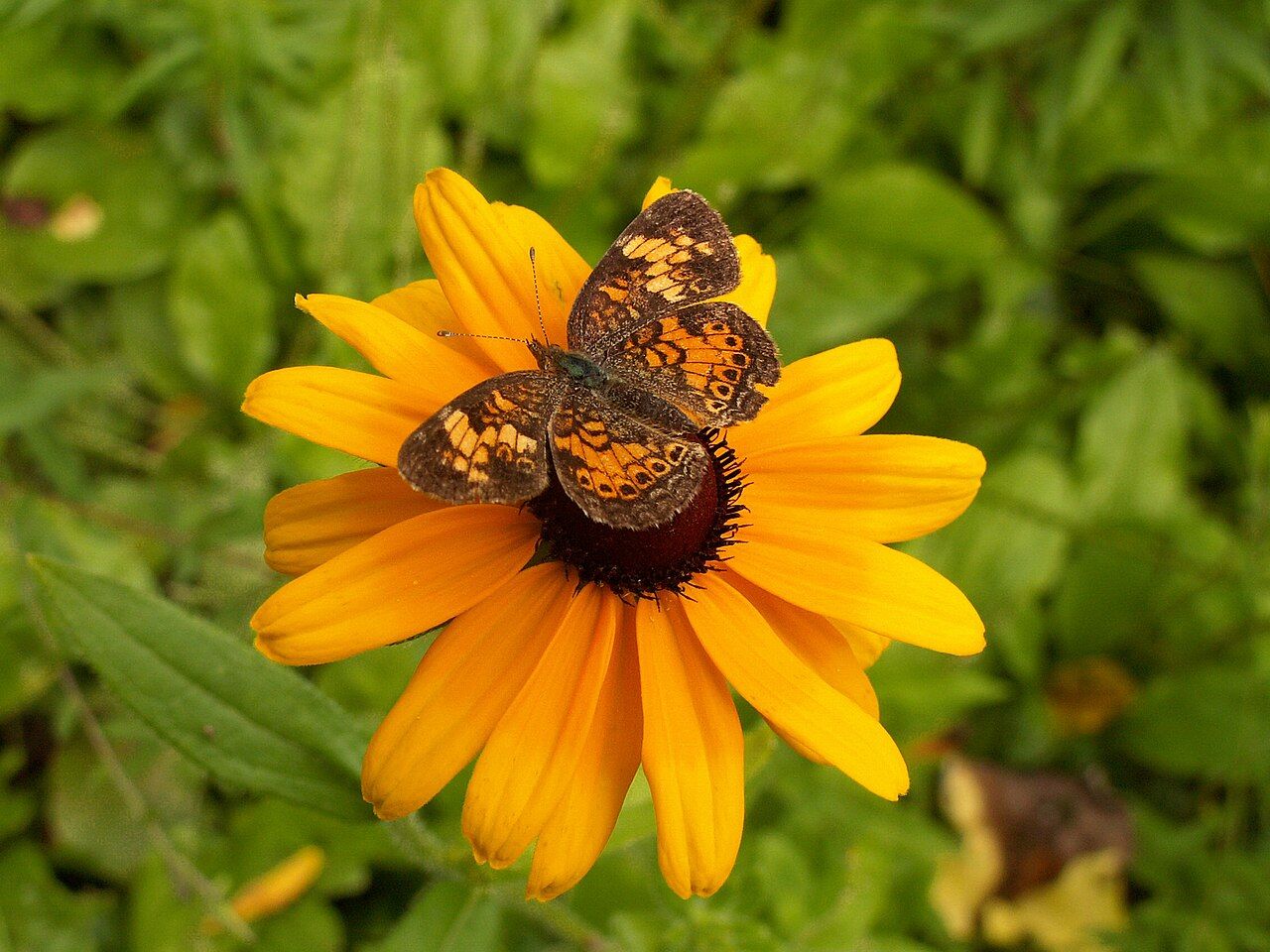
The photograph shows Rudbeckia hirta in Pennsylvania’s Kane Woods Nature Area. Yellow rays surround a raised, dark purplish-brown center. North Carolina State University describes 10 to 20 orange-yellow to red rays around a dark, egg-shaped dome, providing a botanical basis for the visible arrangement.
This photograph is neither an exhibition artwork nor the catalog cover. It is Cbaile19’s own image, uploaded to Commons in 2015, with an original size of 2,272 by 1,704 pixels and a CC0 dedication. The actual original-file link was opened from the source page, and the file identity, plant name, location, and rights statement were checked.
Paper and pigment shift attention
The official list records support and medium work by work: watercolor on paper, colored pencil on paper, watercolor on vellum, and gouache on black paper. Hyun Jung Kim’s Scilla siberica uses colored pencil, Albina Herron’s white violets use gouache on black paper, and Jane Fournier’s rosehips use watercolor on vellum.
Those materials need not be turned into a ranking. A dark ground changes how an edge emerges; vellum receives watercolor differently from paper; colored pencil can build detail through repeated marks. Reading title, plant name, and medium together shows how the point of attention changes from one work to another.
Related programming includes Botanical Costumed Sketch Night on September 16 and “The Beauty of the Faded Specimen” on November 21. The latter is presented as a session on finding color in dried and aging botanicals. Botanical attention therefore extends beyond peak bloom and into specimens altered by time.
Labels remain through January
The 29th Annual International runs from September 10, 2026, through January 9, 2027, at 128 East 63rd Street. Visitors should check the Society of Illustrators for current opening and admission details. The official page already gives remote readers a useful range through artist location, title, and medium.
In front of botanical art, begin with the plant name, then note which part or stage appears and which medium carries it. Pricklypear and pear, violet and persimmon leaf offer different clues in edge, surface, and overlap. The pairing of name and material is what lets an image function as a plant record rather than generic decoration.
The rays around Rudbeckia hirta’s dark center are more than yellow and brown once the plant is named. The raised center and radiating flowers become information for recognizing the species. By holding leaves, fruit, and fading forms beside flowers, the exhibition widens botanical beauty instead of reducing it.