The exhibition occupies Center Park / The Stage #5 on the fifth floor of Isetan Shinjuku's main building from September 5 through 8. The bonsai come from Tohshouen, led by Takehiro Kasai. Kasai met THE MINO organizer Hideya Izawa at a Daikanyama pop-up late in 2025, and the word hachiawase became the project's center. In bonsai it means matching a tree with a pot; in ordinary Japanese, it means an unexpected encounter. Here, chance is turned into a deliberate choice.
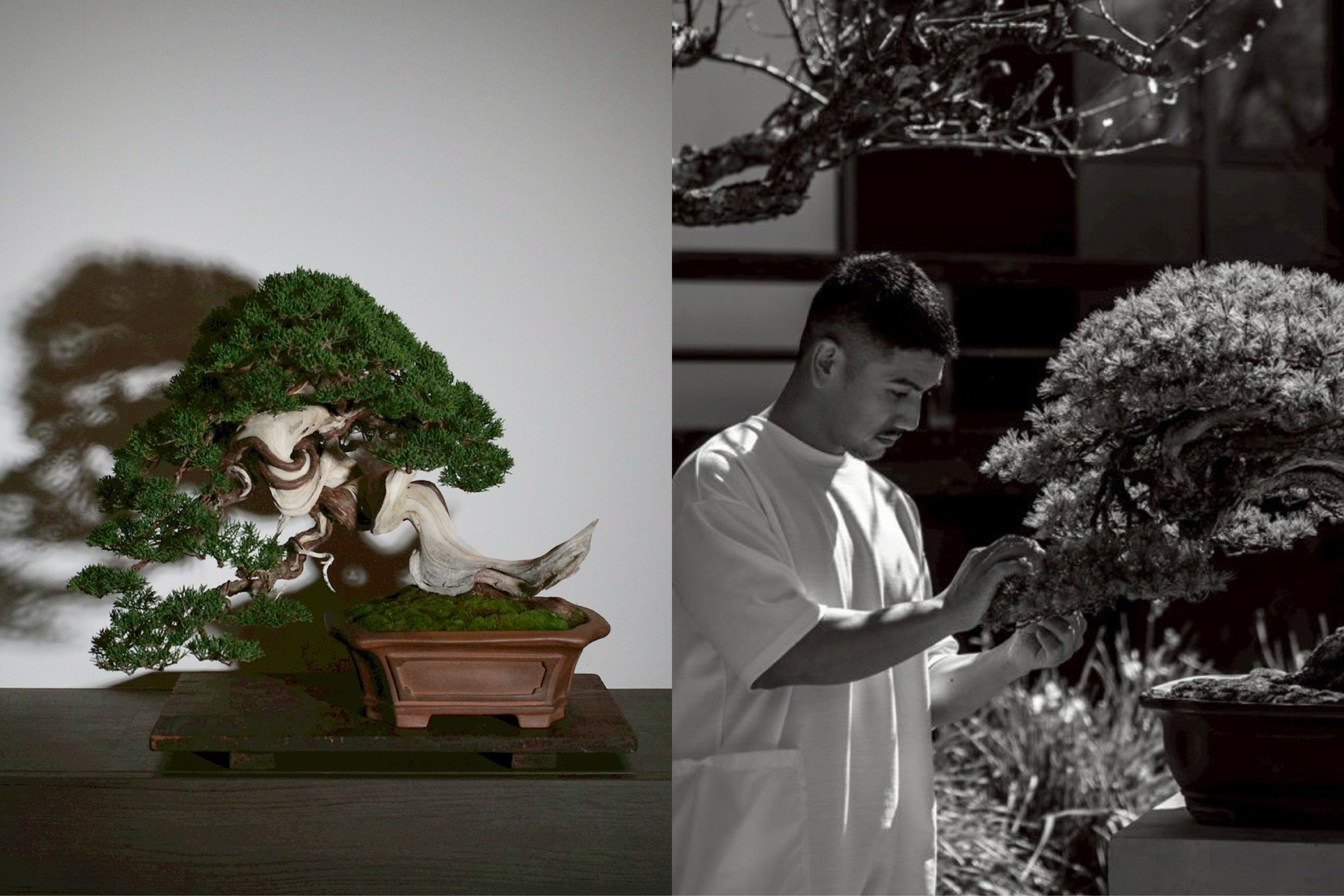
Born in Yamanashi in 1993, Kasai moved from competitive weightlifting into plant cultivation and bonsai. After retiring from competition in 2023, he established Tohshouen, working from Saitama and Yamanashi with trees including Japanese juniper and black pine. His shift from one physical discipline to another echoes an exhibition concerned not only with inherited forms, but with placing a tree into a contemporary space.
Matching rectangular space and height to the tree
Hachiawase does not mean making the pot disappear as a subordinate part. In an Isetan interview, Kasai compares the relationship to coordinating clothes. A tree whose branches move laterally can occupy a rectangular pot with space left around it. A cascade-style tree, whose trunk and branches fall downward, may call for a taller pot. Change the vessel that receives the outline and the same tree can direct the eye differently.
The work is not limited to making the colors or shapes of tree and pot resemble each other. Width, height, the visible surface of the soil, and the interval extending to the final branch all enter one composition. In the official photograph, the open areas at both ends of the pot allow the low trunk to keep moving laterally. The rim is a small pedestal, but it also reads as a horizon against which the tree's scale is measured.
Visitors can look beyond combinations prepared for display and choose trees and pots separately, beginning with either one and consulting the staff. Because the right repotting season depends on species and condition, a purchase need not be forced into an immediate union. The exhibition first creates time to imagine a tree's next outline rather than rushing toward a finished state.
Fifteen treatments of clay divide into harmony and collision
The participating artists do not follow one method. Ryotaro Kato, the eighth-generation head of Kobei Kiln, fires a subtly distorted hemispherical Oribe pot in a climbing kiln and thinks about harmony when it stands beside a plant. Shota Miyashita, who began making vessels for succulents and cacti, instead brings forceful glazes and colors into contact with the tree. A receptive pot and a pot with a contrary character make the act of pairing more dimensional.
Based in Toki, Miyashita has developed distinctive glazes centered on crystalline effects. His official site describes mixing materials to increments of 0.001 gram and controlling firing by single degrees Celsius. This precision is not simply a route to uniform finishes. By narrowing the conditions under which glaze becomes crystal, the pot gains a duration unlike the time held in bark or leaves.
Tetsuya Hioki makes ceramics while working in clay production at Kaneri Toryo. For this exhibition he combines several Mino clays and leaves cracks and masses that evoke the floor of a quarry. Rather than setting a tree on a seamless container, he lets a geological layer appear to continue beneath its roots. Because the pot does not retreat into the background, the distance between tree and soil becomes visible.
Letting Mino clay become more than one regional label
Mino contains clays with different properties, including kibushi, gairome, and mogusa. MINO SOIL is a project that reconsiders the knowledge accumulated through extraction, clay production, and firing, beginning with material rather than only the finished ceramic. THE MINO similarly directs attention beyond a list of 15 artists to the clay each one chooses and the surface each leaves behind.
As Toki's official Mino ware site shows, the region includes both singular handwork and the industrial systems that sustain production. A narrow focus on the bonsai pot lets that breadth emerge through the tree. Oribe green can merge with foliage, a crystalline glaze can flash as an interruption, or coarse clay can extend the landscape beneath the roots. A regional name opens into multiple choices.
Choosing one tree and one pot in person through September 8
THE MINO Hachiawase runs through September 8 on the fifth floor of Isetan Shinjuku's main building. Works are offered for sale, and availability may change during the exhibition. Anyone seeking a particular artist or tree should check the current event and store information before visiting. Even without buying, comparing how one tree might appear in another pot shifts attention from its branches and leaves toward its base.
There is no single correct vessel for one tree. A pot that quietly supports it and a pot that collides through color or texture can both reopen the relationship. Once the pot's outline comes into focus, bonsai changes from a miniature image of nature into a present-tense meeting of clay, firing, and human judgment. Hachiawase is not the encounter of two finished objects, but the act of choosing how they will be seen next.