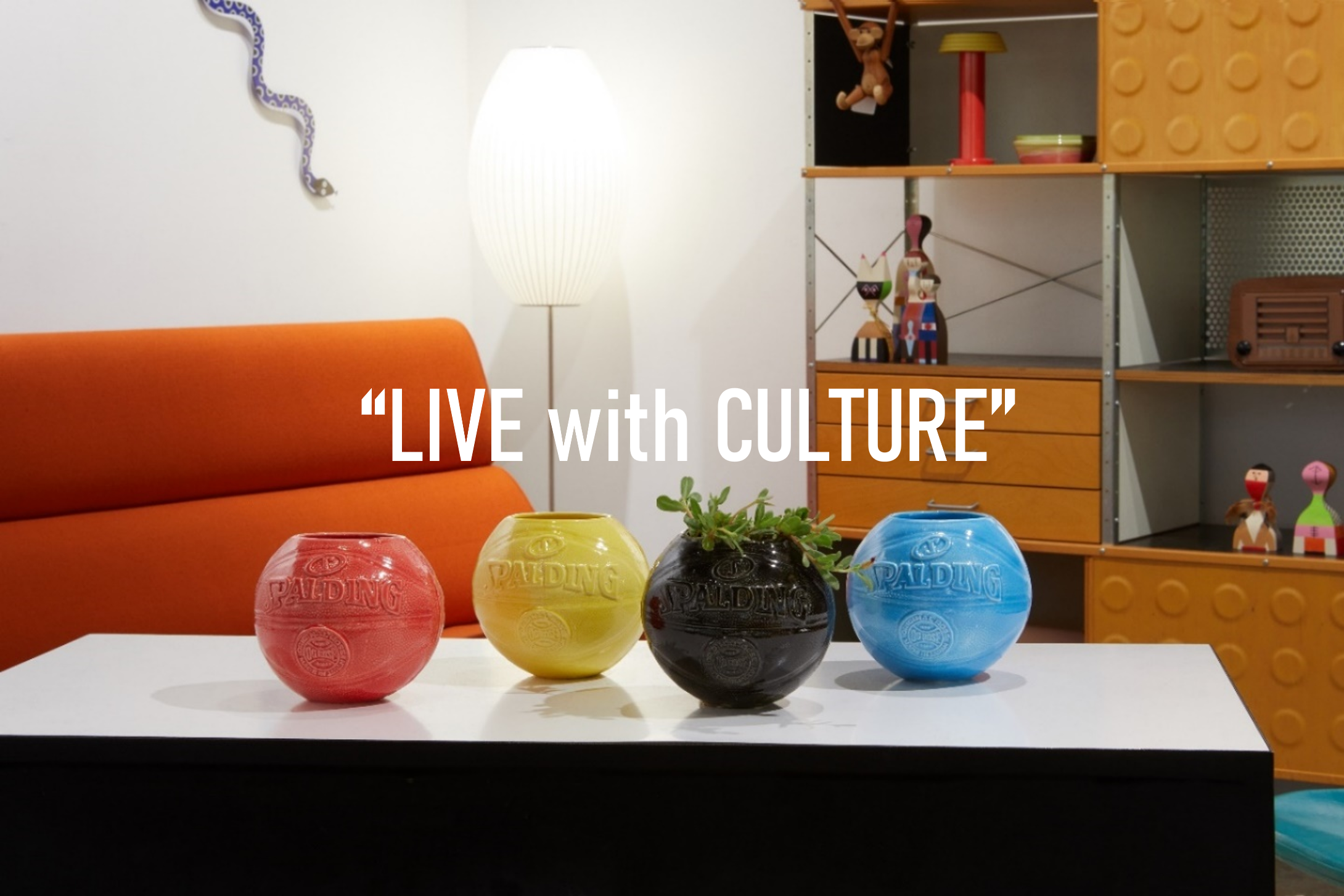
At the center of the official photograph stand a low white table and four spheres. Basketball grooves cross their surfaces, and openings at the top become vessel mouths. A plant occupies the black one; the other three stand like sculpture. Mid-century furniture forms the background. A tool shaped to fit the hand on a court can become planter, vase, catchall, or object indoors.
Keeping the Seams, Changing the Role
CERAMIC BASKETBALL PLANTER with BOX is a limited product translating a SPALDING basketball into ceramic. Each is formed individually in a Japanese workshop and priced at ¥16,500 including tax. Black represents Mid-Century MODERN, yellow Styles, red X-girl, and blue ROSE BUD, with 20, 20, 30, and 30 pieces respectively—100 in total. Color is not a mere option, but a way of placing the identities of four brands and stores spanning furniture, sport, and fashion onto one shared form.
A sphere is unstable and seemingly awkward as a vessel. Instead of erasing that inconvenience by making an ordinary flowerpot, the project pairs it with a box and preserves its ball-like curve. With a plant, leaf and sphere lines collide; with cut flowers, the symbol of sporting equipment moves into a vase. Its form remains even when empty, so the room’s function does not break with the presence or absence of a plant.
Connecting Plants to the Things a City Loves
Olivia Rose is a New York-based botanical artist who leads ORIGINAL ROSE. She studied landscape architecture at Cornell University and treats plants not as decoration, but as material that rearranges space and culture. ORIGINAL ROSE’s archive includes sneaker-shaped ceramic planters and hanging pots made from actual basketballs. The products differ, but share a practice of connecting plants with beloved objects outside conventional horticulture.
According to earlier specialist-media coverage, the basketball planter began in 2017 with a discarded ball found on the street. The edition sold here does not reuse those balls; it is ceramic made in a Japanese workshop. That distinction should remain clear. Retired practice balls are, however, used for wall works at the venue. Sale and exhibition objects separate in material while continuing the idea of moving the memory of a ball into a plant-filled interior.
Choosing a Pot Means Choosing the Room’s Context
Mid-Century MODERN vintage furniture shares the venue with ceramic planters, plants, and works made from discarded balls. Plants do not float as the room’s only natural objects. Upholstery, ceramic glaze, spherical curves, and leaf outlines stand together with different ages and purposes. Instead of matching pot to plant name alone, a view emerges from the side of one’s furniture, clothing, and music.
A spherical vessel demands more from placement than an ordinary cylinder. Very large leaves cover the ball’s outline; very small ones sink at the opening. Water-catching structure and planting method should be inspected in person when purchasing. Official information does not limit the object to a planter, presenting it also as a vase, catchall, or sculpture. Refusing to fix one plant from the beginning creates room for long use.
Only 100 Pieces, Three Days in Nakameguro
The exhibition and sale run August 21–23, 2026, at calif art gallery in Nakameguro, Tokyo. Hours are 11:00 a.m.–8:00 p.m. daily, and admission is free. The first 60 buyers receive a plant selected by The Bulb Book. The plant species is not identified in the announcement, so confirm the pairing at the venue. Quantity and duration are limited, but this article is not intended simply to hurry a purchase. The contextual shift in which a ball begins to look like a pot before furniture is what makes the object worth seeing.
When welcoming a plant, we tend to begin with leaf form and ease of care. Add the question of which tools and culture should stand beside it, and the pot stops being background. For sport lovers, the route runs from ball to plant; for plant lovers, from pot to street culture and furniture. Bringing people with different entrances before the same vessel is the collaboration’s clearest effect. When photographing a plant at home, include not only the pot but one beloved object beside it.