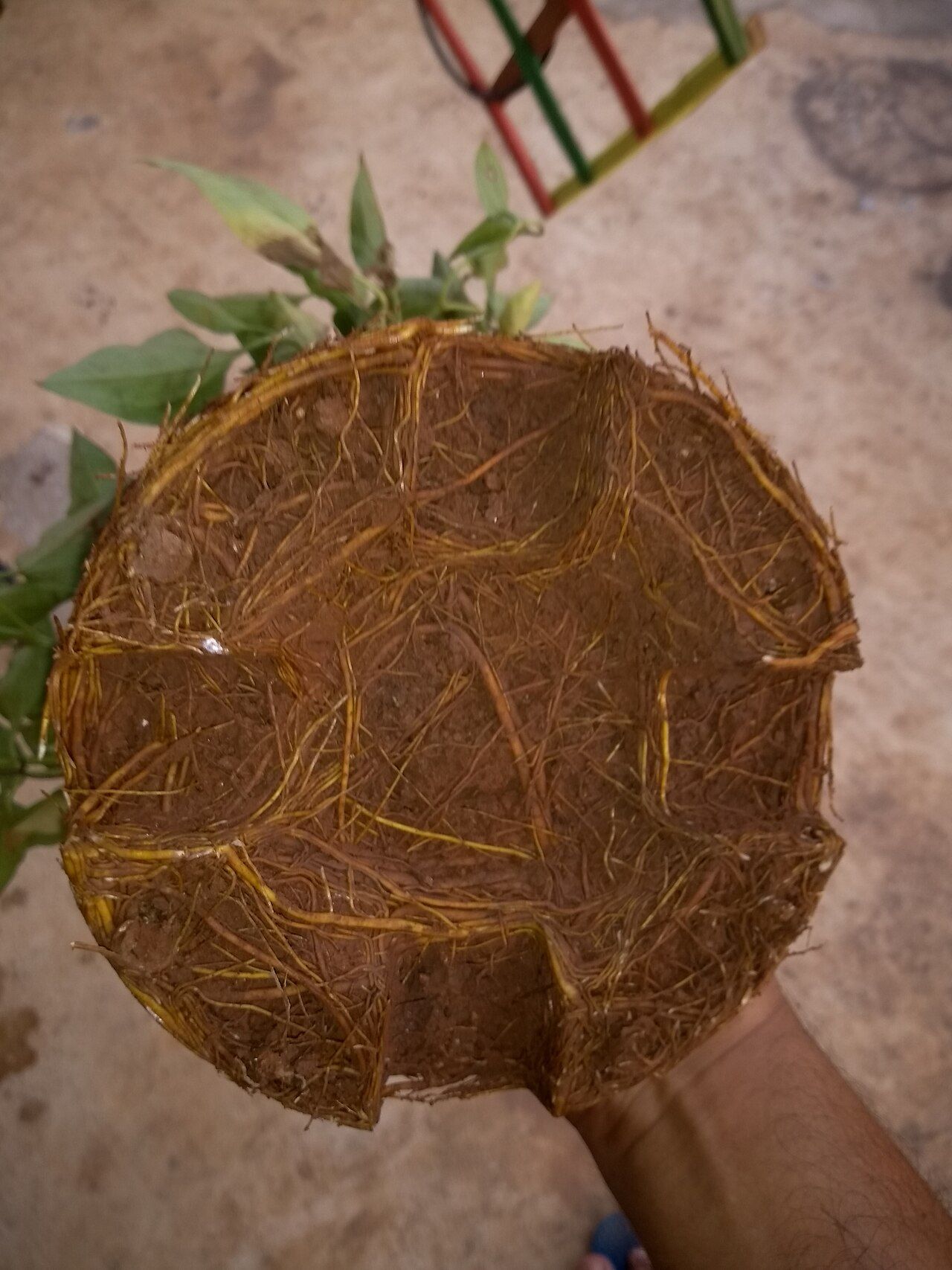
A root ball removed from its pot reveals a form unlike the leaves aboveground. Fine roots trace the outside of the soil, remembering the cylinder that contained them. The plant in this photograph is unidentified, but roots circling so densely that little soil remains visible provide a clear point of reference for thinking about a root-bound plant.
Do Not Decide from One Root at the Bottom
Roots emerge from the drainage hole. They appear at the soil surface. Leaves wilt easily despite ordinary watering. New leaves are smaller than before. University of Illinois Extension lists such changes as signals that repotting may be due. Some plants, however, prefer to remain slightly root-bound and do not require annual repotting. Seeing one root is not the same as the entire root ball reaching its limit.
If the plant is settled and the pot releases without force, support the container rather than pulling the stem and inspect the root ball briefly. If soil remains visible around the outside and roots are sparse, return it to the original depth and continue observing. Photograph the root ball you inspected. If roots circle the exterior in multiple layers and the soil barely crumbles, there is likely little room left for growth inside the container.
Whether Water Moves Too Fast or Too Slowly, Check the Roots
University of Maryland Extension explains that in a root-bound pot, water may drain too rapidly to soak the center of the root ball. Water poured onto the surface runs immediately into the saucer, yet leaves lose strength within hours. Before watering more often, check whether water reaches the center and whether roots have displaced the growing medium.
Conversely, slow drainage and medium that stays wet do not necessarily mean the pot is too small. Old medium may have compacted, reducing channels for air and water. Wilting can come not only from too little water, but from roots damaged by excess moisture. Do not keep adding water based on leaves alone; consider soil texture, pot weight, drainage holes, and root color and firmness together. Soft, disintegrating roots require treatment for decay rather than an ordinary move to a larger pot.
In Late Summer, Read Growth Rate Rather Than the Calendar
Repotting loosens roots and changes their environment to new medium. For many houseplants, spring through early summer, when growth is active, is considered the easiest period. Yet growth seasons vary by species and indoor conditions. Late August is not uniformly too late, nor does approaching fall automatically make it timely.
If new growth is moving, leaves are firm, and temperature and placement are stable, serious root binding can be addressed. If direct sun or heat has damaged foliage and the plant has only just recovered from drought, first stabilize placement and moisture and consider waiting. For a nonurgent plant, confirm its growth season before scheduling the work. Follow the plant’s pace rather than the calendar.
If You Repot, Move Up Only One Size
Even after deciding to repot, there is no need to jump to a much larger container. Horticultural guidance from Iowa State University and others advises choosing a new pot one size larger, or at most two if needed. Too much medium around the roots can stay wet for too long. For a tall plant, base width and stability matter alongside diameter.
Choose a pot with drainage holes, and do not try to improve drainage with a thick gravel layer. Gravel at the bottom can move a saturated layer of medium closer to roots. Set the plant at the same depth as before, fill around it with a suitable medium, water the entire root ball after repotting, and let excess drain. Leave no water in a saucer or cachepot.
There is no need to add fertilizer immediately after repotting. New potting mix may already contain it, and Iowa State University suggests waiting two to four weeks before resuming a normal fertilizer program. Prioritize product labeling and the plant’s traits rather than crowding several interventions into one day. Let the day of root work end with pot, medium, and water; that restraint makes later changes easier to read.
A pot displays a plant, but also determines the roots’ environment. Before choosing color and material, look once at the current root ball. Even a decision not to repot gains a reason. Late-summer care can begin not with welcoming the next pot, but with learning how fully the roots have used the present one.