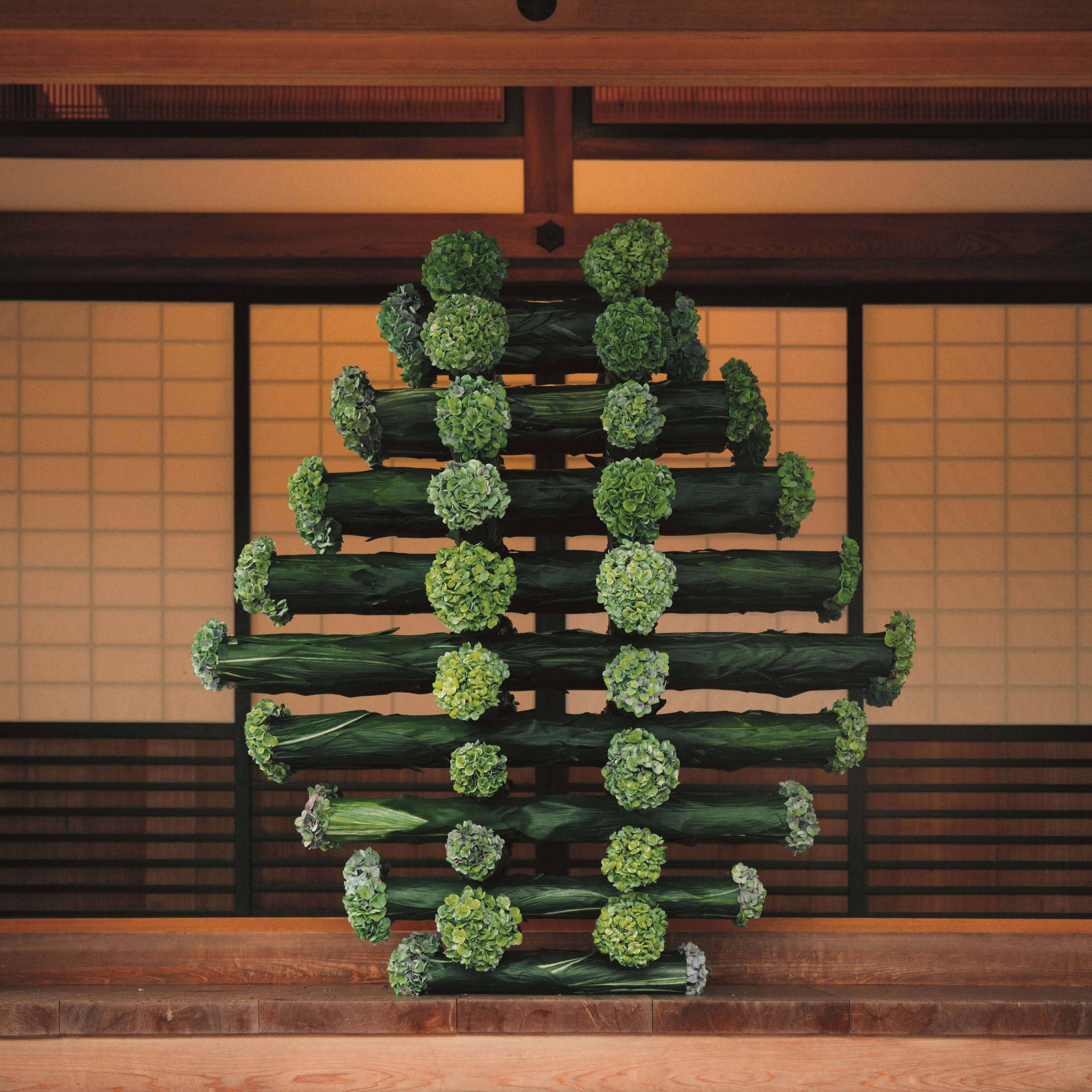
Round green flower clusters emerge at regular intervals between dark horizontal members. Old timber posts and fittings stand behind. Unlike an arrangement gathering flowers at the center, the eye moves up and down, between plant and architecture. Even for viewers familiar with Nicolai Bergmann, this image first prompts the question: “What has been combined with what?”
Flowers Are Not Complete Alone
The title KUMIAWASE: Combinations carries over from the 2025 exhibition marking the artist’s 25th anniversary. According to the official release, the exhibition traced his career through 25 works of flower art. The photobook includes earlier work alongside flower art photographed expressly for the volume.
Bergmann’s “combinations” are more than a technique for arranging different floral materials attractively. He describes respecting each flower while seeking a new beauty born when multiple presences meet. Flower, vessel, color, space, season: none remains the fixed protagonist, so viewers can follow changing relationships.
Even after cutting, flowers open, loosen, and change color. Preserve only the finished state and that motion falls away. A photobook stops an instant while placing works from different periods and places beside one another. Turning 25 years of pages reveals not only how work changed, but what one artist repeated and relinquished.
Large-Format Pages Change the Scale of Flowers
The book measures 340 × 265 mm and runs 214 pages. Official images show thin branches extending beyond vessels, dense fields of petal color, and forms incorporating moss and wood texture at scale. Details that look decorative in small product images become legible as choices of line, plane, and empty space at full-page density.
More than identifying flower names, attend to distances among materials. How far does a branch project into space? How does repetition of round clusters soften straight timber? When colors overlap, do related tones blur or complements sharpen outlines? The works hold ways of seeing that apply when bringing plants into a room.
A bud vase and a large installation require different technique and place. Still, small decisions—pairing leaf curves with a window frame or glossy foliage with a rough pot—share the same entrance. Before adding flowers, reconsider existing furniture and vessels, and morning and evening light. “Combination” becomes a word for carrying viewing back into life.
Photobook and Paulownia Box: Two Ways of Preserving
The standard edition is ¥15,400 including tax. The limited special edition is ¥19,800 and combines a signed book, 25 postcards, and a custom paulownia box. Flower works move into the flat object of a book, which is then enclosed by wood. The specification makes storage, retrieval, and eventual giving part of the form, not content alone.
Fresh-flower works cannot long remain unchanged, so photographs become records. A record is not a substitute for the object: weight, depth, and the speed of plant change are absent from a page. The book’s attraction lies not in erasing that lack, but in showing overlooked details at another scale. A large page creates a place for repeated looking at a distance unlike owning flowers.
Nicolai Bergmann moved to Japan in 1999 and founded his brand in 2001. The official release says he now operates nine Japanese stores, a flower school, three cafés, and a garden facility in Hakone. Twenty-five years is not only a personal career, but time expanding the places flowers inhabit—from gifts and shops to learning, food, and gardens.
On September 1, a Book for Seeing Flowers Again
Release is September 1, with planned sales through Nicolai Bergmann Flowers & Design stores and the official online shop. Prospective buyers should confirm special-edition inventory and store availability officially. The official collection page sharing the book’s name also contains products continuing from the 2025 exhibition, showing the project does not close with one volume.
If a room’s plant feels overfamiliar, change one neighboring thing before seeking a new specimen: vessel, stand, textile, direction of light. Even when the plant remains, a changed relationship reveals its outline again. KUMIAWASE preserves more than 25 years of finished work. It expands the order of looking from one flower to everything around it.