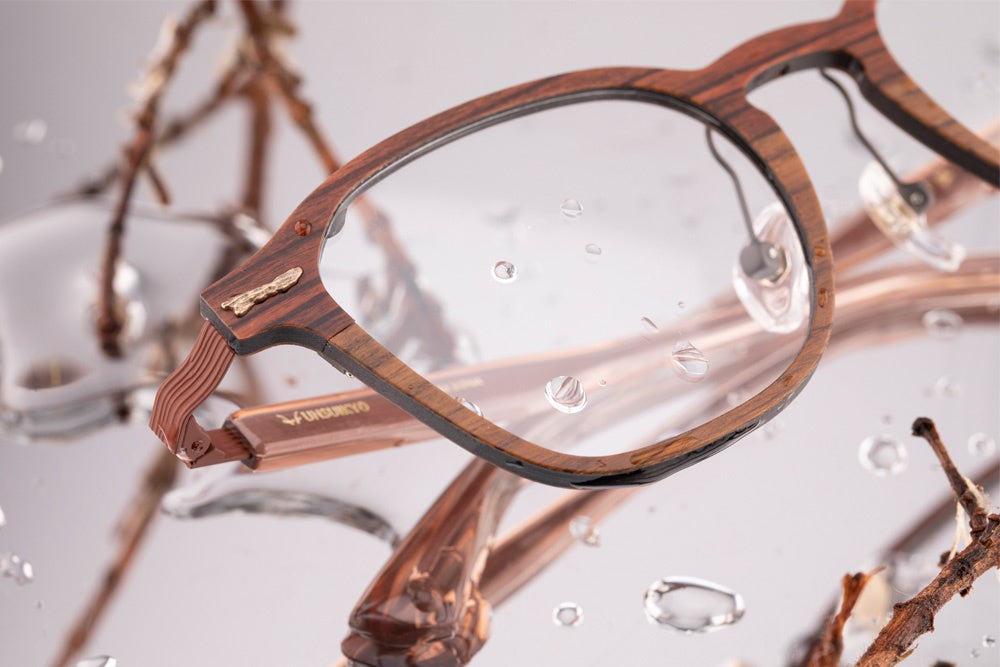
The opening photograph shows one frame using variegated wood grain directly across its front. A softly rounded outline, temples like slender branches, droplets on lenses. Rather than printed imitation, lines made during growth differ slightly from side to side. Precisely because the object sits at the face’s center, an irregular pattern becomes part of dress.
From a Yakushima Forest to Hong Kong Design
Designer Brian Chan founded UNSUIKYO in Hong Kong in 2017. Its name comes from Shiratani Unsuikyo on Yakushima. An official Hong Kong Design Centre program describes Chan’s encounter with the forest landscape and his introduction of sedimentary rock and wood into frames. Rather than reproducing forest scenery as image, he moved rock and tree—the elements composing it—into wearable material.
According to Japanese distributor Yabushita, the collection uses Indonesian ebony, American walnut, Egyptian stone, and other materials. Combined with carbon fiber, designs made in Hong Kong are handcrafted one by one in Sabae, Fukui Prefecture. Materials from different origins are shaped in a center of eyewear production to dimensions following the face. That long movement remains another layer in a frame.
Fashioning Wood and Stone into Thin Contours
Wood loses none of its attraction without the broad surface of furniture. In eyewear, grain gathers within rims only millimeters wide, close to brows, hair, and clothing color. Ebony’s depth holds variation unlike a black acetate frame; walnut brown softly connects skin and dress. Treating each difference as a reason to choose rather than a defect is the pleasure of welcoming natural material near the face.
Stone is more unexpected. Despite the imagined weight of a block, UNSUIKYO combines thin stone expression with carbon fiber in eyewear structure. In MixedClip-Stone, introduced by Ginza Mitsumedo, variations in mineral color cross the front and a removable titanium clip adds another outline. The organizer says the clip uses ZEISS lenses. Ancient material time and precise metal components meet on one face.
Scion also deserves attention. The official release says motifs carved into the trunk of Jomon Sugi inspired its temple design. Rather than shrinking and decorating with a great tree’s scale, it preserves bark repetition in detail. The brand beginning in Shiratani Unsuikyo uses wood as material while layering onto the product a way of looking at trees.
Choose Among About 50 Frames Between Clothing and Face
The trunk show plans roughly 50 samples using wood, stone, and carbon fiber. Online images compare materials but cannot decide how grain overlaps the brow or how stone color meets skin and hair. When natural patterns shift within the same shape, inspect temples extending along the profile as well as the front.
Clothing offers another way not to consider eyewear alone. Wood frames pair not only with ecru linen and brown leather; crisp navy or a white shirt makes grain variation stand out. Stone adds a hard pattern against knit or wool softness. As a plant is chosen between pot and furniture, choosing eyewear through distances among face, clothing, and material makes the reason for one frame easier to find.
Ginza Mitsumedo is an eyewear store carrying independent Japanese and international brands. Orders here are expected to take approximately one to two months. It is not a purchase carried home at once, but includes testing shape and material through samples, then waiting for production. When choosing natural variation and handwork, that wait becomes another value distinct from ready-made uniformity.
Bring Forest Lines into Life Without Reproducing the Forest
Wearing plants need not mean floral or leaf motifs. Lines made by a tree can remain; layered stone color can be cut thin and made into a tool following the face. UNSUIKYO glasses do not bring home Shiratani Unsuikyo itself. They relocate the gaze toward forest material into the morning act of choosing clothes and looking in a mirror. About 50 frames in Ginza offer a chance to compare that translation near the face.