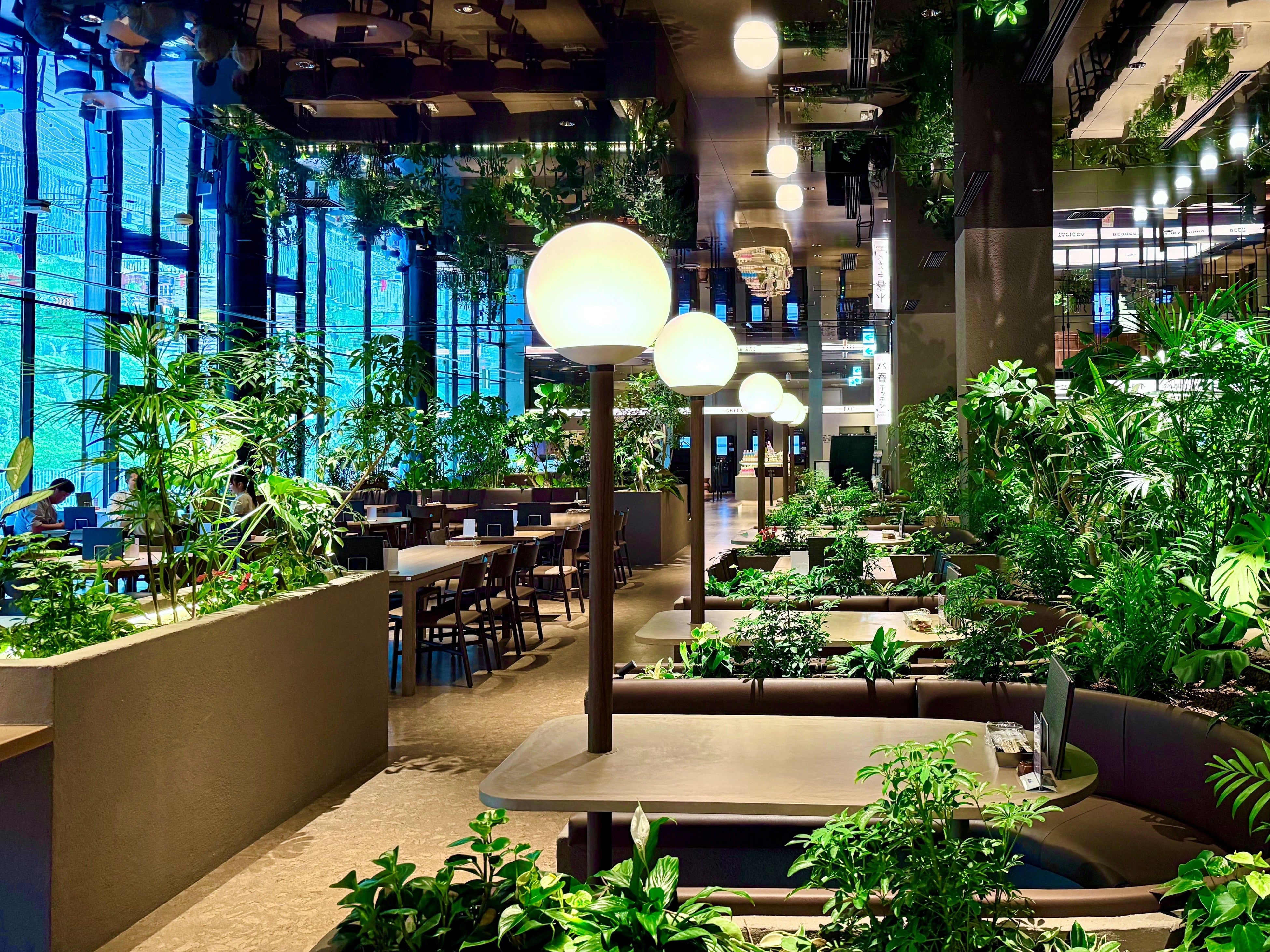
Greenery outside a window need not be brought indoors in the same form. In the lounge at SPA&SAUNA Suishun Hattori Ryokuchi, ceiling mirrors reflect the bamboo grove outside and floor plantings receive that image. Wellne, Hibiya-Kadan’s wellness business, designed, installed, and maintains the planting. The space won the Japan Hanging Basket Association Chairman’s Award in the 2026 indoor-greening competition.
Guiding the Park Indoors through Reflection
The facility stands on the east side of Hattori Ryokuchi. Designed by Yamazaki Kentaro Design Workshop, it aims, according to the official release, to connect nature visible through the windows with interior planting and create “another park.” The mirrored ceiling does more than enlarge the room: it layers bamboo outside with leaves inside, blurring where park ends and building begins.
In photographs, plants are not confined to the walls. Pots of different heights stand behind sofas, at corners of paths, and between seats, dividing sightlines without blocking movement. Tall branches rise overhead; low leaves reach a seated eye. Layers of foliage tune the distances among people resting, eating, and working in one hall.
Plants are dispersed in units comparable to furniture rather than used as one background. A fixed, broad planting bed is difficult to change when uses shift. Here, groups of pots can redraw the room with updated sofas and tables.
Soil-Free Greenery That Can Move
The indoor plants use a soil-free hydroponic base. Wellne says this reduces risks from soil-borne bacteria and pests and, through lower weight, makes rearrangement easier. It is a choice for balancing maintenance and spatial change where bathing, dining, and work meet.
Lightness is not readily visible, but matters in operation. When seating moves for events or crowds, plants need not remain a fixed wall. If pots and furniture can be recomposed together, greenery can return beside people each time the room changes.
Soil-free does not mean care-free. Light, moisture, and leaf condition require continued attention. Hibiya-Kadan’s responsibility from design and installation through maintenance shows planting considered beyond the finished photograph and into time.
Setting the Post-Bath Stay by the Distance of Leaves
In a bathing facility, people move at different speeds before and after a bath: toward reception on arrival, then in search of a seat, sometimes lingering with a drink. Plants do not direct that change as forcefully as signs. The next seat appears through branches, and walking around a pot lets people cross the broad lounge without haste.
Reflected greenery creates more apparent volume than the number of pots alone. Yet spectacle is not its only value. As the bamboo grove changes with season and weather, its indoor image changes too. The ceiling receives the park today rather than holding a fixed interior scene.
A home cannot reproduce this scale, but it can borrow the lesson. Instead of lining pots along a window, consider seated eye height, passage width, and angles in a mirror. Before adding plants, see how one pot changes sightlines and movement. Indoor greening can begin with designed distance rather than quantity.
If You Visit, See the Greenery Outside Too
The facility opened June 5, 2026, at 1-68 Hattori Ryokuchi, Toyonaka, Osaka Prefecture. Official hours are 9:00 a.m.–1:00 a.m. the next day on weekdays and 6:00 a.m.–1:00 a.m. weekends and holidays, with final admission at midnight. Closures may occur for maintenance; check same-day information before visiting.
The point is not to seek only the award-winning pots. Enter the lounge after walking Hattori Ryokuchi and see how window, mirror, furniture, and leaves connect. Plants are not a substitute for the park, but a medium carrying the feeling of time outside into the building. If they make you sit a little longer after bathing, that time too is part of their work.
- Address: 1-68 Hattori Ryokuchi, Toyonaka, Osaka Prefecture
- Opened: June 5, 2026
- Hours: Weekdays 9:00 a.m.–1:00 a.m.; weekends and holidays 6:00 a.m.–1:00 a.m. (final admission midnight)
- Planting design, installation, and maintenance: Hibiya-Kadan Wellne
- Architecture: Yamazaki Kentaro Design Workshop