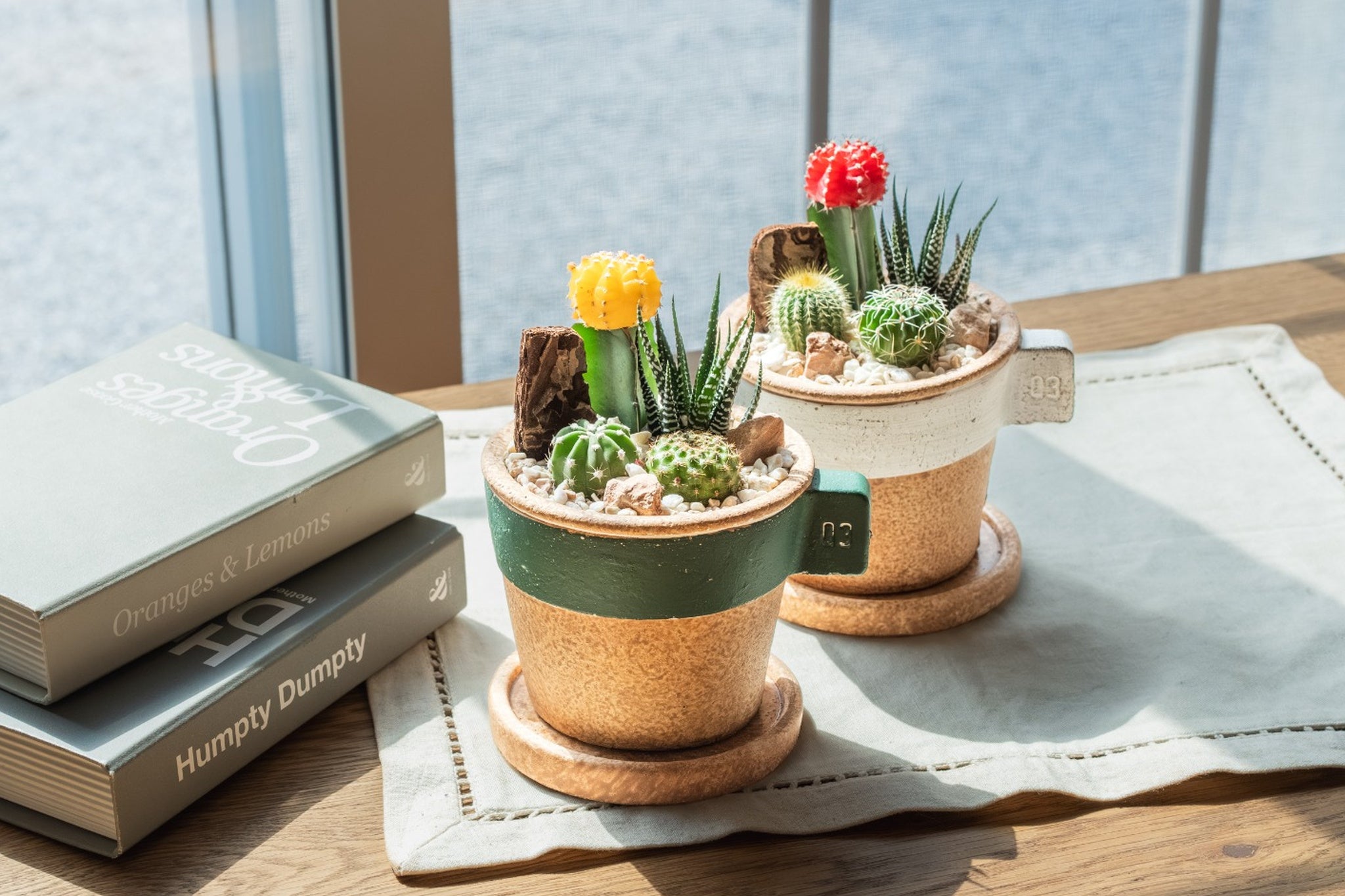
On a small windowsill pot, a red or yellow globe sits on top of a green column. The two colours are not a natural palette within one plant. The bright upper plant, known as Hibotan, has been grafted onto chlorophyll-bearing rootstock. RYOHAKU’s new red and yellow combinations offer a way to look beneath the immediate colour, towards the relationship between two plants that keeps it alive.
The coloured upper plant cannot live alone
Hibotan is sold as a coloured form of Gymnocalycium mihanovichii. Its red, yellow and orange tissues contain little or no chlorophyll, the pigment needed to turn light into food. A coloured plant on its own roots therefore struggles to persist and is grafted onto a green cactus. Its brightness is not decoration alone; it also reveals a dependence on rootstock.
The lower plant carries out photosynthesis and takes up water and nutrients through its roots. It joins the scion across the cut graft union, allowing water and resources for growth to pass between them. The seam does not conceal the fact that there are two plants. It is the crucial place where their different roles are made continuous within one pot.
Seen together, the rounded scion and upright rootstock express those roles through shape as well as colour. Above is a flattened globe patterned with ribs; below is a green column. Choosing a colour also means choosing two directions of growth and the height at which they have been joined.
The mug’s colour makes the graft visible
On October 23, Fun Standard added two combinations to its RYOHAKU latte-mug planter: a green vessel with a red Hibotan, and a white vessel with a yellow one. The listed price is ¥4,980 including tax. Each order is planted in Kasugai, Aichi, with dispatch normally stated as five to eight business days. Availability and delivery can change, so the official store should be checked at purchase.
The arrangement includes companion cacti as well as the Hibotan. Their varieties cannot be selected, and the plants naturally vary in size and form. Rather than expecting the exact balance shown in a photograph, it is more accurate to understand each delivered pot as having its own spacing between plants.
The interest of the new colours lies in more than red against green or yellow against white. A low cylindrical vessel, the vertical line of the rootstock and the round upper plant rise in sequence. Changing the background colour makes the graft union—easy to overlook when the pot is read as one silhouette—more visible.
Not every plant in the pot dries at the same pace
Bright indirect light is a useful starting point. Strong direct sun can scorch the coloured scion, while a position that is too dark weakens the rootstock’s photosynthesis. Rather than watering to a fixed calendar, wait until the growing medium has dried completely and reduce water further in winter. Free drainage and an empty saucer provide the foundation.
In a mixed planter, the Hibotan rootstock and its neighbouring cacti may not show thirst in the same way. Look beyond the colour above: compare the firmness of the rootstock, wrinkling in adjacent plants, the weight of the pot and how the medium dries. Excess water and humidity increase the risk of rot and fungal problems, so water should not remain in the saucer.
As temperatures fall, watch for the cold beside window glass and for direct blasts from heating. A cautious threshold in the cited guidance is to bring the plant indoors before temperatures fall below 10°C and never allow it to freeze. Keep its position steady rather than moving it abruptly into hard light, and observe the graft union and rootstock at short intervals.
Hibotan’s red or yellow is not self-contained. The rootstock receiving light, the roots below, the neighbouring cacti and a grower prepared to wait for dryness all help sustain it. When looking above the rim of the mug, let the eye move just beneath the vivid top towards the graft union. That is where the time of this pot begins.