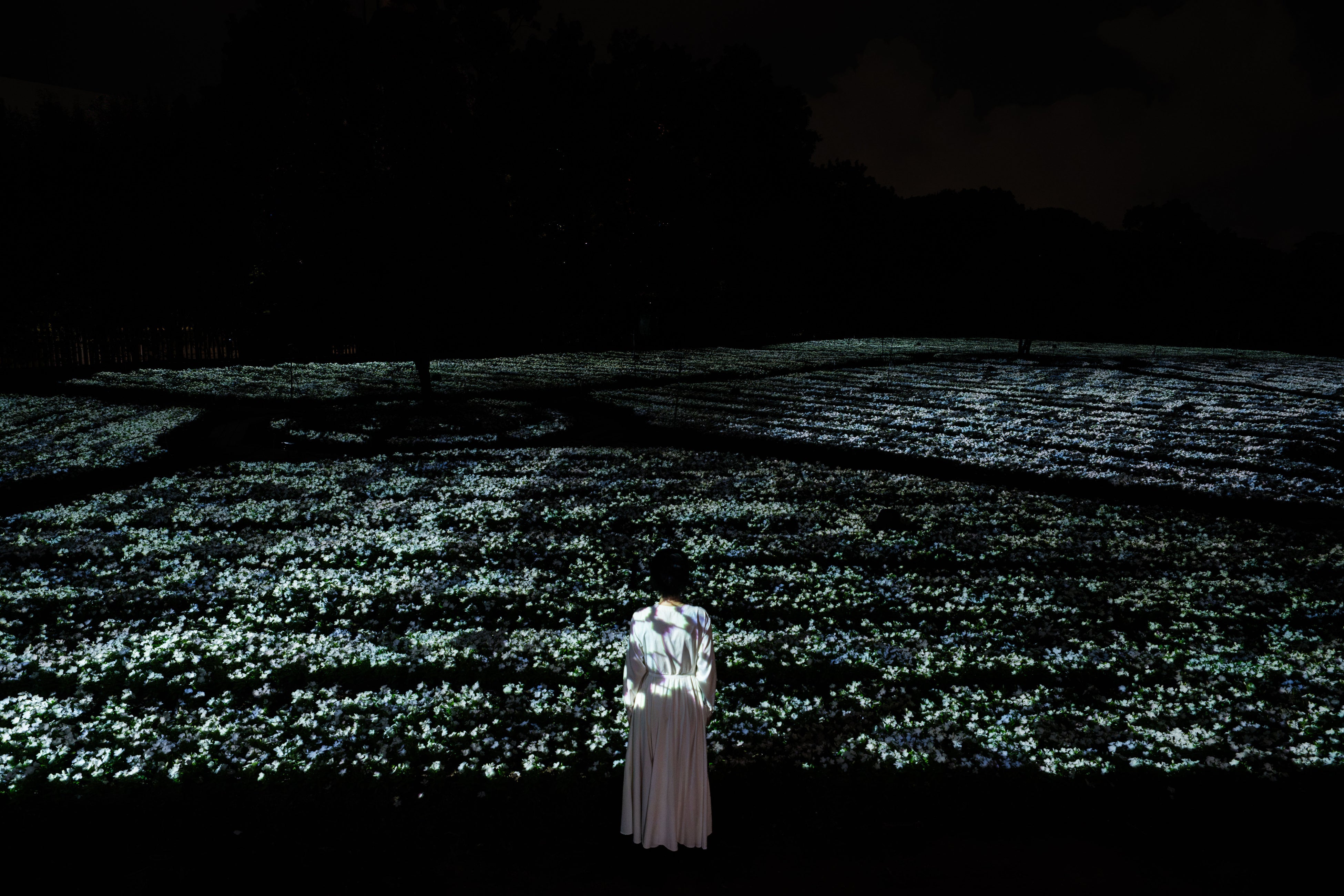
In the official night photograph, white flowers continue into the darkened path, each pool of light lifting the outline of a corolla. The daytime material shows the same field as a bright plane of green leaves and white blooms. The setting has not been rebuilt; living plants and the change in hour give one place two expressions.
Nagai Botanical Garden's White Vinca Fair runs from September 5 through 27, closing on September 7 and 14. Daytime hours are 9:30 a.m. to 5:00 p.m., with final entry at 4:30 p.m., in the Life Garden. White-flowered vinca remains the center of every related program.
A daytime flower field becomes a chain of light at night
On September 3, teamLab opened Life is the Sea Flickering in the Dark in the same field. In the artwork, when people or wild animals approach and stop, nearby vinca glows more strongly and sounds a tone. The response travels through surrounding flowers, while light arriving from farther away signals a person or animal beyond the viewer's immediate sight.
Light does not replace the flowers as decoration. The white corollas receive it and remain visible from plant to plant, allowing movement to register as a change across the field. The sea in the title is supported not by a blue projection, but by the way individual flowers cease to feel isolated and respond through depth.
By day, each white flower separates from its leaves through contrast. At night, the same white becomes a surface that passes light onward. Read together, the fair and the artwork turn day and night into two parts of one botanical experience rather than unrelated events.
Wearing white changes the distance from which the flowers are seen
During the fair, the garden invites visitors to wear white clothing or an accessory for its White Dress Code Challenge. A white dress is not required; a shirt, T-shirt, hat, bag, or shoes can provide a single point of color. Participation is optional, a way to move the flower's color briefly into what one wears.
The clothing does not simply disappear into the field. A photograph can show where the outlines of flower and person overlap and where they divide. Vinca white is not as uniform as cloth: it changes at the flower's center, across overlapping petals, and with the direction of light. A larger plane of white can make those irregular living lines easier to notice.
On September 5 and 6, visitors wearing a white item can receive a white vinca seedling, limited to the first 1,000 people each day. Distribution runs from 10:00 a.m. to 3:30 p.m. while supplies last and is canceled in rain. The route extends from seeing a field of white to taking home a plant that will continue growing in a pot. The giveaway lasts only two days, while the fair continues through September 27, allowing visitors to choose between the moment of taking a plant home and a longer period for looking closely at the field. Clothing and seedlings are presented as ways to alter one's distance from the flowers, not as a contest in accumulation.
A full day requires two sets of admission details
The daytime botanical garden and teamLab's nighttime museum share a site but use separate admission information and tickets. Regular garden admission is ¥300 for adults and ¥200 for high school and university students. Nighttime hours and prices should be checked for the intended date on teamLab's official site and ticketing site. The display period may also change with flowering conditions.
The garden is dark at night and includes uneven paths. Official guidance recommends comfortable shoes, preparation for heat or cold, and seasonal insect protection with clothing that limits exposed skin. Even when choosing a white outfit, color should not displace practical footwear or sleeves. Outdoor displays may also be affected by severe weather.
One shade of white passes from viewer to grower
A fair built around one flower color, clothing worn in response, a night work carried through light and sound, and a seedling taken home offer different forms of participation. Yet white vinca remains central to each. Art does not borrow plants as background, nor does clothing merely copy a floral pattern. Living flowers extend a relationship through where people stand, what they wear, and the pot they tend afterward.
A daytime visit reveals flower centers and the density of leaves. A nighttime visit reveals how one's movement returns through light across distance. Experiencing both shows the same flower presenting its individual form in natural light and the scale of the field in darkness. At Nagai Botanical Garden this September, white is more than a theme color. It moves between plants and people over the course of a day.