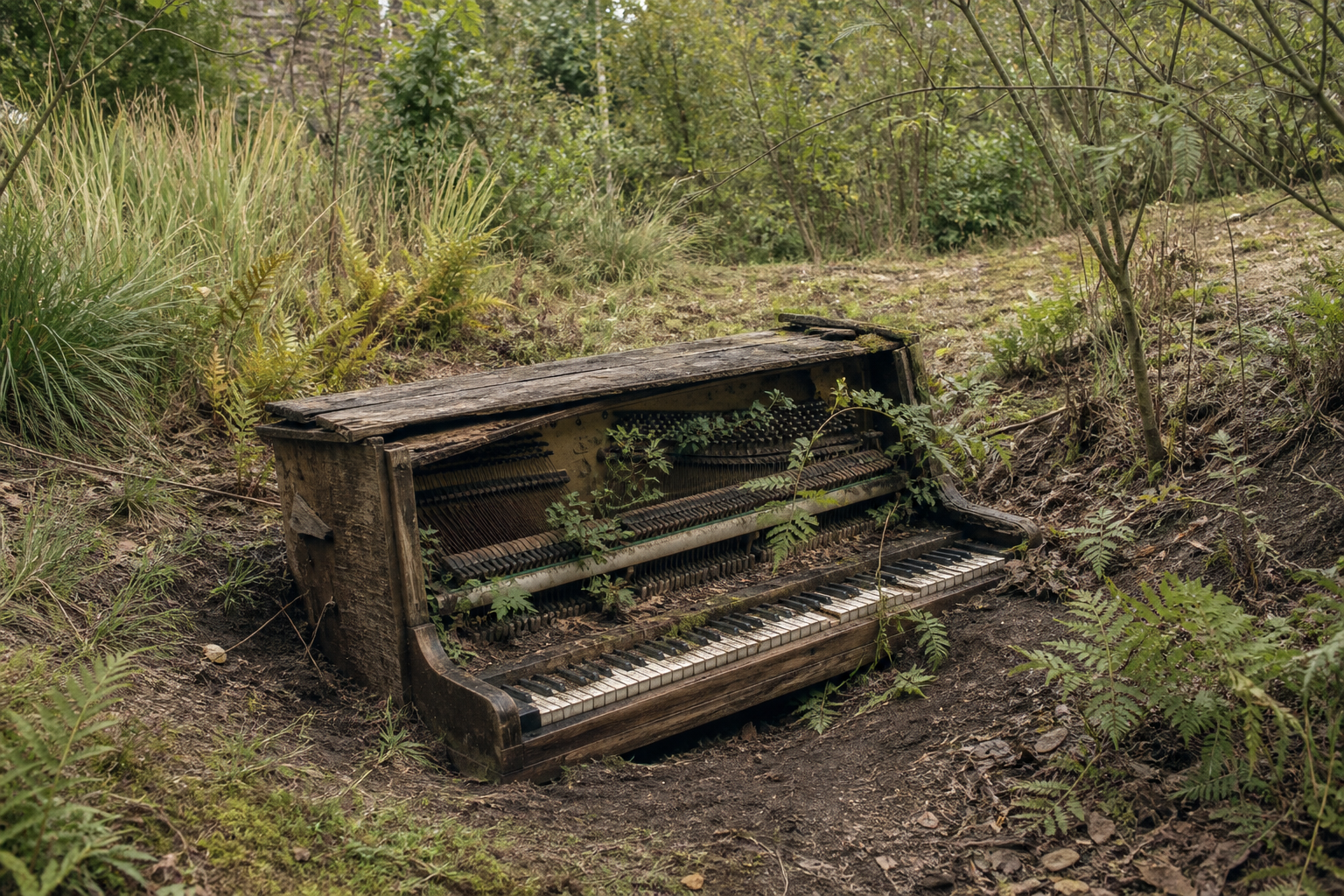
The opening image is neither a view of Serralves nor documentation of the work. Guided by instructions in Lockwood’s published score, it is an image created for this article to explore the relationship among piano, soil, and plants. It should not be treated as evidence of the actual instrument, planting, or arrangement.
Reversing the Premise of Protecting the Keyboard
Piano Garden originated in 1969–70. The composer’s official score requires an irreparable piano. An upright is slid sideways into a sloping trench and placed about halfway underground. A small grand piano may be set among shrubs, with fast-growing trees and vines planted nearby. It remains in place without protection from rain or wind.
The structure removes, one by one, the controls traditionally demanded by an instrument: roof, tuning, dryness, uniform resonance. Without conditions essential to the concert hall, the wooden case, iron frame, strings, and felt inhabit the same environment as plants and soil. The center of the work shifts from preserving pitch to observing how materials change.
It also matters that the piano has finished its useful life. The work does not sacrifice a playable instrument, but gives another function to one already beyond repair. Damaged wood and loosened mechanisms are not concealed as defects; they are re-read as surfaces touching soil, receiving rain, and opening to plants. Rather than completing the work by adding new material, it reveals how what remains reconnects with its environment.
Plants Become Performers, Not Background
Serralves’ official description names the actions of plants, weather, insects, and animals as part of the work. Vines touch the case, humidity swells wood, metal oxidizes, and leaves and soil enter its gaps. This is not a performance of fixed duration. After a person determines the initial placement, the garden assumes responsibility for pace and sequence.
Lockwood called this series Piano Transplants. According to her official biography, the name was inspired by contemporary heart transplants. Burning, drowning, placing on a beach, planting in a garden: these acts can be seen as destroying instruments, but her work transfers the right to make sound from performers alone to the environment. Even after leaving the stage, a piano may find another resonance through raindrops, branches, and slackened strings.
Plants are not there to frame a finished form beautifully. Their direction of growth is uneven and changes with season, sunlight, and soil. There are times of abundant leaves and times when dead stems remain. Unlike a planting display continuously shaped by a gardener, the work accepts change that cannot be fully controlled. Viewers therefore encounter not an ideal combination of piano and plants, but two materials still learning to coexist in one place.
Half a Century Later, the Work Grows Again
This presentation, a collaboration between the Serralves Foundation and Porto Pianofest, opened August 9 in Serralves Park, Porto. The festival welcomed the work into the garden as part of a program connecting music with other fields beyond the concert format. Instructions from 1969 rise again in different soil, climate, and vegetation in 2026. Even when the score is unchanged, a different garden cannot produce the same final form.
Half a century later, there are more ways to read the work. The 2026 book Piano Decompositions considers Lockwood’s piano works through relationships among instrumental disassembly and decay, materials, ecology, and sound. It does not retroactively fix the original intention as one thing. Instead, it offers a new point of entry into the way a changing piano unsettles boundaries between culture and nature, destruction and repair, music and noise.
To Listen, First Look at Where It Is Placed
Piano Garden was on view through August 31. Serralves listed admission at €12 for adult residents of Portugal and €15 for nonresidents, with free admission for children 12 and under and other discounts based on age or membership. Rates and opening status should be checked on the official page before visiting. Published information cannot establish uniformly which keys will sound or which plants are touching the instrument on a given day.
The viewing need not begin with the keyboard. Notice the angle at which the piano enters the ground, where wood meets soil, and whether plants cover the instrument or pass through its gaps. Even when no sound is heard, placement lets the work say much. Seeing the garden as an agent of change rather than scenery expands the outline of what composition can mean.
There is no need to carry a household piano into a garden. Even with one nearby pot, attention can shift beyond the leaves to the floor beneath it, the wind entering through a window, and the soil as it dries. Piano Garden leaves the sense that a long relationship is shaped not only by how we preserve a thing, but also by what we choose to let it change alongside.