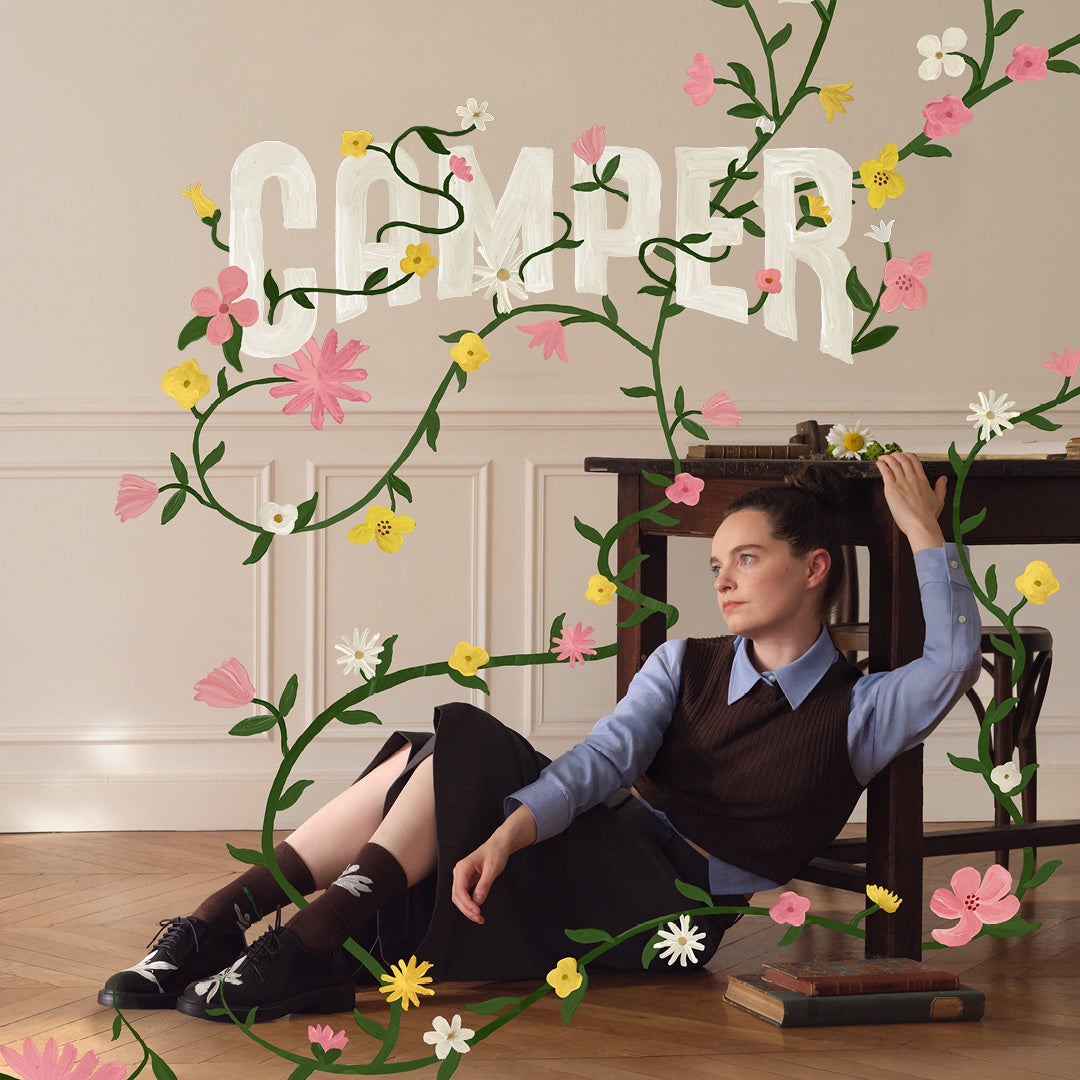
Dancers Emma Portner and Toon Lobach inhabit a set styled like a study, with herbarium volumes and glass bell jars. Amsterdam-based duo Blommers & Schumm photographed the campaign. Erik Winkowski's flowers do not hang on the wall as specimens; they unfurl from the toes of black leather shoes and into the room.
The campaign name combines flora with the suffix -topia, denoting a place. CAMPER calls this imagined setting the Camperium and arranges its shoes like specimens. The mismatched principle behind TWINS, introduced in 1988, becomes a frame for the variations in a flower's form and from one plant to another.
Four Scientific Names Reshape a Shoe
The official digital campaign lists Tulipa gesneriana, Lilium candidum, Bellis perennis, and Ranunculus acris. Plants of the World Online at the Royal Botanic Gardens, Kew accepts all four names. Tulips and lilies belong to Liliaceae, daisies to Asteraceae, and buttercups to Ranunculaceae. Rather than folding everything into a generic floral print, the campaign distinguishes plants from different genera and families.
Casi Myra carries a wavering outline suggestive of a parrot tulip; Dean is paired with the white lily; Pelotas and Runner Twentyfive with the daisy; and Right Left with the buttercup. This is not a field guide that converts plant features directly into footwear functions. It reads more like a design note, layering associations from each plant name onto a low silhouette, lines of leather, and differences between left and right.
The four plants differ in flower size and growth habit. Tulipa gesneriana and Lilium candidum grow from underground bulbs. Bellis perennis is a perennial that spreads its leaves close to the ground, while Ranunculus acris has palmately divided leaves and branching stems. Looking from pair to pair, even the placement and height of an embroidered line begin to suggest why each flower was chosen.
The Blue Buttercup Is a Deliberate Departure
Ranunculus acris is the most revealing choice. The Royal Horticultural Society describes this perennial as bearing bright, glossy, golden-yellow flowers. CAMPER, by contrast, calls the blue buttercup paired with Right Left a botanical “anomaly.” The color is not presented as botanical fact; an impossible blue has been chosen as a sign of difference.
Right Left, poised between a ballerina flat and a heel, also refuses a single category. The scientific name signals precision while the color intentionally steps outside it. The distance between the specimen room's order and the illustrated flower's freedom moves this botanical expression beyond a conventional print.
From the Stillness of a Specimen, Flowers Begin to Walk
A real herbarium specimen preserves a pressed plant together with its collection place, date, and name. Floratopia borrows not that preservation method, but the habit of observing closely and giving details a name. When mismatched shoes are viewed as one pair, the eye moves nearer to the direction of a petal, the curve of a stem, and the difference between embroidery and print.
The campaign should not, however, be read as a botanical reference. There is deliberate invention between the horticultural form of a parrot tulip and the name Tulipa gesneriana, just as there is between Ranunculus acris and its blue illustration. CAMPER does more than borrow botany as decorative authority; its playfulness appears in the moment it departs from botanical accuracy.
In Namba Through September 15
The Fall/Winter 2026 collection launched on September 2 at CAMPER stores, the official online shop, and selected retailers worldwide. Through September 15, a Floratopia pop-up occupies the POP UP STATION on the second floor of Osaka Takashimaya. According to the official announcement, floral new arrivals are shown alongside a wider selection of shoes and bags.
Fashion and footwear often isolate only the beauty of a flower. Floratopia brings in sterner words—scientific name, classification, specimen, anomaly—to support a mismatched pair. What remains at the feet is more than the brightness of a bouquet. It is time spent observing plants that each have a name and never grow into exactly the same form.