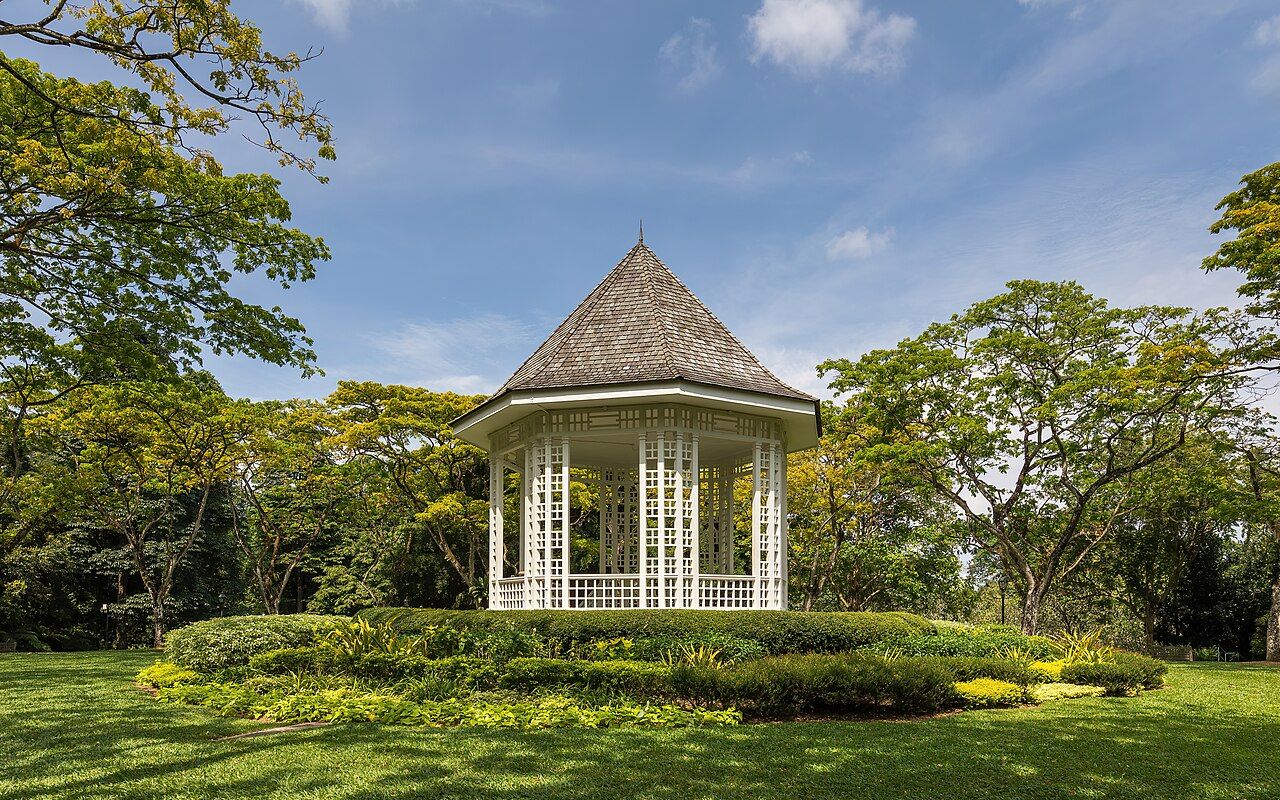
A white bandstand stands beyond the lawn, enclosed by a broad canopy of trees. The opening photograph was made at Singapore Botanic Gardens in 2018 and does not document the 2026 festival. It does show a defining quality of the place: architecture is not isolated from its setting, and shade, grass, and gathering space are used as one landscape.
The 2026 Singapore Botanic Gardens and Fort Canning Park Heritage Festival runs for nine days, from September 5 through 13. Guided walks, exhibitions, talks, cultural performances, and hands-on programs unfold across both gardens. Singapore's National Parks Board frames heritage not as a past already preserved, but as a responsibility carried forward through the care of living plants and landscapes.
Walking beneath trees instead of reading a timeline
Singapore Botanic Gardens was inscribed as a UNESCO World Heritage Site on July 4, 2015. The Heritage Festival began the following year and has become an annual occasion for receiving the Garden's history through performances and activities. Broad promenades, water, lawns, and scattered trees preserve traces of its beginnings as a British pleasure garden while remaining part of a landscape in daily use.
Heritage here is not limited to the dates of old buildings. Mature trees are conserved for exceptional size, age, rarity, and historical or cultural significance, with storyboards explaining individual lives. A tree cannot be moved to meet its audience. Visitors change their own position, walk around its canopy, and learn how one living form belongs to a particular piece of ground.
The Garden's history also joins public pleasure with botanical work. Experimental plots for economic crops, the herbarium, library, orchid collections, and rainforest conservation occupy different layers of time on the same grounds. Festival tours and exhibitions bring that accumulated knowledge out of specialist rooms and back within reach of an ordinary walk. A visitor can ask not only what a plant is called, but who collected, cultivated, recorded, and made it accessible.
Music changes the order of a walk
The official program places music, art, and guided experiences together. A performance confined to one stage asks an audience to face in one direction until it ends. When cultural programs are distributed through a garden, paths enter between them. Trees and water become part of the time between one gathering and the next, giving the day a sequence shaped by the landscape.
The Bandstand makes that relationship visible. Its white columns and roof have a clear outline on the lawn, but no wall fixes the audience in place. Trees divide the light around it, and the structure changes as a visitor approaches from another direction. The value of music in a garden is not a green backdrop. Plants help determine where people stay and how they move.
Earlier editions brought locally rooted music, light-based storytelling across familiar sites, and workshops that extracted plant DNA into the same festival period. Performance, illumination, and science may appear to belong to different programs, yet each treats the Garden as an active meeting place for culture, stewardship, and research. The 2026 edition carries that method across two parks.
Travel between two gardens becomes part of the festival
The venue extends beyond Singapore Botanic Gardens to Fort Canning Park, another landscape layered with the city's history. On festival weekends, a free shuttle links the two sites from 9 a.m. to 10 p.m., running about every 15 to 20 minutes. The connection allows the gardens to be compared within one day rather than divided into separate visits.
Singapore Botanic Gardens is open daily from 5 a.m. until midnight, and admission is free. Individual festival programs vary in location, time, capacity, and registration, so visitors should check each listing before arriving. In a garden of this scale, the lawns, woods, lakes, and glasshouses encountered between scheduled stops deserve a place in the plan.
Preservation and continued use remain together
Protecting a historic garden can sound like leaving it untouched. Trees keep growing, however, shedding branches and changing light and circulation around them. A day of music and exhibitions still requires decisions about root zones, lighting, equipment, and visitor movement. Continued use is not the opposite of preservation; it can make the choices of stewardship visible.
Keeping time with plants involves more than saving a photograph. The place where music was heard, the tree that stopped a guided walk, and the route between two gardens all join a landscape's history to a personal day. Looking at an old tree also brings the work needed to pass it forward into view. Singapore's nine-day festival keeps long-lived plants out of a distant past and within the culture of the present.