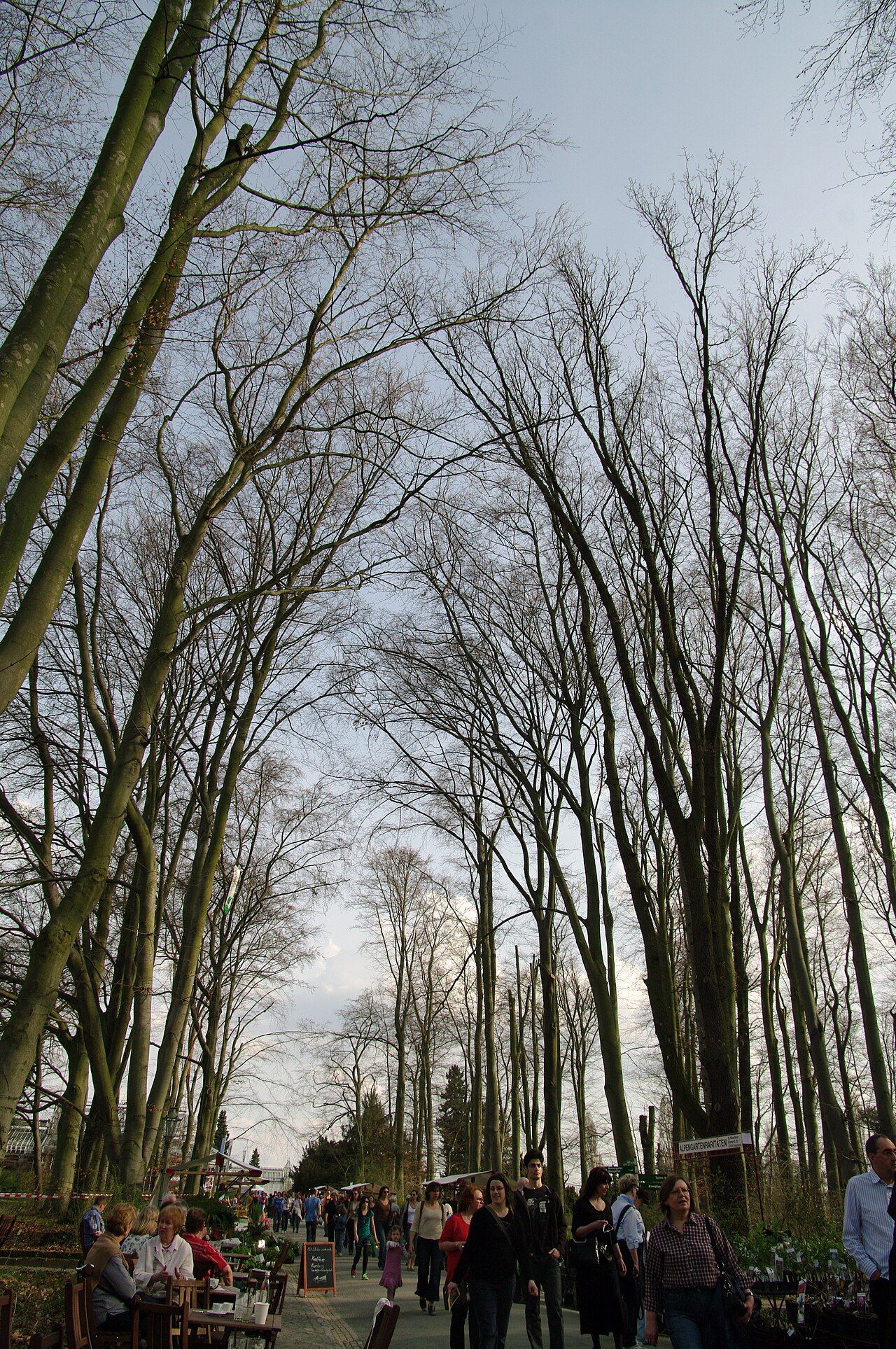
White canopies and plant tables line a path through the trees. In a photograph from the spring 2011 perennial market, visitors pause before trays of plants, then continue to the next stand. The image does not document the autumn 2026 event. It does show the structure that defines the market: the garden paths become the sales floor, and the plants encountered change with the pace of the walk.
The autumn 2026 Berliner Staudenmarkt runs on September 5 and 6 from 9 a.m. to 6 p.m. at the Berlin-Dahlem Botanical Garden. The garden and greenhouses open an hour earlier than usual, with the garden closing at 7 p.m. The organizer says more than 80 nurseries, tree growers, and seed farms will line over one kilometer of paths before the historic greenhouses. The Botanical Garden describes the full market route as roughly 1.5 kilometers.
A 1.5-kilometer path becomes time for comparing plants
Unlike a shop floor visible all at once, a long market gives every choice a sequence. Visitors may begin with perennials, meet trees farther along, then reach bulbs and seeds. Regional small growers and specialists from neighboring countries share the same route, and only selected professional exhibitors are admitted. The value lies less in a rare name than in the short distance between a plant and the person who can explain its size, planting position, and winter requirements.
The market does not end with purchasing. Associations, institutions, and publishers provide information on conservation, garden culture, and plant use. The Botanical Garden's advisory team will discuss regional seed and biodiversity, while this year's program also considers winter shelter for bats and hedgehogs. A perennial chosen to fill an empty border can also shape the places where other life remains through the cold season.
For 26 years, the market has connected specialists and visitors during the spring and fall planting seasons. Its accumulated value includes details that are often compressed on a retail label: the climate where a plant was raised, the form of a mature specimen, and its size several years later. This is less a place for impulsive plant buying while traveling than for matching a plant's future conditions to a garden or room back home.
Foliage and fruit take their place beside flowers
September gives more prominence to foliage and fruit than flowers at their peak. Sedums, echinaceas, wild asters, pennisetums, and other hardy perennials and ornamental grasses appear alongside maples and sweetgums chosen for fall color, as well as grapes, kiwi vines, and regional apples. Leaves and fruit that remain after petals fall help show how long a garden's autumn can hold its form.
Fall is also a time to buy the following spring. Tulips and snowdrops are joined by bulbs such as Puschkinia and Chionodoxa, seeds for biennials, and winter vegetable plants. Agaves, mimosas, and citrus are offered for indoor rooms and winter gardens. Present form and future growth share the same stalls, placing planting time and location alongside color in every choice.
Measuring the light and space at the intended planting site, and deciding where a container can spend winter, makes questions at the market more precise. A perennial shapes a garden not only through one season of bloom but also through dormancy and its width the following year. Turning abundance into better questions rather than a larger number of purchases makes the differences between plants easier to see.
Fuchsias loosen the hold of an old reputation
The organizer has made fuchsias the theme of the autumn 2026 market. Sometimes dismissed in Germany as old-fashioned balcony plants, they return here through a wider range of forms and colors and cultivars capable of overwintering in the garden. The point is not to replace a nostalgic plant with a newly fashionable one. It is to compare differences in growth within the genus through living plants and the knowledge of growers.
The questions change depending on whether a fuchsia will remain a potted display or become a lasting garden plant. Hardiness labels, planting position, and winter care cannot be judged from flower color alone. The market's focus shows why long-familiar plants should be chosen by cultivar and growing conditions rather than by reputation.
The route for carrying plants home is part of the market
After walking 1.5 kilometers, returning to an entrance with several pots is not a small task. Plant taxis and temporary plant parking move purchases toward either exit, while visitors may bring their own carts for the paved paths. There is no parking for cars or coaches, and the organizer asks visitors to use public transport and bring reusable bags or carrying equipment. The route home has been designed to match the scale of the sale.
Entrances are on Königin-Luise-Strasse and Unter den Eichen. Admission is €10, reduced to €7, with free entry for children under six. Conditions can change with the weather, so visitors should check the Botanical Garden's day-of information before leaving. A plant selected along the route continues the season in a garden or room; the market becomes complete when choosing includes a conversation about that later life.