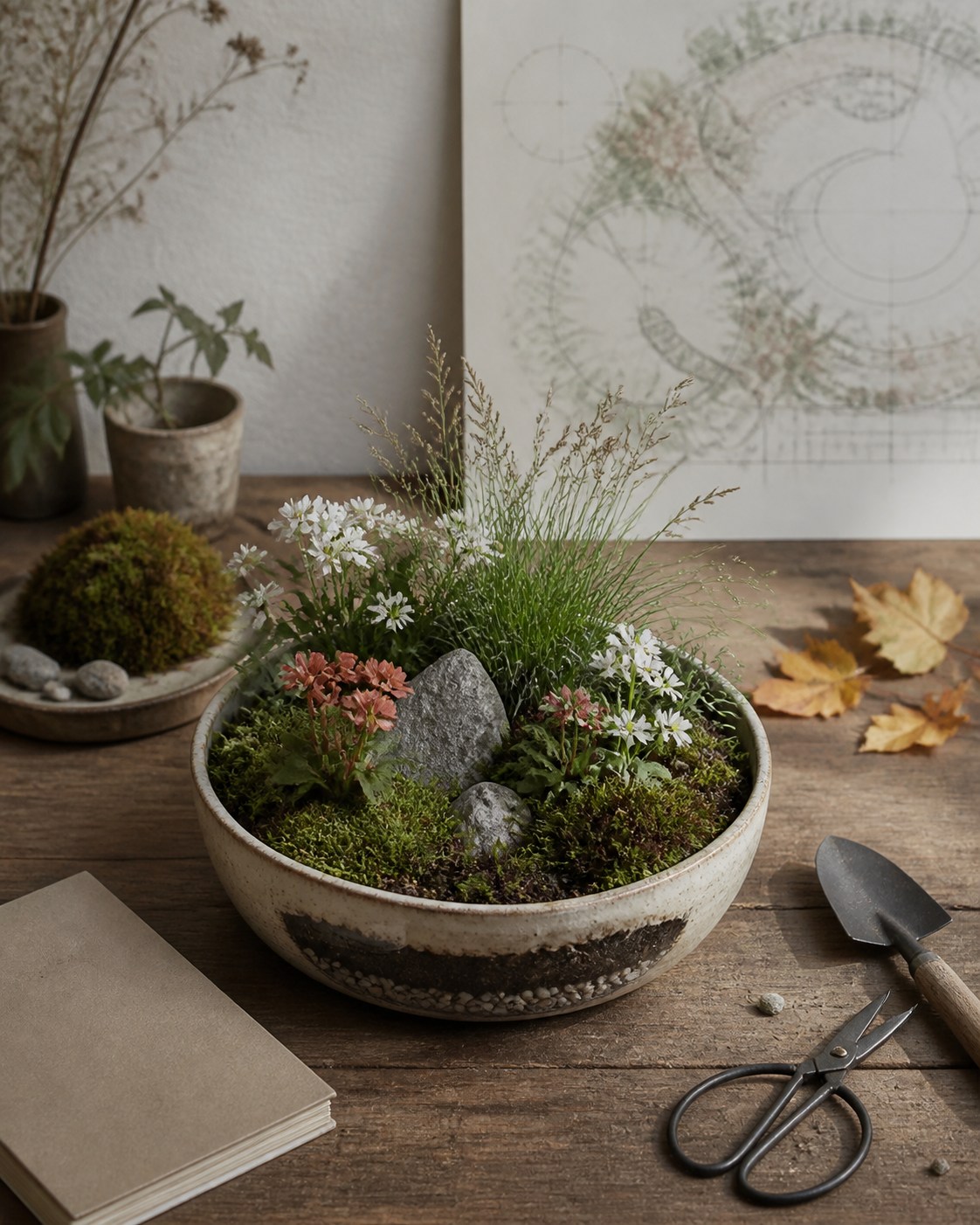
A small garden is not made by reducing plants to fit inside a limited vessel. It requires choices about differences in height, overlapping leaves, spaces around stones, and room for future growth. What makes the Fukuoka City Botanical Garden course compelling is that it does not leave those decisions on the tabletop. It pairs them with maintenance of the One Flower per Person Garden Lab supervised by Kazuyuki Ishihara.
Participants study plant placement and care in the Garden Lab, then create a seasonal mixed planting to take home. A relationship seen in a public flower bed is transferred to a scale that can be watched at home. The course centers less on making a finished piece once than on learning to keep adjusting the arrangement as the plants change.
Tending a Public Flower Bed Before Planting a Pot
The One Flower per Person Garden Lab opened in October 2021 on the former site of a fountain in the lawn plaza at Fukuoka City Botanical Garden. The City of Fukuoka and the Fukuoka City Greenery Promotion Association have positioned it as a base for cultivating people who will lead “community building through flowers and co-creation.” The Miniature Garden Course likewise gives participants a chance to learn directly from Ishihara through the Garden Lab’s upkeep.
There is meaning in beginning with maintenance. A garden does not retain the composition it had when planted. Stems extend, leaves overlap, and flowers finish, changing where light and air can reach. Once participants have decided in an actual flower bed what to keep and what to edit, empty space in a container can be chosen not as leftover room, but as room for plants to move.
October, December, February: Three Seasons Rearrange the Planting
The 11th session consists of three classes: October 3 and December 6, 2026, and February 7, 2027. They span the threshold of fall, winter, and early spring, when light and temperature change even within the same region. The official announcement says each class will make a seasonal mixed planting, without fixing particular plants or a final design in advance. That leaves room to update ideas about placement and care in response to each day’s materials and condition.
When garden design is treated like a single photograph, the arrangement on planting day easily becomes the standard. A continuing course separated by three seasons opens that view into time. Each encounter with a different temperature, volume of foliage, or position of flowers changes the judgment needed to tend the garden. It is less like memorizing one style than practicing how to recompose what is in front of you.
Passing the International Show Garden on to the People Who Tend the City
In 2020, Ishihara became Fukuoka City’s first One Flower per Person Ambassador. His role includes not only creating flower beds across the city, but also increasing the number of people who care for them. At the 2026 RHS Chelsea Flower Show, Tokonoma Garden — Sanumaya no Niwa, created with Paul Noritaka Tange, received a Silver-Gilt Medal. It likewise created depth without an excess of plants, using stone, moss, water, and the heights and tones of foliage.
An international show garden and a three-part course for 24 people in Fukuoka differ in scale and purpose. Yet both involve choosing relationships among materials in a limited place and accepting the changes that follow completion. Instead of merely admiring a major award, the course breaks those judgments down into tending a public flower bed and making a single container. The knowledge reaches the city’s flowers through this transfer of technique.
What 24 Participants Take Home Is More Than a Finished Arrangement
The course is open to adults 18 and older, including beginners. Enrollment is limited to the first 24 applicants, and the fee is ¥15,000 for all three sessions. It includes materials for three mixed plantings, an apron, admission to the zoo and botanical garden, and botanical-garden parking. If weather or temperature makes work in the Garden Lab difficult, the session will shift to classroom instruction. Applications are accepted September 1–18 through the Fukuoka City Greenery Promotion Association’s information page.
A mixed planting taken home is not a souvenir of the day it was made, but a garden whose observation continues. How does the space change as leaves grow? What remains after the flowers finish? Care learned in the botanical garden’s beds returns to a single container at home, and insights gathered there can flow back into the next public space. Moving between scales offers a small, concrete entry point for ensuring that the city’s flowers are not one person’s work alone.