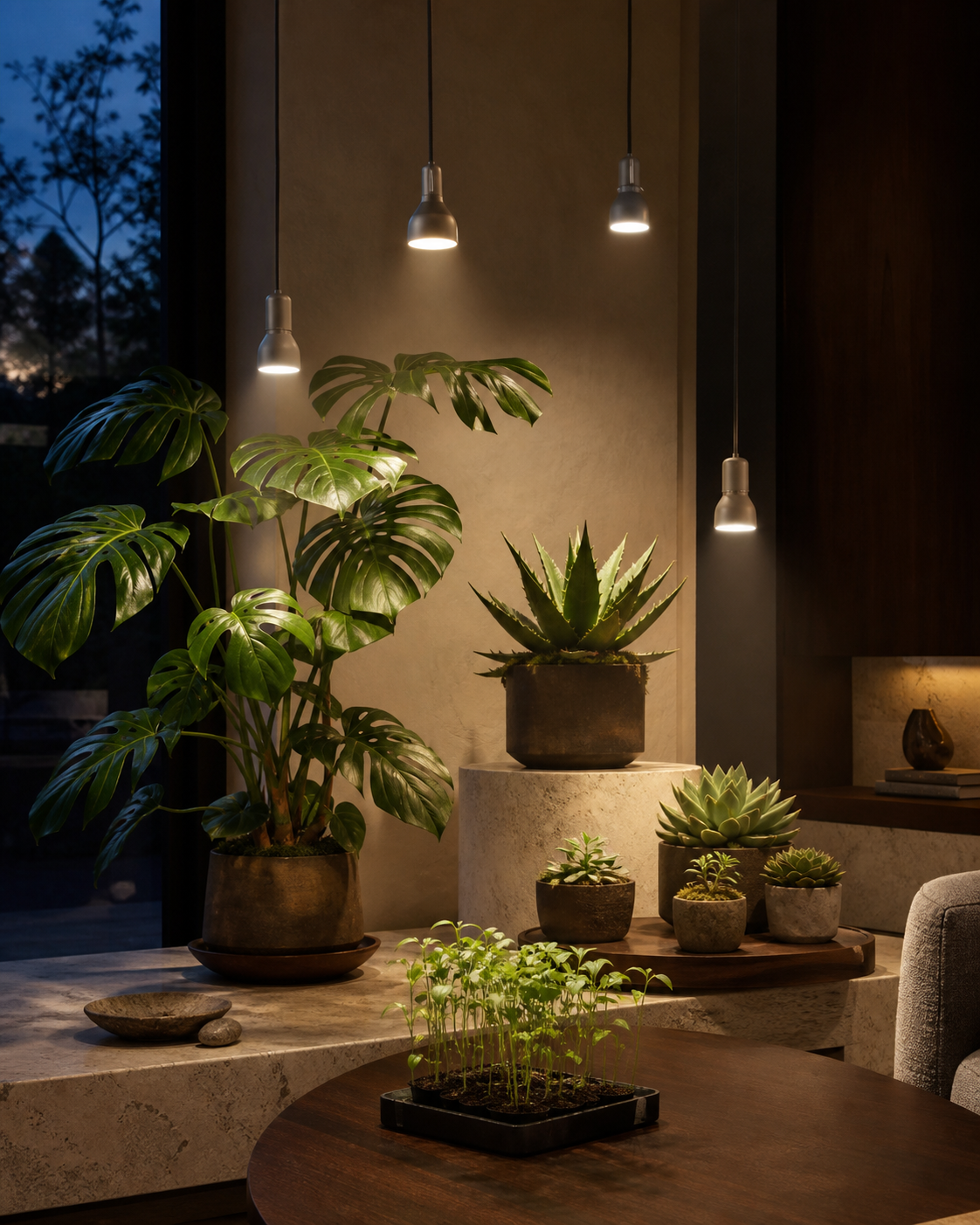
At dusk, as window light thins into blue, leaf edges and the depth of a room recede together. A grow light can restore that scene, but shelves are crowded with cool white, warm white, focused and diffuse lamps in 10W, 20W and 24W forms. The largest number is not automatically the best lamp for every pot. The right choice is not the winner in brightness; it is the light that fits the distance between one plant and one room.
RareDex checked 20 bulb-style products with current manufacturer information and a purchasing route in Japan. Panel and bar lights are excluded, and housing colors alone are not counted as separate products. Functionally different light colors such as 4000K and 5800K are separated because they materially change how foliage and interiors appear. This is not a score-based top 20. It is a September 2026 map for narrowing the field by placement.
Turn light measurements into a view of the pot
PPF describes photosynthetically active light emitted each second; PPFD describes its density at a surface. Yet a number is not a buying decision when manufacturers use different distances, center points, optics and surrounding conditions. A high center reading at 40 cm does not mean the edge of a large Monstera canopy receives the same light. Conversely, a gentler center reading from a wider beam may better supplement a small group of pots.
The comparison keeps every stated figure attached to its manufacturer test condition. A blank appears when a product has no published PPFD, gives illuminance only, or has conflicting figures across official pages. A blank is not a verdict on performance. It marks the present limit of comparable primary information. RareDex has not converted or invented measurements it did not make.
- Will the light cover one small pot, one broad-leaved plant, or a group of pots?
- Will it supplement window light, or support a space with very little daylight?
- How many centimeters are available to the canopy, and how wide an area must be covered?
- Is it a daytime work light, or will it remain on in the living room at night?
Light for one pot and light for a shelf
For a single pot, begin with canopy diameter rather than wattage. A small pothos or young philodendron may pair well with a 9–10W lamp as a supplement near a daylit window. A medium Monstera or Ficus whose leaves extend beyond one narrow beam may need a 20W-class lamp placed farther away, a wider beam, or two separate lamps. Moving a lamp away widens the pool but lowers intensity, so width and strength must be watched together.
Agaves, cacti, succulents and caudiciforms include many plants that favor bright conditions, but needs vary by genus, species, dormancy and acclimation. A focused lamp with a high center PPFD can be useful, yet suddenly placing it close to a plant that lived by a window can cause bleaching or scorch. Start farther away and adjust distance or operating time over days rather than hours.
On a shelf of several pots, the important question is how much light remains at the edges, not only beneath the strongest center point. Several bulb-style lamps can adapt easily to different heights and changing arrangements. For truly even shelf-wide coverage, however, a panel or bar light may be more rational than adding many bulbs. These 20 products serve readers who want flexible light from one pot to a small group.
Four design ideas across 20 products
BARREL's six products span 9W, 10W and 20W, with crisp 5900K light, middle-range 4000–5000K and warmer 4300–4700K options. MINI GROW SUN balances a small pot with its surroundings; AMATERAS emphasizes a clean white appearance; TSUKUYOMI offers a softer color; and WAP-SUN adds IP65 and a more diffuse character. Choosing by light color, water exposure and required area is more useful than choosing by brand alone.
BRIM's SOL, LUNA, COSMO and COSMO UV stand out for pricing around the 24W class and the volume of buyer feedback. SOL and LUNA offer 4000K or 5800K; the official lineup gives COSMO a higher center PPFD. COSMO UV includes ultraviolet wavelengths, but its official lineup and retail page conflict on PPFD and lens inclusion. Rather than repeat a disputed figure, this article keeps it as a product whose current specification requires confirmation from the seller.
HaruDesign offers GL-A, GL-X, HASU38 and Light STAFF VA in 4000K and 5800K. GL-A emphasizes price, GL-X accepts interchangeable lenses, HASU38 has a 2026 heat-resistant lens update, and Light STAFF VA changes beam angle at the body. A three-year warranty also matters for a tool that may run for long hours. One long-use report described lens deformation in an older HASU38 and a manufacturer parts replacement; it is not treated as the failure rate of the current 2026 version.
Richell's 8.5W lamp states 6500K and 2,000 lx at 30 cm. Tokyo Metal's 16W lamp states a 40-degree beam, IP44 and a one-year warranty. They are not present to fill the edge of a chart. They mark two different entry points: modest supplementary output and a mid-output lamp with clearly outlined specifications. Illuminance in lx and PPFD are different quantities and are not ranked against one another.
Monstera and Agave do not resolve to the same lamp
Monstera favors bright indirect light, but a larger canopy becomes difficult to cover with one narrow spot. A 10W-class lamp may supplement a young plant, while a large specimen can require a 20–24W lamp placed farther away, a diffuse optic, or two lamps. No product is assigned by plant name alone; canopy size, window light and lamp distance belong in the same decision.
Agaves and compact succulents can fit neatly inside a focused pool of light, but more intensity is not always better. COSMO's focused approach, GL-X optics and Light STAFF VA's variable beam can shape a circle around one plant. Because the center may be much stronger than the edge, inspect leaf tips, the crown and the far side of the pot on the same day. If the pot is rotated regularly, keep that movement in the growth record.
Seedlings and small cuttings can sit too close to a lamp surprisingly quickly. Begin with 9–10W or a wider beam, and observe temperature and drying speed. A grow light changes more than light: it can affect leaf and substrate temperature, water loss and room humidity. After installation, reassess watering from pot weight and substrate condition instead of preserving the old calendar interval.
4000K and 5800K change the time of a room
Around 4000K, light tends to sit comfortably with wood, soil and beige walls and can remain easier in a living room after dark. At 5800–6500K, veins, new growth, pests and the substrate surface can appear clearer, though the same crispness may feel hard during quiet evening hours. Color temperature is not only a growth label; it is a daily visual choice. Cool white for daytime work and warmer light into the evening can both be coherent decisions.
The 4K and 6K versions from one brand are separated because light color changes materials, foliage and comfort across the day—not to inflate the count with cosmetic variants. White and black housings alone remain one product. The goal is to preserve differences that can change a purchase, not to defend the number 20.
Reviews illuminate only what specifications leave out
Reviews can reveal glare, heat, weight, socket compatibility, stiff adjustment parts and support after an early failure. BRIM's official Rakuten store has accumulated multiple ratings for SOL, LUNA, COSMO and COSMO UV, while HaruDesign's store retains comments on current and earlier products. A single report that a plant grew well is not evidence of efficacy: water, distance, season, operating time and daylight are not controlled.
Negative observations about heat, glare, deformed parts and a stiff adjustment ring were considered alongside praise. When review volume is small, dates and specific circumstances matter more than the average score. Posts with unclear sponsorship, videos with uncertain model numbers, and retail pages that merge old and current versions are not elevated into evidence of popularity or durability. Reviews are a source of better questions, not the answer itself.
Check sockets and heat before chasing light
- Check the fixture's maximum wattage and load rating, not only the E26 base
- Follow each product's rules for enclosed fixtures, dimmers and insulation-contact fixtures
- An IP44 or IP65 lamp does not make the socket, cord and connection water resistant
- Keep curtains, paper and dry foliage clear, and do not obstruct heat dissipation
- Do not touch a lit or newly switched-off lamp with bare hands; let it cool before replacement
- Before unattended timer use, observe heat and surroundings for several days
The final measurement is the distance to your own pot
For a first lamp, consider 9–10W for a small pot with daylight, 20–24W for one medium plant, around 4000K where evening glare matters, and 5800–6500K on a shelf where crisp inspection matters. For agaves and caudiciforms, focused or variable optics may help. For broad leaves or several pots, start with spread or multiple lamps. This framework will outlast any product name.
Before buying, measure pot diameter, maximum canopy width, distance from the window and available hanging height. After buying, keep a one-week record. With those two acts, catalog numbers finally become the language of your room. The aim is to make plants beautiful at night without leaving stress on the next morning's leaves. Choosing a bulb-style grow light is less about adding brightness than shaping the hours spent with a plant.