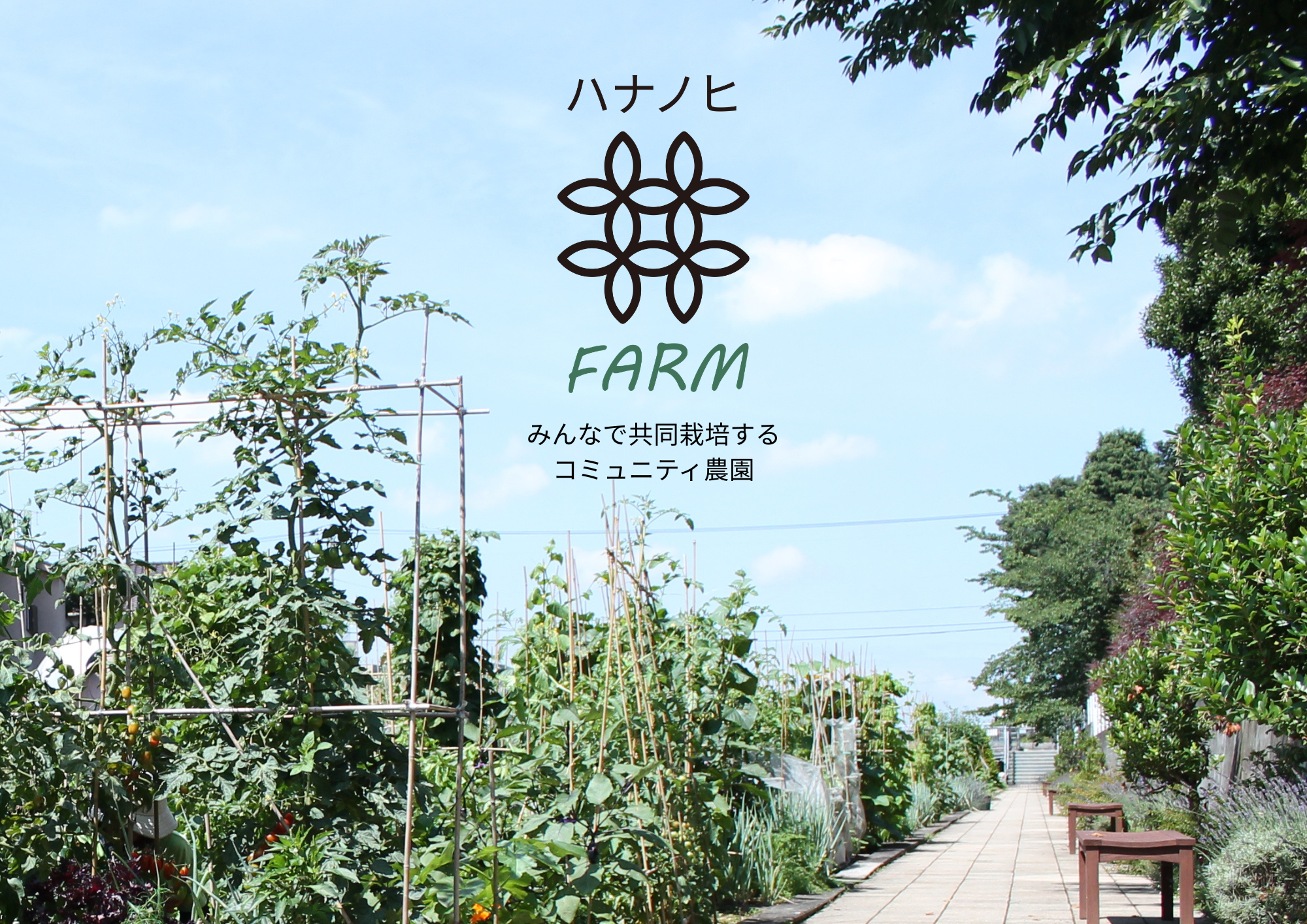
The opening image shows a bright field: staked tomatoes at left, a straight path between beds, and hedge and bench at right showing this is also a place to pause. Centered words—“A community farm cultivated together”—describe how the scene is meant to be used.
On July 27, 2026, Hibiya-Kadan and PLANTIO announced that HANA NO HI FARM, a community farm for joint cultivation, would open that fall within Agris Seijo in Setagaya. Membership opened that day, with a pre-opening information session planned August 22. Near the station, members grow seasonal flowers and herbs as well as vegetables. The new unit is not what is grown, but who cares for it.
From “My Plot” to One Field
In a conventional allotment, the renter generally handles watering and weeding. HANA NO HI FARM asks members to jointly manage one field and share what it produces. If one person cannot visit during a busy week, plant time does not stop. By not locking care into one schedule, it tries to connect changing lives with continued cultivation.
Soil, seeds, seedlings, and tools are supplied, so members can arrive empty-handed. Visits of roughly 30 minutes to an hour fit individual schedules. The joint release says an on-site field coordinator supports growth about once a week. This is less a service where someone grows for you than groundwork for pooling knowledge, tools, and time.
Keeping Changes in Soil beyond the Screen
The field will use PLANTIO’s grow CONNECT soil sensor and grow app. The announcement describes soil readings used to notify members when watering or harvest may be appropriate. It does not mean growing without touching soil; it provides clues during time away and reasons to return.
For a pot, weight, leaf firmness, and drainage can guide one observer. A shared field cannot depend on one person’s view, so sensor records are layered with the perceptions of people seeing soil and leaves on site. Numbers do not replace the plant; they become common language connecting separated observers.
RareDex notices the subject of cultivation records shifting from “I” to “we”: who watered yesterday, which leaf changed, and what comes next. Shared records retain not only harvest but the judgments leading to it. Time with plants becomes the history of people gathered around a place, not an owner alone.
Flowers and the Table Begin in the Same Bed
Seasonal flowers, herbs, and vegetables share the farm. Vegetables go to the table, herbs to food and drink, flowers indoors after cutting. Plants often received from separate retail shelves begin here in one soil and one body of work. Time spent in the field connects a culinary leaf with a bloom at the window.
Sharing does not eliminate burden. Weather, growth, and member schedules change harvest amounts and timing; official information guarantees neither yield nor crops. This is not shopping by another name, but joining care that includes uncertainty. Whether that premise fits is the first question before membership.
Opening a Cultivation Schedule in Seijo
The farm is within Agris Seijo at 5-1-1 Seijo, Setagaya-ku, Tokyo. Monthly membership is ¥3,278 including tax, with no additional charge for up to five family members in the same household. Normal hours are 9:00 a.m.–6:00 p.m.; June–August, 8:00 a.m.–7:00 p.m.; November through the end of February, 9:00 a.m.–5:00 p.m. It is generally closed the first Monday monthly and over New Year. There is no parking; drivers use nearby paid lots.
Membership and information-session details are on the HANA NO HI FARM official site. Before the fall opening, this is not the time to judge a finished farm’s reputation. Examine participation terms and the time you can give plants. Joint cultivation offers another entrance to people who avoided pots because they cannot care daily or found a field difficult to sustain only on weekends.
A relationship with plants need not begin by owning one pot. Visit the same field at different times, continue someone else’s watering, and divide the harvest. What remains is less proof of ownership than a record that care did not break. Seijo’s new field prepares in autumn soil the possibility of making plant time a small shared asset of the city.